Your Business Has Been Accused of Breaching a Contract. What Happens Next Matters.

You may have received a demand letter, a notice claiming your company failed to perform, a threat of litigation, or an actual lawsuit. Or you may know that something has gone wrong with performance and believe a dispute is developing.

An allegation that your business breached a contract does not, by itself, establish liability, determine the damages, or tell you how the dispute should be resolved.

Before deciding how to respond, it is important to understand:

  • What the agreement actually requires of each party.
  • What happened, when it happened, and what the evidence establishes.
  • Whether the other party performed its own obligations.
  • What damages are actually being claimed and what caused them.
  • What can still be done to limit the financial and business consequences.
  • What outcome makes the most sense for your business.

These are separate questions, and each can affect what happens next.

You are in the right place. We will help you understand what is happening, what matters now, and what your options may be moving forward.

ALLEGATION ≠ LIABILITY ≠ DAMAGES ≠ BUSINESS OUTCOME

Which of These Situations Best Describes What Is Happening With Your Business?

A breach of contract accusation can arise in many different circumstances. You may completely disagree with the allegation, recognize that a performance problem has developed, question the damages being demanded, or simply need to determine the best way to resolve the dispute.

Start with the situation that most closely describes where you are right now.

Business owner reviewing a formal notice while speaking on the phone

You Have Received a Demand Letter, Notice, or Threat of Legal Action

Another party is claiming your business breached an agreement and is demanding that you take action, pay money, correct a problem, or face legal consequences.

  • You received a demand letter or written notice alleging a breach.
  • The other party is demanding payment, performance, or some other remedy.
  • You have been given a deadline to respond or take action.
  • The other party has threatened to terminate the agreement or pursue legal action.
  • You need to understand the claim before deciding how your business should respond.
Learn More →
Two people pointing toward one another representing disagreement over responsibility

You Disagree That Your Business Breached the Contract

The other party says your business failed to perform its obligations, but the agreement, the facts, or what actually happened may tell a different story.

  • You believe your business performed what the agreement required.
  • The other party may be interpreting the contract differently than you do.
  • Required conditions, approvals, information, payments, or other events may not have occurred.
  • The other party's own actions may have affected your ability to perform.
  • The allegations do not match your understanding of what actually happened.
Learn More →
Business executive evaluating documents and circumstances affecting the business

Something Has Interfered With Your Ability to Perform as Promised

Your business may be having difficulty completing its contractual obligations because circumstances have changed or an unexpected problem has affected performance.

  • A supplier, shipment, component, employee, contractor, or other resource has become unavailable.
  • Delays or circumstances outside your control have affected performance.
  • You may need additional time to complete what the agreement requires.
  • The original performance may still be possible, but not in the manner or timeframe anticipated.
  • You are concerned that the problem may result in an accusation that your business breached the contract.
Learn More →
Business executive reacting to documents representing a disputed financial demand

The Other Party Is Claiming Damages You Believe Are Excessive or Unsupported

You may understand that a contract dispute exists but disagree with the amount of money the other party says your business caused them to lose.

  • The amount being demanded appears much greater than the underlying dispute.
  • Some claimed losses may have resulted from circumstances other than your business's conduct.
  • You question how the other party calculated its damages.
  • The other party may have had opportunities to reduce or avoid some of the claimed losses.
  • Attorney's fees, continuing losses, or other costs may be increasing the financial exposure.
Learn More →
Business professionals meeting to discuss and resolve a commercial dispute

You Need to Resolve the Contract Dispute Without Losing Sight of the Business

Whatever caused the disagreement, you need to determine how to protect your legal position while making a decision that makes sense for your business.

  • Continuing the business relationship may still have value.
  • Completing or modifying the agreement may be preferable to ending it.
  • The cost and disruption of litigation are part of your decision.
  • You need to understand your potential exposure before deciding whether to negotiate or fight.
  • The best business outcome may depend on more than determining who was responsible for the breach.
Learn More →
Business owner reviewing a formal notice while speaking on the phone

You Have Received a Demand Letter, Notice, or Threat of Legal Action

Understanding the Claim • Protecting the Record • Deadlines and Exposure • Developing Your Response

A demand letter, notice of breach, threat of litigation, or lawsuit tells you what the other party is claiming. It does not establish that its version of the contract, the facts, or the damages is correct.

The first task is to understand exactly what has been alleged and what requires attention now. That begins with the agreement itself, including amendments, exhibits, notices, performance requirements, cure provisions, dispute-resolution provisions, and any contractual deadlines that may affect your response. It also means determining whether a lawsuit has already been filed and identifying any deadlines that may already be running.

At the same time, begin developing the factual record. Preserve the demand or complaint, the contract, communications before and after the agreement, invoices, payment records, project or performance records, photographs, relevant electronic information, and other evidence showing what each party actually did.

Do not allow the other party's demand letter or complaint to become the only chronology of what happened.

The Watkins Firm develops its own chronology and evaluates the allegation against the agreement and the evidence. That analysis may reveal that your business performed as required, that a condition necessary for performance never occurred, that the other party contributed to the problem or breached first, that a legitimate performance issue can still be addressed, or that the damages being demanded do not accurately reflect what actually occurred.

Only then can the response serve the larger objective: protecting the business while determining whether the matter should be challenged, cured, negotiated, or prepared for litigation.

The Next Action Step

Preserve the agreement and all amendments, the demand or notice you received, relevant communications and performance records, and documents relating to the damages being claimed. Identify every deadline contained in the notice, contract, or court papers. Avoid responding based solely on the tone or accusations in the demand before you understand the contractual and factual position.

We invite you to a complimentary and substantive conversation regarding your situation, objectives, and concerns. You can reach out through the chat module on this page, our contact form, or by calling (858) 535-1511.

It is important to understand where you are, what information is available, what information may be missing, your options moving forward, and the most productive and effective steps you can take to protect your interests and accomplish your objectives.


Two people pointing toward one another representing disagreement over responsibility

You Disagree That Your Business Breached the Contract

Contract Requirements • Each Party's Performance • Chronology and Evidence • Defenses and Counterclaims

An accusation of breach should be tested against what the agreement actually required and what happened—not simply against the other party's characterization of the dispute.

That analysis begins by identifying the specific obligation your business allegedly failed to perform. Was that obligation actually required by the agreement? Had the time for performance arrived? Were there conditions that had to occur first? Did the other party provide required information, approvals, materials, access, payment, or its own performance?

The history surrounding the agreement can matter as well. Communications and documents preceding the contract, later amendments, changes in scope, instructions, approvals, course of performance, and communications while the parties were carrying out the agreement may help establish what actually happened and why.

The conduct of the party accusing you of breach deserves the same scrutiny as your own conduct.

The other party may have failed to perform an obligation first, interfered with your performance, changed what was required, caused or contributed to delays, failed to satisfy a condition, or engaged in conduct that gives your business claims of its own. Depending upon the facts and the agreement, affirmative defenses, counterclaims, or crossclaims may materially change the parties' positions.

The objective is not to decide defensively that the accusation must be true—or reflexively insist that your business did nothing wrong. It is to determine what the contract, chronology, and evidence actually establish and build the response from there.

The Next Action Step

Build the chronology from the beginning of the relationship, not merely from the date of the alleged breach. Gather the contract and amendments, communications surrounding the agreement, records of each party's performance, changes or instructions during performance, payments, approvals, notices, and documents showing anything the other party did—or failed to do—that affected your ability to perform.

We invite you to a complimentary and substantive conversation regarding your situation, objectives, and concerns. You can reach out through the chat module on this page, our contact form, or by calling (858) 535-1511.

It is important to understand where you are, what information is available, what information may be missing, your options moving forward, and the most productive and effective steps you can take to protect your interests and accomplish your objectives.

Business executive evaluating documents and circumstances affecting the business

Something Has Interfered With Your Ability to Perform as Promised

Cause of the Problem • Notice and Communication • Cure or Workaround • Protecting Your Options

Sometimes the question is not whether a performance problem exists. Something has happened that may prevent your business from performing exactly as originally anticipated.

A supplier may be unable to deliver a critical component. Materials may be back-ordered. A key employee or contractor may no longer be available. Financial, operational, labor, market, or other circumstances may have changed. The business may simply need additional time—or the problem may be more fundamental and make the original performance substantially more difficult or impossible.

That distinction matters.

The first step is to understand what caused the problem, what the contract requires, what performance remains possible, what deadlines are approaching, and whether there are practical alternatives. Simply working harder may not solve a problem created by an unavailable component, an outside dependency, or a fundamental change in circumstances.

A performance problem does not necessarily mean the relationship or the agreement cannot be saved.

There may be an opportunity to obtain additional time, replace a component or source, modify the method of performance, correct deficient work, provide substitute performance, renegotiate part of the agreement, or develop another solution that allows the parties to obtain much of what they originally intended.

Communication and notice require particular care. Providing notice of a developing performance problem can create an opportunity to address the issue and reduce resulting losses. But the content and timing of that communication can also affect the parties' legal positions. A business should understand the agreement and the circumstances before making statements that unnecessarily limit its options.

This is also where mitigation can become a negotiating tool. A reasonable workaround offered by your business may provide the other party with an opportunity to reduce its losses while creating a practical path toward completing or restructuring the transaction.

The Next Action Step

Identify exactly what has interfered with performance and determine whether the problem is temporary, correctable, or structural. Preserve communications and evidence concerning the cause of the problem. Review upcoming deadlines, notice requirements, cure provisions, and the remaining obligations of both parties before deciding what should be communicated or what action should be taken.

We invite you to a complimentary and substantive conversation regarding your situation, objectives, and concerns. You can reach out through the chat module on this page, our contact form, or by calling (858) 535-1511.

It is important to understand where you are, what information is available, what information may be missing, your options moving forward, and the most productive and effective steps you can take to protect your interests and accomplish your objectives.

Business executive reacting to documents representing a disputed financial demand

The Other Party Is Claiming Damages You Believe Are Excessive or Unsupported

Causation and Proof • Duty to Mitigate • Financial Exposure • Challenging the Damages

Damages, damages, damages.

An accusation that your business breached a contract and a demand for a particular amount of money are two different questions. Even where a breach can be established, the party seeking recovery still must establish the damages attributable to that breach.

That makes it important to work backward through the claimed loss. What does the other party say it lost? How was the amount calculated? What evidence supports it? Was the claimed loss actually caused by the alleged breach, or were other events responsible for some portion of it? Are assumptions about future losses, lost opportunities, replacement costs, or other financial consequences supported by the evidence?

There is another critical question for a business defending a breach of contract claim:

What did the party claiming damages do to reduce the losses after the problem occurred?

A party who suffers loss from a breach of contract is generally required to take reasonable steps to mitigate avoidable damages. The damaged party ordinarily cannot simply allow reasonably avoidable losses to continue accumulating and then automatically charge the entire amount to the party accused of breach.

A failure by the party claiming damages to take reasonable steps to mitigate those damages can provide an important defense to the amount of damages the defendant is ultimately responsible for.

That may include examining whether replacement performance was reasonably available, whether a practical workaround was offered, whether losses continued unnecessarily, and whether actions the claimant could reasonably have taken would have reduced the financial consequences.

This is one reason Watkins evaluates damages early. The practical question is not simply, “Did somebody breach?” It is also, “What financial exposure can actually be established?” Those can produce very different answers.

The Next Action Step

Do not evaluate your exposure simply by looking at the amount demanded. Obtain the calculations and evidence supporting the claimed damages. Identify other causes of the alleged loss and document any alternatives, replacement performance, proposed solutions, or other opportunities the claimant had to reduce those losses. Preserve evidence of your own efforts to solve the problem or limit its financial consequences.

We invite you to a complimentary and substantive conversation regarding your situation, objectives, and concerns. You can reach out through the chat module on this page, our contact form, or by calling (858) 535-1511.

It is important to understand where you are, what information is available, what information may be missing, your options moving forward, and the most productive and effective steps you can take to protect your interests and accomplish your objectives.

Business professionals meeting to discuss and resolve a commercial dispute

You Need to Resolve the Contract Dispute Without Losing Sight of the Business

Business Objectives • Economics and Exposure • Negotiation and Leverage • Litigation Strategy

A breach of contract dispute can become consuming very quickly. The parties may disagree about what happened, who was responsible, what the agreement required, and how much money is at stake.

Those questions matter. But they do not by themselves answer the business question:

What outcome actually makes sense for your company?

That requires looking beyond liability. The value of continued performance or an important commercial relationship may matter. So may the cost of replacement performance, attorney's fees, management time, disruption to operations, timing, potential exposure, the ability to collect from the other party, and the financial consequences of allowing the dispute to continue.

A theoretically successful legal result can still be a poor business result if achieving it costs more—in money, time, disruption, or lost opportunity—than the result is worth.

The opposite can also be true. Preparing a matter thoroughly for litigation can create the leverage necessary to resolve it without trial. A well-developed chronology, strong evidence, a realistic damages analysis, viable defenses and claims, and a clear understanding of the parties' respective risks can materially change a negotiation.

The legal strategy should serve the business objective—not replace it.

Depending upon the circumstances, the appropriate path may involve completing or modifying the agreement, direct or leveraged negotiation, mediation, arbitration, litigation, or preparing for trial. Resolution does not always require one party to “win” and the other to “lose.” It requires understanding what can realistically be accomplished and deciding which strategy best protects the client's interests.

The Next Action Step

Define the business result you are trying to achieve before allowing the dispute itself to dictate the strategy. Consider the amount realistically at stake, your potential exposure, the cost and disruption of litigation, the value of the agreement or relationship, available alternatives, timing, and what happens operationally if no agreement is reached.

Then evaluate the legal strategy against those objectives.

We invite you to a complimentary and substantive conversation regarding your situation, objectives, and concerns. You can reach out through the chat module on this page, our contact form, or by calling (858) 535-1511.

It is important to understand where you are, what information is available, what information may be missing, your options moving forward, and the most productive and effective steps you can take to protect your interests and accomplish your objectives.

THE MOST IMPORTANT THING YOU NEED TO KNOW RIGHT NOW

Hourglass representing the importance of what happens next in a breach of contract dispute

The greatest risk—and often the greatest opportunity—in a breach of contract dispute may be what happens next, before positions harden, damages increase, or decisions are made that become difficult to reverse.

There may be actions you should take now. There may be actions you should delay or avoid. There may be communications that need to occur—and things you should not say until you understand how they could affect your contractual and legal position.

A challenge may have arisen that you believe your business can work through. A supplier may have delayed an important delivery. A critical component may be unavailable. A subcontractor or employee may have created a performance problem. Work may be taking longer than expected. Your business may need additional time, cooperation from the other party, a modification to the agreement, or another practical solution.

There may be a solution. But before you act, you need to understand how that solution could affect your position.

This Is Why You Need to Speak With an Experienced San Diego Breach of Contract Defense Attorney

How do you know whether you should notify the other party, ask for more time, offer substitute performance, attempt to cure the problem, negotiate a modification, continue performing, stop performing, make a payment, withhold a payment, or take another action?

How do you know what should be communicated—and what should not?

An experienced Watkins Firm breach of contract defense attorney can help you understand what the agreement requires, what has happened, what information is available or still needed, what deadlines may apply, what damages or other exposure may be developing, and what options remain available before you make consequential decisions.

The purpose is not simply to prepare for a lawsuit. It is to help you make informed decisions now that protect your position, limit unnecessary exposure, and preserve as many productive options as possible.

Attorney reviewing client files and developing a chronology of events

Understand What Happened Before You Decide What to Do

A demand or accusation usually presents the dispute from one party's perspective. Your first reaction should not determine your strategy.

Develop the chronology. Review the agreement and amendments. Preserve communications and evidence. Determine what each party was required to do, what each actually did, whether required conditions occurred, what interfered with performance, and whether the other party's conduct contributed to the problem.

You may ultimately determine that your business did not breach the agreement. You may discover that responsibility is shared. Or you may conclude that a legitimate performance problem exists and should be addressed.

As Dan Watkins puts it, “You don't have to decide that you are the person that breached.”

What matters now is understanding the situation well enough to make the next decision intelligently.

Be Careful About What You Do Before You Understand Its Consequences

Business owners are problem solvers. When something goes wrong, the natural instinct is often to fix it.

That instinct can be valuable. But actions taken to solve the immediate business problem can also affect the contractual dispute.

Before terminating an agreement, suspending performance, withholding payment, replacing the other party, accepting responsibility, offering compensation, attempting a cure, or substantially changing how the contract will be performed, understand what that action may mean.

The right business action and the right legal strategy should support one another.

Sometimes a practical workaround, additional time, substitute performance, or negotiated modification can solve the underlying problem and reduce everyone's damages. In other circumstances, taking action too quickly can unnecessarily surrender leverage, affect available defenses, or create a new dispute.

Be Equally Careful About What You Communicate

What you say now can matter later.

A communication intended simply to keep a customer, vendor, contractor, partner, or other party informed could be characterized differently once a dispute develops.

That does not mean you should stop communicating. Silence can create problems of its own. Some circumstances may require notice, a response, a request for information, or another timely communication.

The question is what should be communicated, when, and how?

Before admitting a breach, promising a particular cure, announcing that your business cannot perform, threatening termination, accepting the other party's version of events, or sending a notice that could materially affect the parties' positions, understand what the agreement requires and what you are trying to accomplish.

Business owner considering an important decision before taking action
Business professionals reviewing information and considering strategic options

Take Steps Now to Protect the Evidence, the Chronology, and Your Options

Preserve the contract, amendments, notices, emails, text messages, invoices, payment records, project records, photographs, schedules, performance documentation, and other information relating to what happened.

Document the problem that interfered with performance and the steps your business took to address it. Preserve evidence of proposed solutions, attempted workarounds, efforts to complete performance, and actions taken to prevent or reduce losses.

This information may become important not only in determining whether a breach occurred, but also in evaluating causation, damages, mitigation, defenses, counterclaims, negotiation strategy, and the credibility of the parties' competing versions of events.

The earlier the chronology and evidence are developed, the more effectively they can inform the decisions that come next.

Protect Your Options Before You Choose Your Ultimate Strategy

You may not yet know whether the best outcome is completing the agreement, correcting a performance problem, negotiating additional time, modifying the contract, resolving the dispute, asserting defenses or claims of your own, pursuing mediation or arbitration, or preparing for litigation.

You do not necessarily need to make that ultimate decision today.

You do need to avoid unnecessarily eliminating good options before you understand them.

That is why early legal guidance can be so valuable. The Watkins Firm can help you understand where you stand, what requires immediate attention, what should wait, what information is missing, what can still be accomplished, and how the decisions you make now may affect the eventual business outcome.

We invite you to a complimentary and substantive conversation regarding your situation, objectives, and concerns. You can reach out through the chat module on this page, our contact form, or by calling (858) 535-1511.

It is important to understand where you are, what information is available, what information may be missing, your options moving forward, and the most productive and effective steps you can take to protect your interests and accomplish your objectives.

ALLEGATION ≠ LIABILITY ≠ DAMAGES ≠ BUSINESS OUTCOME

An Accusation of Breach Is Not the Same as Establishing Liability

The other party may be absolutely convinced that your business breached the agreement. A demand letter or lawsuit may state that conclusion as though the issue has already been decided.

It hasn't.

A breach of contract claim has to be evaluated against the agreement itself, what each party was required to do, what actually happened, and the evidence available to establish those facts.

The starting point is not simply whether something went wrong. It is identifying exactly what your business was required to do—and whether the circumstances actually establish that your business failed to do it.

Business professional carefully reviewing the requirements of a contract

What Did the Contract Actually Require?

Start with the agreement.

What obligation does the other party claim your business breached? What does the contract actually say about that obligation? When was performance required? Were there conditions that had to occur first? Were amendments or modifications made? Did the parties change how the agreement was being performed?

The answer may require more than reading one paragraph of the contract. Exhibits, amendments, specifications, schedules, notices, written modifications, and the parties' communications and conduct may all become important to understanding what was actually required.

Did the Time or Conditions for Your Performance Actually Occur?

An obligation cannot always be evaluated in isolation.

Your performance may have depended upon the other party providing information, approvals, access, materials, payment, instructions, specifications, or its own required performance.

If those things did not happen—or happened late or differently than contemplated—the question becomes more complicated than simply asking whether your business completed its part of the agreement.

The chronology matters because contractual obligations often depend upon what happened before them.

Hourglasses, calendar, records and documents representing timing and chronology

What Does the Evidence Establish About What Actually Happened?

Once a dispute develops, the parties frequently remember the same events differently.

That is why the Watkins Firm develops the factual record rather than relying solely upon either party's characterization of the dispute.

Contracts, emails, text messages, invoices, payment records, project records, photographs, schedules, notices, change requests, approvals, and witness information can help establish what happened, when it happened, what each party knew, and what each party did.

The history preceding the agreement may matter as well. Understanding how the contract originated and reviewing communications surrounding its negotiation can sometimes become important to evaluating the claims and defenses available to the parties.

Two sides pulling against one another representing the contractual obligations of both parties

Did the Other Party Perform Its Own Obligations?

The conduct of the party accusing your business of breach deserves the same examination as your own.

Did the other party perform what it promised? Did it make required payments? Provide necessary information or approvals? Supply materials or access? Cooperate when cooperation was required? Did its actions interfere with, delay, or prevent your performance?

A contract dispute may look very different once the conduct of both parties is placed into the same chronology.

That does not mean every accusation of breach can be defeated. Your business may have encountered a legitimate performance problem. Responsibility may be shared. Or the evidence may establish that one party failed to perform before the other.

The point is to determine what actually occurred before accepting anyone's conclusion about responsibility.

Even If a Breach Can Be Established, That Does Not Decide the Entire Dispute

Establishing that an obligation was breached does not automatically establish everything the other party is demanding.

There are still separate questions about what loss the alleged breach actually caused, whether those damages can be supported by evidence, whether some losses resulted from other causes, whether reasonable steps could have reduced those losses, what defenses or claims your business may have, and what outcome makes sense given the economics of the dispute.

Liability is one part of the analysis. It is not the entire business dispute.

That is why the Watkins Firm evaluates the agreement, chronology, evidence, conduct of both parties, potential defenses, damages, and business objectives before determining how a breach of contract accusation should be defended.

Who Breached First — and What Did the Other Party Do?

When your business is accused of breaching a contract, the dispute can quickly become focused almost entirely on what your company allegedly failed to do.

That can be a serious mistake.

A contract creates obligations for both parties. Before deciding who is responsible for what went wrong, you need to examine the performance and conduct of both sides.

Your business may have experienced a delay, missed an obligation, or encountered a legitimate performance problem. That does not necessarily mean responsibility for the resulting dispute rests entirely with you.

As Dan Watkins has explained, even if you may have shared all or some part of the responsibility, the circumstances may not be entirely one-sided.

Business contracts and two sides of the same coin representing competing perspectives in a contract dispute

What Was the Other Party Required to Do?

Was the other party required to make a payment, provide information, materials, access, approvals, instructions, personnel, or equipment before your business could perform? Did it have deadlines of its own? Was its cooperation necessary for the work to continue?

Then determine whether those things actually happened—and when.

The question is not simply, “Did our business fail to do something?” It is also, “What was supposed to happen before we were required—or able—to do it?”

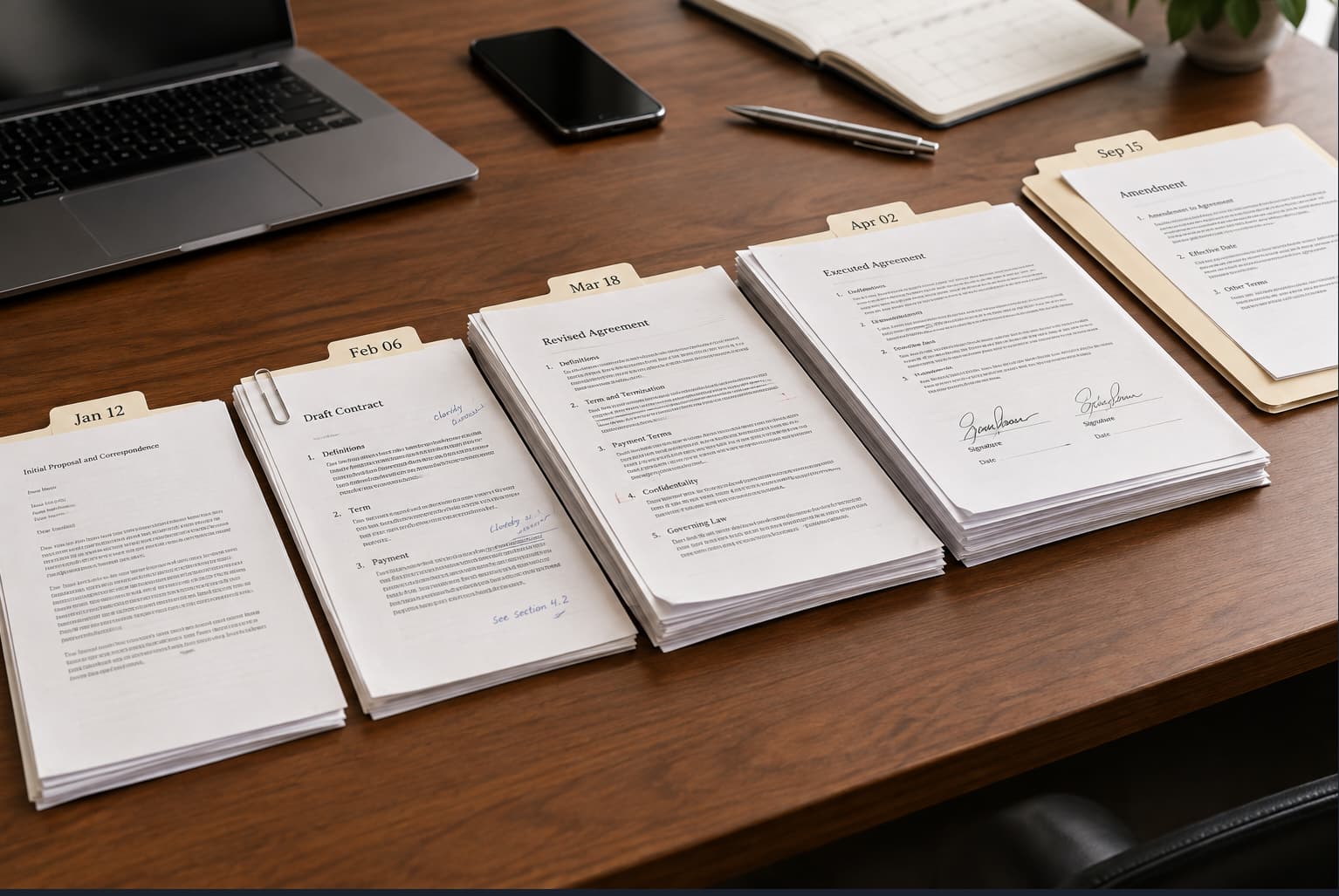
Business contracts and documentation arranged in chronological order

Did Their Conduct Affect Your Ability to Perform?

Necessary information may have arrived late. Approvals may have been delayed. Specifications may have changed. Required payment, materials, access, instructions, or cooperation may not have been provided.

Or the other party may itself have failed to perform an obligation before the alleged breach by your business occurred.

That is why the Watkins Firm develops a chronology of the entire transaction. Contracts, amendments, pre-contract communications, emails, project records, change requests, invoices, schedules, approvals, notices, and other evidence can establish not only what your business did, but what the other party did or failed to do before the dispute developed.

Responsibility May Not Be One-Sided

You do not have to pretend there was no problem on your side of the transaction in order to defend your business effectively.

Perhaps your company did contribute to what happened.

The questions then become: How much? What caused it? What did the other party contribute? What happened afterward? And what consequences can actually be attributed to your conduct?

A contract dispute does not necessarily become an all-or-nothing proposition simply because both sides made mistakes.

Business professionals discussing differing positions in a commercial dispute

What Does That Mean for Your Defense?

Once the complete chronology is developed, the other party's conduct may do more than explain why your business did not perform as expected.

Depending upon the agreement and the facts, it may affect the other party's claims, support defenses available to your business, or reveal claims, counterclaims, or crossclaims of your own.

Before accepting the premise that your business is “the party that breached,” establish what both parties promised, what both parties did, who was required to act first, what interfered with performance, and what the evidence actually establishes.

That analysis leads directly to the next question: What defenses may be available to your business?

Affirmative Defenses to a Breach of Contract Claim

Even when the other party can point to a contract and an alleged failure to perform, that does not necessarily end the analysis.

The facts surrounding the agreement, how it was created, and what happened during performance may provide defenses to the breach of contract claim.

That is why the Watkins Firm looks beyond the accusation itself and investigates the entire contractual relationship.

Shield representing defenses to a breach of contract claim

Was There a Valid and Enforceable Agreement?

Some defenses begin with the contract itself.

Depending upon the circumstances, questions may arise about whether the agreement was sufficiently definite, whether there was a material mistake, whether a provision is illegal or unenforceable, or whether fraud, misrepresentation, or improper inducement affected the formation of the agreement.

These are fact-specific issues. They cannot be determined simply because one party produces a signed document and says, “You breached.”

Were the Conditions for Your Performance Satisfied?

A contract may require something to happen before another obligation becomes due.

Payment may be required before work begins. An approval may be necessary before the next phase proceeds. Information, materials, access, or another party's performance may be necessary before your business can fulfill its own obligation.

If a required condition did not occur, that may materially affect whether your business was obligated to perform in the manner the other party now claims.

Did the Other Party's Conduct Affect the Claim?

The other party may have breached first, interfered with performance, prevented your business from completing its obligations, agreed to changes, accepted different performance, or otherwise acted in a way that affects the position it is now taking.

This is where the contract, pre-contract communications, amendments, chronology, and evidence begin working together.

A Defense Has to Fit the Facts

There is no useful checklist of defenses that should simply be asserted because your business has been sued.

The objective is to identify the defenses actually supported by the agreement and evidence—and understand how they affect your potential liability, leverage, and strategy.

The strongest defense is not necessarily the one with the most legal arguments. It is the one that best fits what actually happened.
Interconnected puzzle pieces representing a defense that fits the facts

And even after the potential defenses are identified, another critical question remains:

What damages can the other party actually establish?

We invite you to a complimentary and substantive conversation regarding your situation, objectives, and concerns. You can reach out through the chat module on this page, our contact form, or by calling (858) 535-1511.

Damages, Damages, Damages

Whether your business breached the contract is obviously important. But it is only part of the case.

The other party must still establish what the alleged breach actually cost them.

That means examining the claimed loss from the bottom up: What money was actually lost? What caused that loss? What evidence supports it? Were other events responsible for some of it? Are projected or future losses based upon evidence—or assumptions?

This is why Dan Watkins puts damages at the center of his litigation analysis:

Financial records, invoices, calculations and supporting documentation being reviewed to calculate business damages

“When I advise my clients, I tell them the most important item in litigation is not whether you are liable or they're liable, or somebody breached. I say the three most important things in a lawsuit are: damages, damages, damages. And I say it just like ‘location, location, location’ in real estate, because it's that important.”

— Dan Watkins, Founding Partner

Work Backward From the Number

A demand may say your business caused $50,000, $100,000, $300,000 or more in damages. The size of the number does not establish that the number is correct.

Dan's approach is to work backward from the claimed loss.

What specifically was lost? How was it calculated? Which part resulted from the alleged breach? What documents support it? What happened afterward? Could some of the loss have been avoided?

A damages claim should be investigated and proven—not simply accepted because it appears in a demand letter or complaint.

What Did the Other Party Do After the Problem Occurred?

The conduct of the party claiming damages matters here, too.

A party claiming losses generally has an obligation to take reasonable steps to avoid or reduce damages that could reasonably have been prevented. If replacement performance, another supplier, a workaround, or another practical solution was available, what did the other party do?

That can be particularly important when your business proposed a reasonable solution and the other party rejected it while losses continued to accumulate.

A failure to take reasonable steps to mitigate avoidable losses can materially affect the amount of damages ultimately recoverable.

Balance scale comparing time and money in evaluating the economics of a business dispute

The Economics of the Fight Matter Too

There is another number Watkins evaluates: what will it cost to fight about the damages?

Attorney's fees, expert costs, discovery, management time, disruption to the business, and the length of the dispute all become part of the economic analysis.

As Dan describes it, litigation can mean “investing money to get money.”

For a business defending a claim, the corresponding question is just as important: How much should you invest to protect yourself from the exposure being claimed?

That does not mean settling simply because litigation is expensive. It means understanding the real financial stakes so that decisions about negotiation, mediation, arbitration, litigation, or trial are made with the economics of the dispute in view.

The accusation tells you what the other party says happened. The damages analysis begins to tell you what the case may actually be worth.

What You Do Next Can Change the Dispute

Notice of breach of contract and sword representing the potential consequences of contractual notice

Notice Can Help — and It Can Be Double-Edged

There may be good reasons to tell the other party about a developing performance problem. Early communication can create an opportunity to find a workaround, modify the agreement, preserve a valuable business relationship, or reduce the losses that might otherwise result.

But notice is not automatically harmless.

Depending upon what is communicated and the circumstances, the other party may attempt to characterize your statement that you cannot or will not perform as an anticipatory breach and use it to take action of its own. The legacy Watkins material specifically warns that notice can create an opportunity for resolution while also creating legal risk.

The question is not simply whether to communicate. It is what to communicate, when to communicate it, and what you are trying to accomplish by doing so.

A Workaround Can Affect the Damages

If there is a reasonable way to correct the problem or reduce the resulting loss, that matters.

Your business may be able to offer additional time, replacement performance, another source, corrected work, or some other practical solution. Even if the other party refuses the proposal, the fact that a reasonable alternative was available may become important when evaluating what it subsequently did to mitigate its damages. The Watkins source material specifically identifies a proposed workaround as potentially relevant to the other party's reasonable mitigation efforts.

Document the problem, the proposed solutions, and your efforts to reduce its consequences.

If a Lawsuit Has Been Filed, the Clock May Already Be Running

How and when you learned about the lawsuit matters.

As Dan Watkins puts it, once you learn that you have been sued, “there's going to be a time clock ticking away of action items you have to take.”

That is not the time to let a complaint sit unanswered while the business decides whether the dispute is serious.

Whether the problem can still be fixed, the dispute can be negotiated, or litigation has already begun, the objective is the same: understand where you are before taking actions that unnecessarily reduce your options.

Businessperson approaching a large clock representing deadlines after litigation has begun

The next question is no longer simply who breached the contract.

It is what outcome now makes the most sense for the business.

How Should the Contract Dispute Be Resolved?

Business professionals engaged in a serious negotiation working toward resolution

Watkins Firm is prepared to help answer your questions and protect your interests. The good news is this: We are able to resolve the vast majority of our business disputes and breach of contract cases through effective, leveraged negotiation. This is the fastest, most effective path to resolve most contract disputes.

It begins with a thorough, well documented chronology of events, and a mastery of potential damages. We provide our clients sound counsel on their position in the matter, and potential steps they should begin to take to resolve any potential dispute.

Usually, the questions we help our clients to answer are more practical:

What outcome makes the most sense for the business?
What is the nature of the relationships between the parties, and is the protection of an important business relationship important in this context?
What steps should be taken to reduce potential damages?
What outcome(s) would constitute a successful conclusion?
How serious is the potential breach and what is your likely resulting exposure?
What deadlines might still be in effect?
Can this still be fixed? Can the breach be cured? Can a relationship be salvaged?

The basic steps toward resolution of a breach of contract or business dispute may include:

Negotiation
The Filing or Defense of a Lawsuit
Pre-Trial Settlement Conferences and Mediation
Arbitration or Trial
Dan Watkins meeting with a business client

The Legal Strategy Should Serve the Business Objective

Your priority may be preserving an important customer, supplier, or business relationship. In other cases, it may be necessary to complete the contract, modify its terms, obtain additional time, resolve the financial exposure, or end the relationship altogether.

Sometimes the objective is to defeat any claim.

Sometimes it is to resolve the dispute before the cost and disruption of litigation become greater than the dispute itself.

A successful outcome is not measured solely by who was right or wrong. It is measured by whether the resolution protects the client's interests and accomplishes what the business ultimately needs to accomplish.

Preparation Creates Leverage

Effective negotiation begins with proven experience, legal skill, an understanding of the potential damages, and the documentable facts of the case.

A well-developed chronology, supporting evidence, credible defenses, a realistic damages analysis, and a clear understanding of the client's objectives allow Watkins attorneys to negotiate from a position of preparation and strength at every stage in the process, rather than simply exchanging demands.

The better you understand your own position—as well as the other party's exposure—the more effectively you can evaluate potential opportunities for resolution.

Business professional organizing documents and communications into a chronology of events

Frequently Asked Questions About Defending a Breach of Contract Claim

If my business is accused of breaching a contract, does that mean we are liable?

No. An allegation of breach does not by itself establish liability. The agreement, the obligations of each party, the chronology of events, the evidence, and the conduct of both parties must be evaluated. It is also important to determine whether conditions required for performance occurred and whether the other party's actions affected your ability to perform.

What should I do if my business receives a breach of contract demand letter?

Start by preserving the demand letter, the contract and amendments, relevant communications, invoices, payment records, performance documents, notices, and other evidence concerning the dispute. Identify any response deadlines and avoid making admissions or commitments before you understand the agreement, the facts, and the potential consequences of your response.

What if I disagree that my business breached the contract?

The accusation should be tested against what the contract actually required and what occurred. A thorough chronology may establish that your business performed, that a required condition did not occur, that the other party interfered with performance or failed to perform its own obligations, or that responsibility for the dispute is not entirely one-sided.

What if my business cannot perform because something unexpected happened?

A performance problem does not necessarily mean that the dispute cannot be resolved. Depending upon the circumstances, additional time, replacement performance, a modification of the agreement, or another practical solution may be possible. Before proposing a solution or communicating that your business cannot perform as promised, however, it is important to understand how that action or communication could affect your position.

Can the other party recover every dollar of damages it claims?

Not necessarily. The amount demanded is not itself proof of damages. The claimed losses should be evaluated to determine what was actually lost, what caused the loss, what evidence supports it, whether other circumstances contributed to it, and whether reasonable steps could have been taken to avoid or reduce the damages.

Does the other party have a responsibility to reduce its damages?

Generally, a party claiming damages is expected to take reasonable steps to mitigate avoidable losses. Whether reasonable mitigation opportunities existed and what the claimant actually did after the alleged breach can therefore become important parts of the damages analysis.

Should I notify the other party if I think my business may have difficulty performing?

Possibly, but the content and timing of the communication matter. Early communication may create an opportunity to address the problem, develop a workaround, modify the agreement, or reduce potential losses. Depending upon the circumstances, however, a statement that your business cannot or will not perform may also affect your legal position. The communication should be considered in the context of the agreement and the objectives of the business.

Can a breach of contract dispute be resolved without going to trial?

Yes. The Watkins Firm is able to resolve the vast majority of its business disputes and breach of contract cases through effective, leveraged negotiation. Depending upon the dispute, resolution may also involve mediation, a settlement conference, arbitration, or litigation. The appropriate strategy depends upon the agreement, the evidence, the potential exposure, the parties' positions, and what the business ultimately needs to accomplish.

What should I do if a breach of contract lawsuit has already been filed against my business?

Act promptly. Once litigation has begun, deadlines and required actions may already be running. Preserve the complaint and related documents, determine when and how the lawsuit was received or served, and contact the Watkins Firm so our attorneys can evaluate the allegations, applicable deadlines, potential defenses, damages, and the steps necessary to protect your interests.

Why should I hire the Watkins Firm to defend my business against a breach of contract claim?

Breach of contract defense requires more than responding to the allegations made against your business. Watkins attorneys develop the chronology, examine the obligations and conduct of both parties, identify potential defenses and claims, evaluate the damages, and determine how the legal strategy can best accomplish the client's business objectives.

Our goal is to understand where you are, protect your position, and develop the most productive path toward resolving the dispute.

Why Choose Daniel Watkins and the Watkins Firm?

Experience Matters When the Dispute Matters.

Daniel Watkins has practiced law in San Diego since 1987. He attended the University of San Diego School of Law, worked at respected San Diego firms, and founded his own business law firm more than 30 years ago.

For Dan, San Diego is more than the market in which he practices. It is his community. He and his team have built lasting relationships with clients, many of whom have been with the firm since its beginning.

Over the course of his career, Dan has helped clients form businesses, protect and defend them, navigate difficult disputes, and later sell or merge those same companies.

Daniel Watkins, Founding Partner of the Watkins Firm
Daniel Watkins Founding Partner, Watkins Firm
Business Contract and Dispute Experience

A Business Dispute Resolution Attorney Who Understands the Businesses He Represents

Dan’s experience spans healthcare and medical practices, high technology and science, construction, hospitality, real estate, manufacturing, employment, and other commercial industries.

Working with companies across these industries has given Dan practical insight into how businesses operate, how agreements are performed, how financial losses develop, and how a breach can affect the business beyond the terms of the contract itself.

A breach of contract does not occur in isolation. It occurs within an operating business, where agreements govern payment, performance, delivery, timing, responsibilities, business relationships, and financial expectations.

That experience becomes particularly important when a dispute involves complicated business records, conflicting explanations of what occurred, questions about performance or payment, specialized industry practices, or substantial financial exposure. Understanding the business behind the contract can be essential to understanding the dispute, the damages, and the most effective path toward resolution.

Litigation and Trial Experience

A Trusted Litigation Strategist and True Trial Attorney

Dan is a trusted litigation strategist and true trial attorney with over 50 jury and bench trials to his credit. Dan has successfully represented both large companies and individual litigants and achieved substantial victories in well-publicized trials throughout California and the U.S.

Dan doesn’t believe in needlessly aggressive litigation however he also doesn’t believe there is a case that can’t be won. There is always a way.

He has won numerous cases experts said couldn’t be won. Dan and his team pride themself in looking at cases differently than most attorneys. Clients value Dan’s ability to listen carefully, understand complex challenges, and develop practical, effective solutions to difficult legal problems.

His litigation experience includes Healthcare Compliance, Commercial Litigation, Unfair Business Practices, Fraud, Breach of Contract, Battery, Premises Liability, Product Defect, Medical Malpractice, Discrimination, Sexual Harassment, Construction Defect, Unfair Competition, Defamation, and Trade Secrets.

Dan has also spent nearly four decades working with, for, and against some of the largest insurance companies in the country.

Demonstrated Experience

Significant Litigation and Investigative Work

HealthSouth Surgery Center Litigation

In December 2003, Dan commenced litigation against Health South Surgery Centers-West, Inc. and its subsidiaries, exposing the company’s extensive mismanagement and misconduct of its surgery centers.

Municipal and Corporate Investigations

Dan has also been asked by some of California’s largest municipalities and corporations to conduct legally required investigations into matters involving alleged employment discrimination and harassment.

The Firm Dan Built

More Than Three Decades of Solutions-Based Representation

When Dan founded the Watkins Firm, he began building a team of attorneys and staff who could learn from one another and share a commitment to the clients they serve.

Over more than three decades, the firm has become a long-standing San Diego business law institution.

Dan and his team believe they have a responsibility to continue the firm’s tradition of solutions-based representation. They work to understand their clients, care about the businesses and people they represent, and develop practical solutions to difficult legal problems.

Why It Matters

What This Experience Means for Your Business Dispute

Experienced Judgment Across Decades of Business and Litigation

Dan’s practice since 1987 has involved complex transactions, ownership disputes, fraud allegations, commercial litigation, employment matters, and other consequential business issues.

His experience provides perspective when the facts are complicated, the financial consequences are substantial, or the opposing parties strongly disagree about what occurred.

Resolution Focused, but Prepared to Litigate

A business dispute should not become prolonged litigation simply because litigation is available.

The Watkins Firm evaluates the evidence, damages, risks, and objectives of the client and pursues opportunities for productive resolution when appropriate.

When negotiation or mediation cannot produce an acceptable result, Dan and his team have the litigation and trial experience necessary to continue pursuing the matter.

Experience Turning Complicated Facts Into a Coherent Case

Business disputes can involve years of transactions, financial records, contracts, emails, representations, and conflicting explanations.

The firm works to establish the chronology, identify the relevant evidence, understand the damages, and develop a clear explanation of what happened and why it matters.

A case that can be clearly understood is generally in a stronger position to be evaluated, negotiated, mediated, litigated, or tried.

The Ultimate Question

Why Should You Hire the Watkins Firm?

Because the objective is not to make your business dispute larger than it needs to be.

It is to understand what happened, identify what is at stake, evaluate the available options, and develop a strategy designed to protect your interests and accomplish your objectives.

Dan’s decades of business litigation and trial experience have taught him when a dispute may be resolved—and when being prepared to try the case becomes essential to achieving the best available outcome.

Your matter begins with a substantive conversation. We invite you to speak with the Watkins Firm about your situation, your concerns, and what you hope to accomplish.

Reviewed and approved by Daniel Watkins, Founding Partner, Watkins Firm.

A breach of contract is not just a legal issue—it is a business decision with financial consequences that must be evaluated carefully.

The outcome of a contract dispute is often shaped early, based on how quickly the facts are understood and how clearly the financial impact is defined. Many business owners wait until positions have hardened or options have narrowed, which can limit flexibility and increase cost.

A well-developed chronology and a clear understanding of potential damages provide the foundation for effective strategy. Whether the matter is resolved through negotiation, mediation, or litigation, preparation determines leverage.

Experienced San Diego Business Law Lawyers

Call 858-535-1511 for a Free Consultation

Begin with a Conversation

Most matters begin with a free, substantive consultation.  This is a clear discussion of your current situation, what is known, and what is uncertain. The purpose of that conversation is to understand your position and determine the most effective next step.
That initial consultation is focused, structured, and practical. It is designed to identify risk, clarify options, and determine whether further action is necessary.

If you are starting a business, facing a business challenge, evaluating a situation, or simply need clarity on where you stand, we invite you to a conversation.

Call Directly

(858) 535-1511
Talk through your situation with an experienced business attorney.

Live Chat

Engage the Chat Module –
Get a Quick Answer or connected to a Watkins Firm Attorney

Contact Us

Share Your Situation
Provide details on our contact form and we will reach out to you.