









 In California, and here in San Diego a business is not a static entity; it is a living lifecycle. From the moment of inception through the complexities of growth and the ultimate transition of ownership, informed insight and the guidance of an experienced business counsel are an important part of the equation that ensures stability. These are essential components required to navigate the most challenging business environment in the nation: California.
Business Formation and Structural Foundation (Entity Integrity): Beyond the Filing
Business formation involves much more than selecting an entity, downloading a few forms, and filing with the California Secretary of State. A business entity is more than a tax designation; it is a defensive structure. For over 40 years, the Watkins Firm has served as the strategic business architect for thousands of San Diego and Southern California entities. We ensure the “vessel” you choose is built to withstand the unique pressures of the California commercial environment.
1. Strategic Entity Selection
The lifecycle of your business begins with choosing the correct legal framework. This decision impacts everything from tax efficiency to your ability to attract investment or eventually sell.
LLC vs. Corporation: We analyze your risk profile to determine if a Limited Liability Company or a traditional S-Corp/C-Corp provides the superior “Structural Defense” for your assets.
Professional Corporations: Navigating the strict California requirements for licensed professionals, including medical, legal, and engineering practices.
Management Services Organizations (MSOs): Architecting compliant structures that allow for the separation of business operations from professional clinical services.
2.  Safeguarding the “Corporate Veil”
The greatest trap in California business law is the “Alter Ego” doctrine. If you do not treat your company like a separate legal entity, the courts won’t either.
Institutional Behavior: We don’t just file your Articles of Incorporation. We advise on the governance—the minutes, resolutions, and record-keeping—required to maintain and protect the “corporate veil” that separates your personal wealth from your business liabilities.
Customized Governance: Moving beyond boilerplate templates to draft Bylaws, Shareholder Agreements and Operating Agreements that actually reflect how you intend to run your company.
3. Shareholder & Partnership Unity
Internal conflict is the “silent killer” of mid-sized businesses. We use our pattern recognition to anticipate where partners and shareholders usually clash.
Buy-Sell Agreements: Ensuring there is a clear, pre-negotiated roadmap for when a partner wants to exit, retires, or passes away.
Voting Rights & Control: Architecting the “check and balance” systems that protect the vision of the founders while allowing for institutional growth.
Business Transactions are the Essence of Business; Carefully Crafted Contracts are the Roadmap to Successful and Profitable Transactions.

Once a solid foundation is in place, a business should operate with structured discipline. The Operational Framework is the set of systems and agreements that manage your relationships with partners, employees, vendors, and competitors. We ensure these interactions are governed by clarity, not ambiguity.
We work together to make sure these important components are not boilerplate or generic, but custom tailored to your unique business.
Our advanced AI quickly and efficiently assembles appropriate options and sections of our proprietary, proven contracts and transaction documents. You get a custom tailored solution that has withstood the test of years and multiple transactions and relationships like the situation you are entering into.
The right contract is the guide, it clearly establishes the benefit of the bargain, the responsibilities of each party, as well as the process to manage unexpected developments
1. The Watkins Firm Proprietary Contract Library
 The foundation of every successful transaction is the contract that governs it. Over 40 years, the Watkins Firm has developed and refined a comprehensive library of proven, successful business contracts tailored to the unique complexities of California law.
- Beyond the Template: We do not use generic forms. Our contracts are “Pattern-Based”—designed to anticipate the specific traps we have seen derail businesses in your industry.
- The “Benefit of the Bargain”: We draft to ensure that the economic intent of your deal is legally enforceable. A strong contract should not only capture the essence of the transaction but provide a clear roadmap for a successful conclusion.
Your company benefits from a proven, tested contractual structure that is efficiently customized to meet your unique, specific requirements.
We work with our clients to structure reliable, successful business transactions supported by contracts that protect their interests while helping to avoid potential disputes. This provides a cost-effective solution while avoiding the risks of downloading a contract from a generic forms website and attempting to modify it yourself.
2. Intellectual Property & Trade Secrets
For many California businesses, the “secret sauce” or intellectual property —your proprietary processes, client lists, and technical innovations—is your most valuable asset. These are often intangible. They serve as the engines of your growth. Without a specific strategy to protect them, these assets can become liabilities the moment a partner departs or a competitor enters the market.
Protection by Design: We don’t just file for protections; we help to develop an environment of exclusivity. Confidentiality and Non-Disclosure Agreements (NDAs) may be necessary to keep your IP secure.
- Trade Secret Audits: Identifying internal vulnerabilities in how information is stored, shared, and accessed.
- Licensing & Distribution: We guide you through the process of monetizing your IP while retaining the control and ownership necessary to protect your long-term interests. We guide clients through the complexities of sharing their innovations while retaining the underlying ownership that supports the company’s valuation.
 Licensing Agreements: Crafting the terms that allow you to scale your reach without diluting your legal rights.
- Distribution Contracts: Ensuring that your partners and distributors are legally bound to protect your brand and technical integrity.
3. Corporate Maintenance & Institutional Protections
The “Foundational Strategy” only works if it is maintained. We act as a partner in your ongoing corporate governance to ensure your structural protections remain intact.
- Outside General Counsel: We provide the “Sound Business Insights” typically reserved for large corporations with in-house legal departments.
- Shielding the Corporate Veil: We ensure your minutes, resolutions, and internal record-keeping satisfy the strict “Alter Ego” standards in California, keeping your personal assets decoupled from business risks.
How To Meet the Challenge as a California Employer
 California employers operate within the most complex and rapidly evolving employment environments in the country. Hiring decisions, employee classification, workplace policies, discipline, leave management, wage and hour compliance, and termination procedures all carry potential legal and operational consequences if handled inconsistently or without structure.
The Employer Framework is not simply about reacting to employee disputes after they arise. It is about creating operational systems that reduce preventable conflict, strengthen internal consistency, and help businesses make informed employment decisions before small issues become expensive distractions.
We work with San Diego and California employers to establish practical, business-focused employment structures designed to support operational continuity while helping reduce unnecessary legal exposure.
A properly developed employment framework should:
- establish clear duties and performance expectations
- create operational consistency
- define internal procedures
- reduce ambiguity
- improve documentation
- support management decision-making
- and help businesses respond appropriately when employment concerns arise.
As a business grows, employer-related complexity often grows with it. Policies that once functioned informally frequently become inadequate once staffing, departments, supervisory layers, or operational scale begin to expand.
1. Employer Policies, Procedures & Operational Consistency
 Employment policies should not be generic templates copied from internet forms libraries. They should reflect how the business actually operates, the realities of California employment law, and the specific operational structure of the company.
We help employers develop practical policy systems designed to support both compliance and operational stability.
This may include:
- Employee Handbooks
- Workplace Policies
- Hiring Procedures
- Discipline & Termination Procedures
- Leave Policies
- Internal Complaint Procedures
- Independent Contractor Evaluations
- Wage & Hour Practices
- Operational Documentation Standards
Strong internal procedures often help businesses address issues earlier, more consistently, and with significantly less disruption.
2. Employer Risk Reduction & Workforce Management
 Many employment disputes begin long before a claim is formally asserted. Misaligned expectations, inconsistent enforcement, poor documentation, unclear supervisory authority, and informal practices often create operational vulnerabilities that gradually compound over time.
We work with employers to identify preventable areas of risk exposure and strengthen internal management systems before disputes escalate.
This includes guidance involving:
- employee classification
- workplace documentation
- disciplinary consistency
- management practices
- operational communication
- internal investigations
- and response planning when employment concerns arise.
Operational discipline matters. Employers who maintain organized procedures, consistent documentation, and clearly communicated expectations are often in a significantly stronger position when disputes or claims occur.
3. Ongoing Business Guidance & Outside General Counsel Support
 Employment issues rarely arise in isolation. Workforce decisions frequently intersect with operational strategy, contracts, governance, expansion planning, acquisitions, and internal business transitions.
We frequently serve as ongoing outside general counsel for California businesses seeking practical legal guidance as employment-related situations arise during the normal course of operations.
This allows business owners and management teams to address questions proactively rather than waiting until a situation has already escalated into formal litigation or agency involvement.
The objective is not simply to react to problems after they occur. The objective is to help businesses operate with greater structure, predictability, and long-term operational stability.
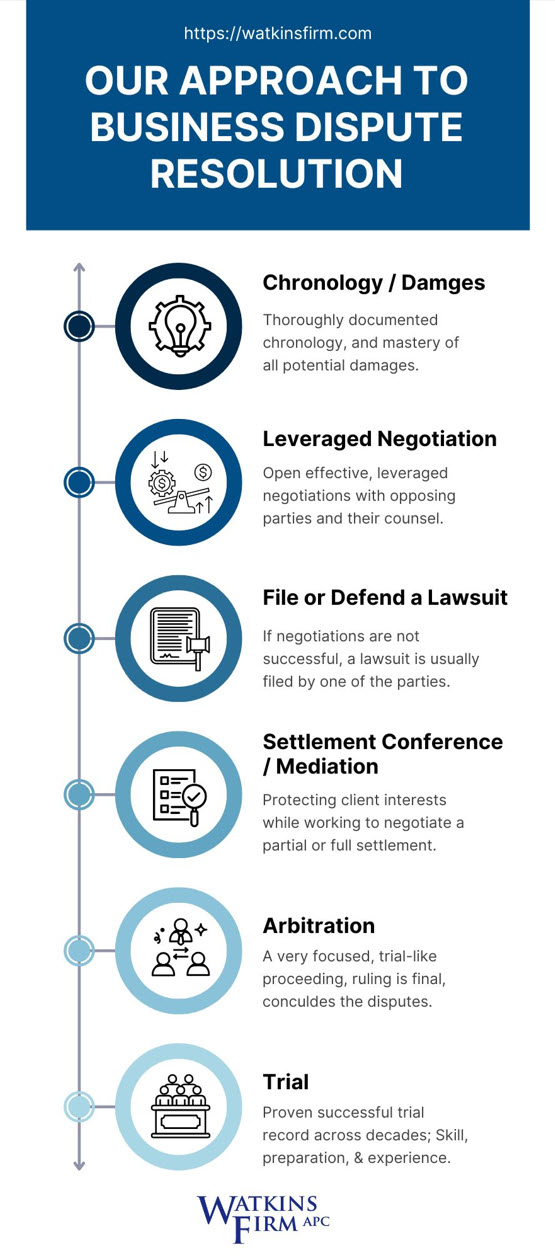 Even well-structured businesses encounter conflict. Agreements break down. Partners disagree. Employees assert claims. Transactions fail to perform as expected. Commercial relationships that once appeared aligned can gradually become adversarial when financial pressure, operational disruption, or competing expectations emerge.
The objective is not simply to respond after conflict escalates into litigation. The objective is to identify leverage early, protect the company’s position, reduce avoidable exposure, and pursue the most effective path toward resolution based on the realities of the situation.
Watkins Firm is able to resolve the vast majority of our business disputes through effective, leveraged negotiation. This is the fastest, and most cost-effective way to resolve any business disputes. We represent our clients in every aspect of a dispute including:
- Negotiations
- The filing or defense of a lawsuit
- Settlement Conferences
- Business Mediation
- Business Arbitration
- Trial
For over 40 years, the Watkins Firm has represented California businesses in complex disputes involving contracts, ownership conflicts, operational disagreements, employer defense matters, real estate disputes, and high-stakes litigation exposure.
1. Contract Disputes & Business Litigation
Most business disputes ultimately trace back to expectations that were unclear, undocumented, improperly performed, or interpreted differently once financial pressure emerged.
We represent businesses in disputes involving:
- breach of contract
- failure to perform
- partnership disagreements
- vendor disputes
- customer disputes
- commercial collection matters
- business torts
- fraud-related allegations
- operational interference
- and transactional breakdowns.
Early evaluation matters. Many disputes become significantly more difficult and expensive because businesses wait too long to organize documentation, assess leverage, preserve evidence, or evaluate strategic options.
 Strong litigation positioning often begins long before a lawsuit is formally filed.
We help businesses assess risk:
- operational exposure
- contractual leverage
- evidentiary strengths and weaknesses
- financial risk
- negotiation opportunities
- and litigation strategy.
The objective is not conflict for the sake of conflict. The objective is to protect the business and pursue practical, economically rational outcomes.
2. Shareholder, Partnership & Internal Ownership Disputes
 Internal business disputes between partners, members, shareholders, investors or business owners can become particularly disruptive because they frequently involve overlapping operational, financial, and personal conflicts simultaneously.
Disagreements involving:
- shareholder rights
- partnership obligations
- member authority
- fiduciary duties
- profit distributions
- management control
- succession planning
- or ownership transitions
can quickly threaten the long-term stability of the business itself.
 These disputes often require both legal analysis and operational understanding. We work with business owners to evaluate governing agreements, internal records, financial structures, and operational realities in order to determine the most effective strategy moving forward.
This may involve:
- negotiated resolution
- buyout strategy
- restructuring
- injunctive relief
- litigation
- or long-term operational separation planning.
When ownership conflict emerges, timing and preparation frequently determine whether the business remains stable during the dispute or becomes collateral damage to it.
 Are you considering buying a business here in San Diego or anywhere in California? A Mergers & Acquistions or M&A transaction is more than a transfer of assets; it is a complex transition of liability and value. In California’s aggressive market, success depends on a firm that understands how to de-risk the deal before the ink is dry. We guide our clients through the entire lifecycle of the transaction—from initial letter of intent to final closing.
1. Strategic Due Diligence
The most critical work happens before the contract is signed. We act as the “Strategic Architect,” uncovering the hidden patterns that determine if a deal is truly viable.
- Liability Forensics: We scrutinize the target’s employment history, tax compliance, and existing contractual obligations to ensure you aren’t inheriting a lawsuit.
- IP Verification: Confirming that the intellectual property you are buying is legally owned and fully protected.
2. Structuring the Transaction

Every deal has a different “DNA.” We advise on the structure that best serves your tax position and long-term liability shield.
- Asset Purchase Agreement or Stock Purchase Contract: We explain the “why” behind the structure—whether it’s better to buy the underlying assets to avoid successor liability or purchase the entity itself.
- Membership Interest Purchase Agreement or MIPA – buying or selling an ownership interest in an LLC
- The “Benefit of the Bargain” in M&A: We draft the specific representations, warranties, and indemnification clauses necessary to ensure that the value you see on the balance sheet is what you actually receive at closing.
3. Exit Strategy and Succession
For the seller, a transition is the culmination of a career. We ensure the exit is clean, profitable, and legally final.
- Buy-Sell Implementation: Executing the pre-negotiated roadmaps that allow for a smooth transition of power.
- The “Clean Exit”: We architect the transition to ensure that your liabilities are capped and your proceeds are protected from post-closing disputes.
The 85% Factor in M&A
 Why 85% of Watkins Firm Acquisitions Succeed
A recent summary of 18 large-scale studies conduct by institutions including the Harvard Business Review reached a sobering conclusion: 70% to 85% of business acquisitions fail. The root causes are almost always the same: poor valuation, surface-level due diligence, or the inability to merge institutional cultures post-closing.
The Watkins Difference
Over the last 40 years, we have navigated thousands of M&A transactions. While the national failure rate is high, our clients’ success rate is closer to 85%. We invert the national average by treating M&A as an investigation rather than a checklist:
- Liability Forensics: We find the “Skeletons” (unpaid PAGA risks, misclassified workers, or handshake vendor deals) before they become your problem.
- Structuring for Success: We carefully craft the specific representations and warranties that ensure the “Benefit of the Bargain” is protected on Day 2.
- The Clean Exit: We ensure the seller’s liabilities are capped and the buyer’s transition is seamless.
3 Important Takeaways When Considering Business Law and a Business Attorney
 Look for extensive experience in every aspect of the life of a business. This should include everything from business formation, to contracts and transactions, employer defense and advisory services, mergers and acquisitions, and the timely, efficient resolution of a business dispute of any size or scope.
- California is a unique state in which to do business, often referred to as the most challenging and difficult environment in which to own a business or be an employer. Look for a law firm you can relate to that has extensive focus and experience with California’s unique business laws and commercial code, as well as the draconian legal burdens placed upon employers in our state.
- Your business attorney should be one of your most trusted advisors. Take the time to sit and talk with your attorney. Get to know them professionally and personally. Look for a legal partner who has “been there” and “done that,” who will take a quick phone call when you have a question without running up the bill, and someone you are comfortable with when discussing any business-related question or matter.
Listen to our Recent Sound Business Insights Podcasts:
Episode 19: Your Business Attorney is a Valuable Partner

Episode 34: Business Formation