

What is a Failure to Disclose in a Business Transaction or Contract?
 Failure to disclose in a business transaction is a specific form of business fraud and misrepresentation. These cases arise when material information is withheld during a deal, contract, or financial transaction in a way that affects decision-making and causes measurable harm.
In the high-stakes environment of a business merger, acquisition, or stock purchase, information is the most valuable asset. When a party intentionally or recklessly withholds critical information that would have altered the decision-making process, it is not a mere oversight. In California, a failure to disclose material facts in a business deal is a form of business fraud that can unravel the most sophisticated transactions.
At the Watkins Firm, we understand that “silence” in a boardroom can be just as deceptive as an outright lie. Business failure to disclose occurs when one party has a legal or ethical duty to speak but chooses to remain silent, leading the other party into a detrimental agreement based on an incomplete reality.
The Duty to Disclose in a Corporate Context
 In a business transaction, the duty to disclose typically applies when one party possesses “exclusive knowledge” of material facts that the other party does not know or cannot access. While many parties in the transaction may approach a deal with a “buyer beware” mindset, California law imposes strict requirements for transparency in several key situations:
- Material Financial Liabilities: Withholding information regarding pending litigation, undisclosed debts, or significant tax liabilities.
- Operational Defects: Concealing the loss of a major client, the expiration of a vital patent, or internal labor issues or disputes that threaten future productivity.
- Asset Valuation Issues: Failing to disclose that the company’s inventory is obsolete or that the “proprietary technology” at the center of the deal is actually licensed from a third party.
- Regulatory Hurdles: Hiding correspondence from government agencies or regulators that could lead to fines or the loss of a business license.
How Failure to Disclose Ties into Business Fraud and Misrepresentation
 Failure to disclose is rarely an isolated incident; it is often the “engine” behind a broader business fraud claim. In a legal sense, this is frequently referred to as “Fraudulent Concealment.”
When a party makes a partial representation but hides the “other half” of the truth, they have committed Misrepresentation. For example, if a seller provides a glowing revenue report but fails to disclose that 80% of that revenue came from a single contract that has just been canceled, the financial document itself becomes a deceptive tool. Unfortunately, business fraud and misrepresentation are quite common here in San Diego and throughout the State of California. The Watkins Firm has more than 40 years of proven experience in these cases. We will help you to get to the bottom of what has happened, and protect your interests.
The Intersection with Breach of Fiduciary Duty
The legal consequences of a failure to disclose are significantly increased when a Fiduciary Relationship exists. As we have discussed in our “Layer Cake of Duty,” officers, directors, and partners are held to the highest standard of conduct.
In these cases, the failure to disclose is not just a tactical error; it is a Breach of Fiduciary Duty. A partner or officer who conceals a conflict of interest or fails to disclose a “corporate opportunity” they are pursuing for their own benefit can be held liable for disgorgement of profits. Because the law assumes a relationship of “trust and confidence,” the duty to disclose is absolute. Silence in this context is a betrayal of the legal obligation to act in the company’s best interest.
Unfair Business Practices and Deceptive Conduct
California’s Unfair Competition Laws (UCL) and statutes regarding unfair business practices provide additional layers of protection for those harmed by or suffering documentable damages from a failure to disclose. If a business routinely conceals material facts to gain an edge over competitors or to mislead investors, it may be liable for deceptive practices.
These cases are complex because they often involve a “pattern of conduct.” Proving a failure to disclose requires more than just showing that a fact was missing; it requires a structured approach to establish:
- That a Duty to Disclose existed.
- That the withheld information was Material to the transaction.
- That the victim Reasonably Relied on the incomplete information.
- That the silence resulted in Measurable Financial Harm.
Why Chronology and the Documentation of Damages are Critical
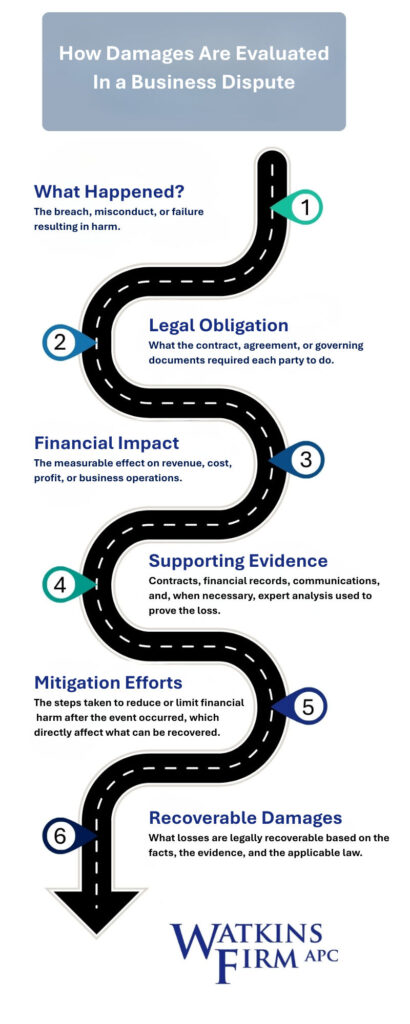 Because a “failure to disclose” is based on what wasn’t said, these cases are won or lost on the Chronology of the Deal. Proving a negative—that information was withheld—requires establishing a detailed and specific timeline of the entire transaction. We must document exactly what information was requested, what was specifically provided, and—most importantly—the precise moment critical facts were actively concealed during the due diligence or decision making process.
At the Watkins Firm, we apply a disciplined investigative approach to uncover these “missing pieces.” However, proving the omission is only half of the battle; we must also pursue and document a Mastery of the available Damages. In a business fraud or non-disclosure case, the financial impact must be tied directly to the deception. This includes:
• Out-of-Pocket Losses: The difference between what was paid for the business or asset and its actual value at the time of the transaction.
• Consequential Damages: The additional costs incurred as a result of the fraud, such as unexpected liabilities, tax consequences, or operational losses.
• Lost Profits and Opportunities: Quantifying the earnings that were lost because the business could not perform as represented.
• Rescission or Restitution: In certain specific types of California cases, seeking to undo the transaction entirely and restore our client to their original legal or financial position.
By connecting the gaps in financial reporting to the specific losses our clients suffered, we move the case from a “he said, she said” dispute to a documented, high-leverage claim for damages. This structured approach ensures that the facts speak for themselves, allowing us to pursue a resolution based on financial reality and legal accountability.
Contact Experienced San Diego Business Fraud Attorneys
If you believe a transaction you entered into was based on an intentional failure to disclose material facts, the window to protect your interests is narrow. Whether the issue involves a merger, a partnership buy-out, or an investment, you need the counsel of an attorney who understands the institutional behavior behind corporate deception.
The Watkins Firm provides grounded, principled guidance to help you recover your losses and hold the responsible parties accountable. invite you to review our podcast Episode 32 – Business Fraud as well as the strong recommendations of our clients and contact the Watkins Firm or call 858-535-1511 for a complimentary consultation today. Lets discuss your situation and your options for resolution.