

How Damages are Established in a Business Dispute or Lawsuit in California
 In a business dispute, damages are not a side issue. They are often the central issue. Courts, mediators, arbitrators, and opposing parties all need to understand the same thing: what financial harm actually occurred, how it is measured, and what evidence supports it. Without a clear understanding of damages, it is difficult to evaluate a position, negotiate effectively, or determine whether litigation is worth pursuing.
In breach of contract matters, damages are generally intended to place the injured party in the position it would have occupied if the agreement had been performed as promised. In ownership disputes, shareholder disagreements, and LLC conflicts, damages often focus on diverted profits, improper distributions, concealed revenue, misuse of company assets, or financial harm caused by another party’s conduct. In either setting, damages must be documented, reasonable, and supported by evidence.
Delays in identifying and documenting damages can narrow your options, weaken your negotiating position, and increase the overall cost of resolving the dispute. Early clarity is not just helpful—it directly affects the outcome.
What Are Damages in a Business Dispute?
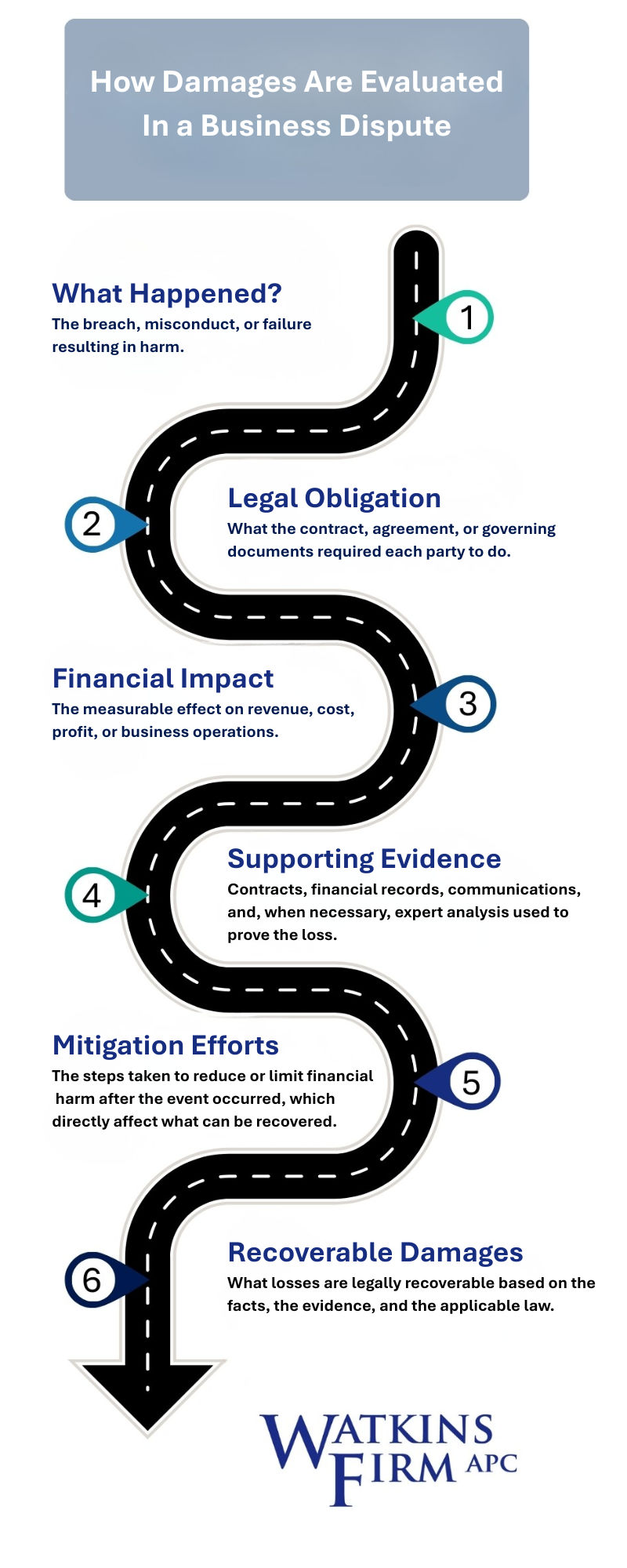 The evaluation of damages in a business dispute typically follows a structured process. These steps reflect how attorneys, courts, and opposing parties analyze financial harm, assess available evidence, and determine what can actually be recovered under the law.
Damages are the measurable financial consequences of another party’s actions or failure to act. In a legal setting, damages represent the amount of money required to place the injured party in the position they would have been in had the agreement been performed as promised, or had the wrongful conduct not occurred.
In breach of contract cases, the primary objective is to restore the “benefit of the bargain” to the injured party. This is achieved through a structured calculation of damages:
- Requirement for Alternative Performance: When one party fails to perform their contractual duties, the injured party is typically required to mitigate losses by securing a replacement or alternative performance.
- Calculation of Damages: The core financial remedy is based on the difference between the original contract terms and the actual cost incurred to achieve the same outcome.
- Inclusion of Incidental Costs: Damages also account for any additional, reasonable expenses that were directly caused by the initial breach.
In other forms of business litigation, such as disputes between shareholders, partners, or LLC members, damages are not based on replacing performance. Instead, they often focus on financial harm caused by another party’s conduct. This may include diverted profits, improper distributions, misuse of company funds, or financial loss resulting from decisions that violated duties owed to the business or its owners.
Regardless of the type of dispute, damages must be supported by evidence. Courts and opposing parties evaluate whether the claimed losses are real, reasonable, and directly connected to the underlying events.
How Damages Are Established in Shareholder, Partnership, and LLC Disputes
While breach of contract damages focus on replacing performance, disputes between business owners require a different analysis centered on financial conduct and its impact on the business. In disputes between business owners, damages are not based on the cost of performing under a contract. Instead, they are based on the financial impact of one party’s actions on the business and the other owners.
These cases often involve allegations that one party has altered, diverted, or improperly controlled the business’s financial outcomes. The focus shifts from what was promised under an agreement to what actually occurred during the company’s operations and how those actions affected revenue, expenses, and distributions.
When disputes arise between business owners, damages are typically tied to a breach of fiduciary duty or a failure to adhere to the company’s internal governing rules. These conflicts often center on the following financial and ethical stressors:
Improper Allocation of Profits: Decisions that disproportionately benefit one owner or stakeholder at the direct expense of others.
Diversion of Business Opportunities: Acting in one’s own self-interest rather than prioritizing the best interests of the company.
Asset Mismanagement: The misuse of company funds or the commingling of personal and business assets.
Information Asymmetry: Disputes regarding financial data that is incomplete, inaccurate, or intentionally structured to obscure the true economic position of the business.
 The resolution of these matters depends heavily on the “ground rules” established at the company’s inception. The clarity and application of governing documents are the primary safeguards against litigation:
Central Role of Governing Documents: Shareholder, operating, and partnership agreements define the mandatory protocols for calculating profits, treating expenses, and issuing distributions.
The Risk of Boilerplate Language: Using generic or unclear language in these documents often leads to inconsistent application.
Consequences of Non-Compliance: When these established rules are ignored or applied inconsistently, financial disputes and subsequent legal action are virtually inevitable.
Establishing the amount of damages in these cases requires a detailed examination of all available financial records, including accounting statements, tax filings, internal reports, and transactional data. In many instances, expert analysis and witness testimony is required to reconstruct what happened financially, identify discrepancies, and quantify the actual economic impact of the actions in question.
As with breach of contract matters, the outcome ultimately depends on demonstrating that the claimed losses are real, supported by evidence, and directly tied to the conduct at issue.

Call 858-535-1511 for a Free Consultation
Understanding Damages Early Changes the Outcome
Damages are not determined at the end of a dispute. They are shaped from the beginning—by the actions you take, the timing of those decisions, and how clearly the financial impact is defined. Early evaluation helps protect your position and preserve what can ultimately be recovered.
If you are involved in a business dispute or believe you have suffered financial harm, it is important to understand how damages apply to your situation before taking the next step.
Speak with a San Diego Business Litigation Attorney with 40 Years of Experience
Your Watkins Firm San Diego business litigation attorney brings almost 40 years of experience in evaluating and proving damages in complex disputes. Call for a free consultation today, at 858-535-1511 or contact the Watkins Firm to discuss your unique situation and how we can help.