

When Trust Breaks Down Between Shareholders
 A shareholder dispute rarely begins as a legal problem. After 40 years of experience in these cases, we can also tell you that a minority shareholder dispute doesn’t have to end in litigation.
It often begins with unanswered questions, growing frustration, or a concern that something is no longer being handled fairly. Many of these actions may raise concerns involving minority shareholder oppression, breach of fiduciary duty, or other misuse of majority control.
Minority shareholder disputes often arise when minority owners or investors believe the majority is using its control to reduce the value, influence, or economic benefits associated with a minority ownership position. Whether through dilution, exclusion from management, restricted access to information, compensation decisions, mergers that alter ownership rights and voting power, the sale of significant corporate assets, or other actions that disproportionately benefit controlling shareholders, these situations often become the source of significant conflict.
Over time, what begins as a business disagreement can evolve into a dispute that threatens the value of the company, the relationships between its owners, and the investment each shareholder worked hard to build.
After more than four decades representing California businesses, shareholders, investors, and closely held companies, the Watkins Firm has learned that most shareholder disputes ultimately involve one central issue: protecting the value of the investment and ensuring each party receives the benefit of the bargain they expected when they became an owner.
This isn’t about litigation or the immediate filing of a lawsuit. It is about working with our clients to determine the status of their investment, understand their financial and ownership risk, and evaluate whether the actions of controlling or majority shareholders genuinely represent minority shareholder oppression, a breach of fiduciary duty, or the opening symptoms of a conflict that may be headed in an adversarial direction.
Our role is to move the dispute from an emotional standoff to a structured business resolution focused on protecting assets, preserving leverage, and achieving the most favorable financial outcome possible.







The Most Important Thing You Need to Know Right Now
 The best time to preserve your options, protect your investment, avoid unnecessary litigation, and increase the likelihood of a successful outcome is now.
Shareholder disputes are more common than many business owners realize.
After more than four decades of helping shareholders, investors, founders, corporate officers, and closely held businesses resolve ownership conflicts, we can tell you this with confidence:
There is often a practical path forward.
The challenge is determining which path makes the most sense based upon the governing documents, corporate governance and ownership structure, financial realities, business objectives, and the priorities of the individuals involved.
The first step is usually understanding the facts.
What do the shareholder agreement, bylaws, buy-sell agreement, corporate records, meeting minutes, or other governing documents actually say about ownership, control, voting rights, management authority, and corporate governance? What rights exist? What obligations exist? What options are available? What outcome is each party attempting to achieve?
In many situations, shareholders become focused on the disagreement itself when the more important questions involve structure, process, leverage, and objectives.
There are actions you should take immediately, and there are actions you should avoid. There are conversations that should continue, and others that may benefit from experienced guidance before positions become entrenched, important decisions are made, or relationships deteriorate further.
It should encourage you to know that Watkins Firm is able to resolve the vast majority of our shareholder disputes through effective, leveraged negotiation. This is the fastest, most cost-efficient path to resolve any shareholder dispute. In some situations, effective guidance helps the parties navigate the issue themselves. In others, direct negotiation, mediation, buyouts, governance changes, or other business solutions provide an effective path toward resolution.
When necessary, the Watkins Firm is prepared to protect your interests through the filing or defense of a lawsuit, settlement conferences, mediation , arbitration, and at trial.
Our objective is always to help protect the value of your investment, preserve your legal rights, and identify the most practical, effective, and economically sound path forward.
Strategic Resolution of Financial Conflicts and Power Abuses

Our corporate law attorneys help shareholders who have been subjected to unfair treatment and other violations of their rights. We assist them in pursuing positive resolutions through effective negotiation, mediation and litigation strategies.
Most shareholder disputes ultimately fall into one or more of three categories. Understanding where your dispute sits helps Watkins Firm to identify the issues that matter most and the leverage available to move the matter toward resolution:
- Direct Financial Losses: Claims for Nonpayment of Dividends, misappropriation of funds or embezzlement, actions for accounting, or concealment of material information.
- Equity & Control Issues: Breach of Fiduciary Duty, freeze-outs, or violation of the covenant of good faith and fair dealing.
- The Valuation Gap: Dissenting shareholder rights and disagreements over the “Benefit of the Bargain” during a buy-out or merger
If You Are a Minority Shareholder
Minority Shareholder Rights • Minority Shareholder Oppression • Access to Information • Dilution of Ownership
Minority shareholders often become concerned about minority shareholder oppression when they begin to feel excluded from important decisions, denied access to information, deprived of economic benefits, or treated differently than majority owners.
In some situations, the concern involves compensation decisions, distributions, access to corporate records, dilution of ownership interests, or actions that appear to favor controlling shareholders at the expense of minority owners. In others, the dispute centers on management authority, voting rights, governance issues, or the long-term direction of the company.
The first step is understanding the facts.
What do the shareholder agreement, bylaws, buy-sell agreement, corporate records, and other governing documents actually provide? What rights exist? What obligations exist? What information is available? What outcome is each party attempting to achieve?
Understanding these issues often helps identify strengths, weaknesses, risks, opportunities, and potential paths toward resolution.
Watkins Firm is able to resolve the vast majority of our disputes involving minority shareholders through effective communication, strategic and leveraged negotiation, governance changes, buyouts, or other business solutions that protect both the company and the interests of the parties involved. This is the most cost-efficient manner to resolve any shareholder dispute while protecting our client’s goals.
When necessary, the Watkins Firm is prepared to protect your interests through the filing or defense of a lawsuit, settlement conferences, mediation, arbitration, and at trial.
We invite you to a complimentary and substantive conversation regarding your situation, objectives, and concerns. You can reach out through the chat module on this page, our contact form, or by calling (858) 535-1511.

It is important to understand where you are, what information is available, what information may be missing, your options moving forward, and the most productive and effective steps you can take to protect your investment and ownership interests.
Many shareholder disputes are influenced not only by what has already happened, but by what happens next. An early conversation can help you better understand your position, your risks, your opportunities, and the actions that may improve the likelihood of achieving a successful outcome.
You may also be interested in:
→ Minority Shareholder Rights
→ Minority Shareholder Disputes
→ Shareholder Oppression
→ Dissenting Shareholder Rights
If You Disagree About the Future of the Business
Strategic Direction • Growth Initiatives • Expansion Plans • Acquisitions • Allocation of Company Resources
Many ownership disputes begin when business owners no longer share the same vision for the future of the company.
One owner may want to expand, hire additional employees, acquire another business, open new locations, increase spending, take on debt, raise capital, or pursue new opportunities. Another may believe the company should remain focused on its existing operations, preserve cash reserves, reduce risk, or pursue a different strategy altogether.
In closely held companies, disagreements regarding the future of the business can quickly evolve into disputes regarding management authority, voting rights, control of company resources, and the responsibilities of those making decisions on behalf of the organization.
The first step is understanding the facts.
What authority exists under the shareholder agreement, bylaws, buy-sell agreement, or other governing documents? Who has decision-making authority? What approvals are required? What financial resources are available? What risks and opportunities exist? What outcome is each owner attempting to achieve?
Understanding these issues often helps identify strengths, weaknesses, risks, opportunities, and potential paths toward resolution.
Watkins Firm is able to resolve the vast majority of our disputes involving minority shareholders through effective communication, strategic and leveraged negotiation, governance changes, revised operating procedures, or other business solutions that protect both the company and the interests of the parties involved. This is the most cost-efficient manner to resolve many disputes involving the future direction of a business while preserving both the company and the relationships between its owners.
When necessary, the Watkins Firm is prepared to protect your interests through the filing or defense of a lawsuit, settlement conferences, mediation, arbitration, and at trial.
We invite you to a complimentary and substantive conversation regarding your situation, objectives, and concerns. You can reach out through the chat module on this page, our contact form, or by calling (858) 535-1511.
It is important to understand where you are, what authority exists, what obligations apply, your options moving forward, and the most productive and effective steps you can take to protect your investment and business interests.
Many business disputes are influenced not only by what has already happened, but by what happens next. An early conversation with Watkins Firm can help you better understand your position, your risks, your opportunities, and the actions that may improve the likelihood of achieving a successful outcome.
You may also be interested in:
→ Business Ownership Disputes
→ Resolving Your Business Deadlock
→ Shareholder Agreements and Corporate Bylaws
→ Buy-Sell Agreements
If You Are Being Denied Access to Information
Corporate Books and Records • Financial Statements • Accounting Information • Corporate Transparency
Many shareholder disputes begin when an owner becomes concerned about the company’s finances, operations, management decisions, or overall direction, but is unable to obtain the information necessary to understand what is actually happening.
In some situations, shareholders are denied access to financial statements, accounting records, meeting minutes, contracts, or other corporate documents. In others, information is provided selectively, incompletely, or only after repeated requests. The lack of transparency often creates suspicion, uncertainty, and conflict among owners.
The first step is understanding the facts.
What information has been requested? What information has been provided? What rights exist under the shareholder agreement, bylaws, corporate records, or applicable law? What information may be missing? What concerns led to the request in the first place?
Understanding these issues often helps identify strengths, weaknesses, risks, opportunities, and potential paths toward resolution.
Watkins Firm is able to resolve the vast majority of disputes involving access to information through effective, leveraged negotiation. This is the fastest, most cost-efficient manner in which to settle these matters. We must help the parties establish a clear understanding of what information is available, what information should be provided, and the legitimate interests of everyone involved. In other situations, a more formal approach may be required to obtain records, conduct an accounting, investigate potential misconduct, or protect the rights of shareholders.
When necessary, the Watkins Firm is prepared to protect your interests through the filing or defense of a lawsuit, settlement conferences, mediation, arbitration, and at trial.
We invite you to a complimentary and substantive conversation regarding your situation, objectives, and concerns. You can reach out through the chat module on this page, our contact form, or by calling (858) 535-1511.
 It is important to understand where you are, what information is available, what information may be missing, your options moving forward, and the most productive and effective steps you can take to protect your investment and ownership interests.
Many shareholder disputes are influenced not only by what has already happened, but by what information becomes available next. An early conversation can help you better understand your position, your risks, your opportunities, and the actions that may improve the likelihood of achieving a successful outcome.
You may also be interested in:
→ Shareholder Rights
→ Actions for Accounting
→ Get Access to the Books as a Shareholder
→ Breach of Fiduciary Duty
If You Are Deadlocked
50/50 Ownership Disputes • Voting Deadlock • Management Disagreements • Business Paralysis

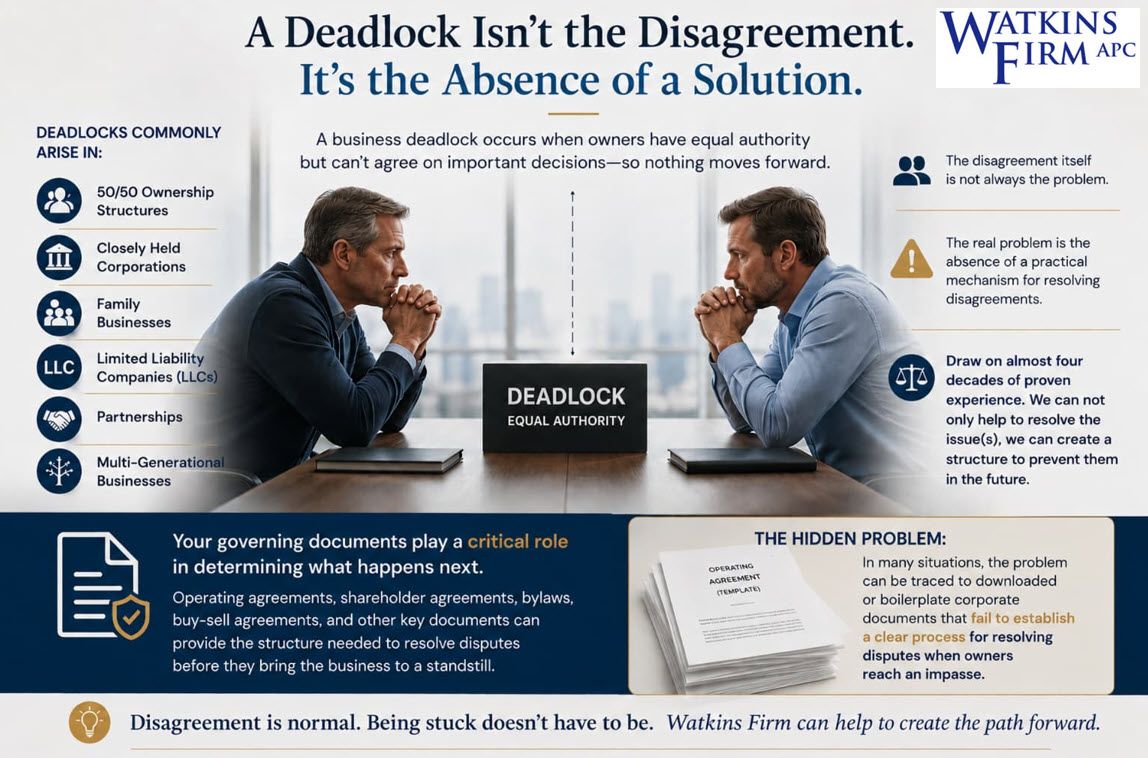
Business deadlocks are more common than many business owners realize.
They often occur when owners share equal ownership, equal voting power, or competing authority, and are unable to reach agreement on important decisions affecting the company. What begins as a disagreement regarding management, operations, compensation, hiring, spending, expansion, or strategy can eventually prevent the business from moving forward.
A deadlock can create uncertainty for employees, customers, vendors, lenders, investors, and the owners themselves. More importantly, it can threaten the value of the business and the investment each owner has worked hard to build.
The first step is understanding the facts.
What do the shareholder agreement, bylaws, buy-sell agreement, operating procedures, or other governing documents actually say? How are decisions supposed to be made? What authority exists? What options are available when agreement cannot be reached? What outcome is each owner attempting to achieve?
Understanding these issues often helps identify strengths, weaknesses, risks, opportunities, and potential paths toward resolution.
Watkins Firm is able to resolve the vast majority of disputes involving business deadlocks through effective, leveraged negotiation. This is the fastest, most cost-efficient manner in which to settle these matters. In some situations, effective guidance helps owners navigate the issue themselves. In others, direct negotiation, facilitated discussions, mediation, ownership transitions, buyouts, governance changes, or other business solutions provide an effective path toward resolution.
When necessary, the Watkins Firm is prepared to protect your interests through the filing or defense of a lawsuit, settlement conferences, mediation, arbitration, and at trial.
We invite you to a complimentary and substantive conversation regarding your situation, objectives, and concerns. You can reach out through the chat module on this page, our contact form, or by calling (858) 535-1511.
 It is important to understand where you are, what authority exists, what obligations apply, your options moving forward, and the most productive and effective steps you can take to protect your investment and business interests.
Many ownership disputes are influenced not only by what has already happened, but by what happens next. An early conversation can help you better understand your position, your risks, your opportunities, and the actions that may improve the likelihood of achieving a successful outcome.
You may also be interested in:
→ Resolving Your Business Deadlock
→ Business Ownership Disputes
→ Shareholder Agreements and Corporate Bylaws
→ Buy-Sell Agreements
If You Are Concerned About Misconduct
Breach of Fiduciary Duty • Self-Dealing • Misappropriation of Assets • Conflicts of Interest

Many shareholders become concerned when they believe those managing the company are acting in their own interests instead of the interests of the business and its owners.
In some situations, the concern involves excessive compensation, undisclosed conflicts of interest, misuse of company funds, self-dealing transactions, or the diversion of business opportunities. In others, shareholders question management decisions, financial reporting, accounting practices, or actions that appear to disproportionately benefit a small group of owners at the expense of others.
Not every concern ultimately proves to be misconduct. However, unanswered questions, missing information, unusual transactions, or a lack of transparency often create uncertainty that deserves careful evaluation.
The first step is understanding the facts.
What specifically occurred? What information is available? What information may be missing? What do the corporate records, financial statements, agreements, and governing documents reveal? What obligations do directors, officers, and controlling shareholders owe to the company and its owners?
Understanding these issues often helps identify strengths, weaknesses, risks, opportunities, and potential paths toward resolution.
Watkins Firm is able to resolve the vast majority of disputes involving allegations of misconduct through effective, leveraged negotiation. This is the fastest, most cost-efficient manner in which to settle these matters. In some situations, however, formal legal action may be necessary to protect the company, recover losses, obtain information, or hold responsible parties accountable for their conduct.
When necessary, the Watkins Firm is prepared to protect your interests through the filing or defense of a lawsuit, settlement conferences, mediation, arbitration, and at trial.
We invite you to a complimentary and substantive conversation regarding your situation, objectives, and concerns. You can reach out through the chat module on this page, our contact form, or by calling (858) 535-1511.
 It is important to understand where you are, what information is available, what information may be missing, your options moving forward, and the most productive and effective steps you can take to protect your investment and business interests.
Many shareholder disputes are influenced not only by what has already happened, but by what information becomes available next. An early conversation can help you better understand your position, your risks, your opportunities, and the actions that may improve the likelihood of achieving a successful outcome.
You may also be interested in:
→ Breach of Fiduciary Duty
→ Representing Minority Shareholders
→ Actions for Accounting
→ Shareholder Derivative Lawsuits
If You Are Facing a Buyout, Merger, or Exit
Business Valuation • Buyout Disputes • Dissenting Shareholder Rights • Mergers and Acquisitions
Transactions involving the sale of a business, a merger, a buyout, or a significant restructuring often create important questions regarding value, control, ownership rights, and the future of the company.
A negotiated buyout may provide an effective path to resolve the shareholder dispute when the parties can agree upon valuation, transaction terms, payment structure, and the conditions under which one shareholder will acquire another minority shareholder’s ownership interest.
In some situations, all parties agree that a transaction should occur but disagree about the value of the ownership interests involved. In others, shareholders may object to the proposed transaction, question the fairness of the terms, or believe the process disproportionately benefits certain owners while disadvantaging others.
These disputes frequently involve much more than a simple disagreement regarding price. Voting rights, governance issues, future participation in the business, access to information, tax consequences, and the long-term impact of the transaction may all become important considerations.
The first step is understanding the facts.
What transaction is being proposed? What do the shareholder agreement, buy-sell agreement, bylaws, merger documents, or other governing documents require? How is the ownership interest being valued? What rights exist? What alternatives may be available? What outcome is each party attempting to achieve?
Understanding these issues often helps identify strengths, weaknesses, risks, opportunities, and potential paths toward resolution.
Watkins Firm is able to resolve the vast majority of disputes involving buyouts, mergers, and ownership transitions through effective, leveraged negotiation. This is the fastest, most cost-efficient manner in which to settle these matters. In some situations, however, formal legal action may be necessary to protect the company, recover losses, obtain information, or hold responsible parties accountable for their conduct.
This often requires careful analysis of valuation issues, revised transaction terms, or other business solutions designed to protect the interests of all parties involved.
When necessary, the Watkins Firm is prepared to protect your interests through the filing or defense of a lawsuit, settlement conferences, mediation, arbitration, and at trial.
We invite you to a complimentary and substantive conversation regarding your situation, objectives, and concerns. You can reach out through the chat module on this page, our contact form, or by calling (858) 535-1511.
It is important to understand where you are, how the transaction may affect your ownership interests, what rights and options are available, and the most productive and effective steps you can take to protect your investment and achieve your objectives.
Many ownership disputes are influenced not only by the terms of the transaction itself, but by the decisions made before those terms become final. An early conversation can help you better understand your position, your risks, your opportunities, and the actions that may improve the likelihood of achieving a successful outcome.
You may also be interested in:
→ Dissenting Shareholder Rights
→ Buy-Sell Agreements
→ Shareholder Agreements and Corporate Bylaws
→ Business Ownership Disputes
If You Believe the Majority Is Trying to Force You Out
Shareholder Oppression • Freeze-Out Tactics • Dilution of Ownership • Loss of Voting Influence • Litigation
Many disputes and minority shareholder oppression lawsuits arise when minority shareholders believe the majority is using its control to reduce the value, influence, or economic benefits associated with a minority ownership position.
In some situations, minority owners find themselves excluded from important decisions, denied access to information, removed from management roles, subjected to dilution of their ownership interests, or pressured to sell their shares. In others, compensation decisions, distributions, voting actions, mergers, asset sales, or other corporate actions may disproportionately benefit controlling shareholders while reducing the practical value of a minority position.
These situations are often referred to as shareholder oppression, freeze-outs, or squeeze-outs. Regardless of the label, the underlying concern is usually the same: whether majority owners are using their control in a manner that unfairly harms the interests of minority shareholders.
The first step is understanding the facts.
What specifically has occurred? What do the shareholder agreement, bylaws, buy-sell agreement, corporate records, and other governing documents actually say? What rights exist? What obligations exist? What actions have already been taken? What outcome is each party attempting to achieve?
Understanding these issues often helps identify strengths, weaknesses, risks, opportunities, and potential paths toward resolution.
Watkins Firm is able to resolve the vast majority of disputes involving allegations of shareholder oppression through effective, leveraged negotiation. This is the fastest, most cost-efficient manner in which to settle these matters. These cases often involve governance changes, buyouts, revised ownership arrangements, or other business solutions designed to protect the interests of both the company and its owners. In some situations, however, formal legal action may become necessary to protect ownership rights, preserve the value of an investment, or prevent further harm.
When necessary, the Watkins Firm is prepared to protect your interests through the filing or defense of a lawsuit, settlement conferences, mediation, arbitration, and at trial.
We invite you to a complimentary and substantive conversation regarding your situation, objectives, and concerns. You can reach out through the chat module on this page, our contact form, or by calling (858) 535-1511.
It is important to understand where you are, what rights and protections may exist, your options moving forward, and the most productive and effective steps you can take to protect your investment and ownership interests.
Many shareholder disputes are influenced not only by what has already happened, but by what happens next. An early conversation can help you better understand your position, your risks, your opportunities, and the actions that may improve the likelihood of achieving a successful outcome.
You may also be interested in:
→ Minority Shareholder Disputes
→ Minority Shareholder Rights
→ Dissenting Shareholder Rights
→ Breach of Fiduciary Duty
Common Shareholder Issues and Questions:
 What Rights Does a Minority Shareholder Have?
Minority shareholders often have important legal rights even when they do not control the company. Depending upon the circumstances, these rights may include access to certain corporate records, participation in shareholder votes, protection against oppressive conduct, the right to receive distributions when appropriate, and the ability to pursue legal remedies when their ownership interests or the value of their investment are harmed.
The specific rights available in any situation depend upon the governing documents, ownership structure, applicable law, and the facts of the dispute.
Can a Minority Shareholder Be Forced to Sell Their Shares?
The answer depends upon the governing documents, ownership structure, and circumstances involved.
Some shareholder agreements and buy-sell agreements contain provisions governing ownership transitions and the circumstances under which shares may be purchased or redeemed. In other situations, shareholders may dispute whether a proposed sale, merger, buyout, or corporate action improperly affects the rights of minority owners.
Understanding the governing documents and the rights of the parties involved is often the first step in evaluating the situation.
What Is Shareholder Oppression?
 “Shareholder oppression” is a commonly used term that describes situations in which minority shareholders believe controlling owners are unfairly using their authority to reduce the value, influence, or economic benefits associated with a minority ownership position.
Examples may include exclusion from management, denial of access to information, dilution of ownership interests, excessive compensation paid to controlling owners, unfair distributions, freeze-out tactics, or other actions that appear to disproportionately benefit those in control of the company.
While the term “shareholder oppression” is widely used by business owners, investors, courts, attorneys, and legal commentators, California law does not recognize shareholder oppression as a separate, independent cause of action. Instead, these disputes are typically addressed through claims involving breach of fiduciary duty, violations of shareholder rights, corporate governance issues, statutory remedies, or other legal theories depending upon the specific facts involved.
The important question is often not what label applies to the conduct, but whether the actions taken have violated legal duties, shareholder rights, or obligations owed to the company and its owners.
What Is a Shareholder Derivative Lawsuit?
A shareholder derivative lawsuit is a legal action brought by a shareholder on behalf of the company itself.
These cases often arise when shareholders believe directors, officers, or controlling owners have harmed the company through misconduct, breaches of fiduciary duty, self-dealing, or other improper actions. Rather than seeking recovery for an individual shareholder, the claim is generally intended to recover losses or protect interests belonging to the company.
What Are Dissenting Shareholder Rights?
 Dissenting shareholder rights may provide legal protections for shareholders who disagree with certain major corporate transactions, such as mergers, acquisitions, or other significant changes affecting ownership interests.
These rights often focus on ensuring that shareholders receive fair value for their ownership interests and protect the value of their investment when they object to a transaction and choose not to participate.
What Happens When Shareholders Cannot Agree?
When shareholders cannot agree, the dispute may affect management decisions, voting rights, compensation, distributions, business strategy, or the future direction of the company. Some disagreements are resolved through negotiated settlements, mediation, governance changes, or buyouts, while others evolve into deadlocks, ownership disputes, or litigation.
The appropriate path depends upon the governing documents, ownership structure, business objectives, and the specific facts involved.
Listen to our Recent Sound Business Insights Podcast:
“Episode 14 – Shareholders’ Rights and Disputes”

Avoid Shareholder Conflicts Through Careful Advance Planning

Many shareholder disputes can be traced back to unclear expectations, outdated governing documents, unresolved ownership issues, or the failure to address foreseeable problems before they arise.
As companies grow and evolve, ownership structures change. New investors are added. Management responsibilities shift. Family members become involved. Business objectives change. Documents that made sense years ago may no longer reflect the realities of the business today.
This is why shareholder agreements, corporate bylaws, buy-sell agreements, governance procedures, and ownership structures should be reviewed periodically. Clear expectations regarding management authority, voting rights, distributions, access to information, ownership transfers, and dispute resolution procedures can often reduce the likelihood of future conflict.
After more than four decades of experience, we can tell you that most shareholder disputes ultimately come down to money, control, or valuation. Disagreements regarding distributions, compensation, access to information, ownership rights, governance issues, and the future direction of the company are among the most common issues we encounter.
Careful planning cannot prevent every dispute. It can, however, help business owners identify potential issues early, clarify expectations, preserve relationships, and create practical mechanisms for resolving disagreements before they threaten the value of the business itself.
Why Should You Consider a Business Formation and Corporate Attorney from the Watkins Firm?
 Why should you partner with a Watkins Firm corporate attorney? Navigating California’s intricate entity structures and protective firewalls requires both precise legal craftsmanship and deep industry experience. The Watkins Firm provides more than 40 years of local experience and insight serving the business, healthcare, technology, and real estate investment communities in San Diego and throughout California.
Meet Daniel Watkins
Dan has practiced in the areas of business, medical practices and healthcare business, high tech/science, real estate and employment defense law since 1987. He is a trusted litigation strategist and true trial attorney with over 50 jury and bench trials to his credit. Dan has successfully represented both large companies and individuals and achieved substantial victories in well-publicized trials throughout California and the U.S.
He is experienced in business and corporate formation and administration, as well as all forms of alternative dispute resolution, including binding arbitration and mediation. Clients value Dan’s ability to listen carefully, understand complex challenges, and develop practical, effective solutions to difficult legal problems.
DECADES OF TRIAL AND LITIGATION EXPERIENCE
Dan has nearly four decades of experience working with, for, and against some of the largest insurance companies in the country. He has successfully tried and litigated cases in the areas of Healthcare Compliance, Commercial Litigation, Unfair Business Practices, Fraud, Breach of Contract, Battery, Premises Liability, Product Defect, Medical Malpractice, Discrimination, Sexual Harassment, Construction Defect, as well as Unfair Competition, Defamation, and Trade Secrets.
In December 2003, Dan commenced litigation against Health South Surgery Centers-West, Inc. and its subsidiaries, exposing the company’s extensive mismanagement and misconduct of its surgery centers. Dan has also been asked by some of California’s largest municipalities and corporations to conduct legally required investigations into matters involving alleged employment discrimination and harassment.
You can rely upon direct, personalized access and insightful corporate guidance based on three distinct institutional pillars:
- Four Decades of Specialized Experience: Our corporate practice group has guided founders, directors, and executive teams through complex corporate governance matters, partner equity distributions, employment defense strategies, and multi-million-dollar commercial transactions for more than forty years.
- Responsive, Client-Focused Advocacy: We understand the intense demands placed on business owners and corporate officers. We provide process-driven, preventative legal strategies that actively insulate your personal assets while freeing your leadership team to focus entirely on growth and corporate execution.
- A Proven Track Record of Commercial Success: We have successfully overseen the formation of thousands of California businesses, designed dual-entity networks for expanding groups, managed thousands of corporate mergers and acquisitions, and defended clients from relatively minor operational disputes to high-exposure litigations that commanded national attention.
Our corporate attorneys anticipate problems, analyze risk patterns, and implement customized protective shielding before internal deadlocks or external liabilities have a chance to escalate into catastrophic exposure. Working with the Watkins Firm places an unshakeable record of real-world results directly on your side of the equation.