

It’s 3:00 AM and Nothing Is Moving Forward
 After more than 40 years of representing business owners, shareholders, partners, LLC members, founders, and investors, we have learned that business deadlocks don’t begin in a courtroom.
They begin much earlier.
It’s 3:00 in the morning. You cannot get the situation out of your mind. Every conversation seems to end in the same place. Important decisions are being delayed. Questions remain unanswered. The business is no longer moving forward, and you’re beginning to wonder what happens next.
You may be asking yourself:
- Why won’t my business partner agree to anything?
- How long can the company continue operating like this?
- What happens if we cannot reach an agreement?
- Can I force a buyout?
- Can they force me out?
- What happens to the business if neither side will budge?
The reality is that most business deadlocks do not begin with hostility. They begin when two owners with equal authority can no longer agree on decisions that affect the future of the company.
What starts as a disagreement regarding compensation, growth strategy, management authority, capital contributions, ownership rights, or the future direction of the business can gradually evolve into a situation where neither side can effectively move the business forward.
Understanding where you stand, what rights exist, what options may be available, and what actions should or should not be taken next is often the first step toward resolving the conflict and protecting the value of the business.
What Is a Business Deadlock?
A business deadlock occurs when owners possess equal authority but are unable to reach agreement on important decisions affecting the company. Because neither side has sufficient authority to break the tie, the business can become stalled, preventing meaningful decisions from being made.
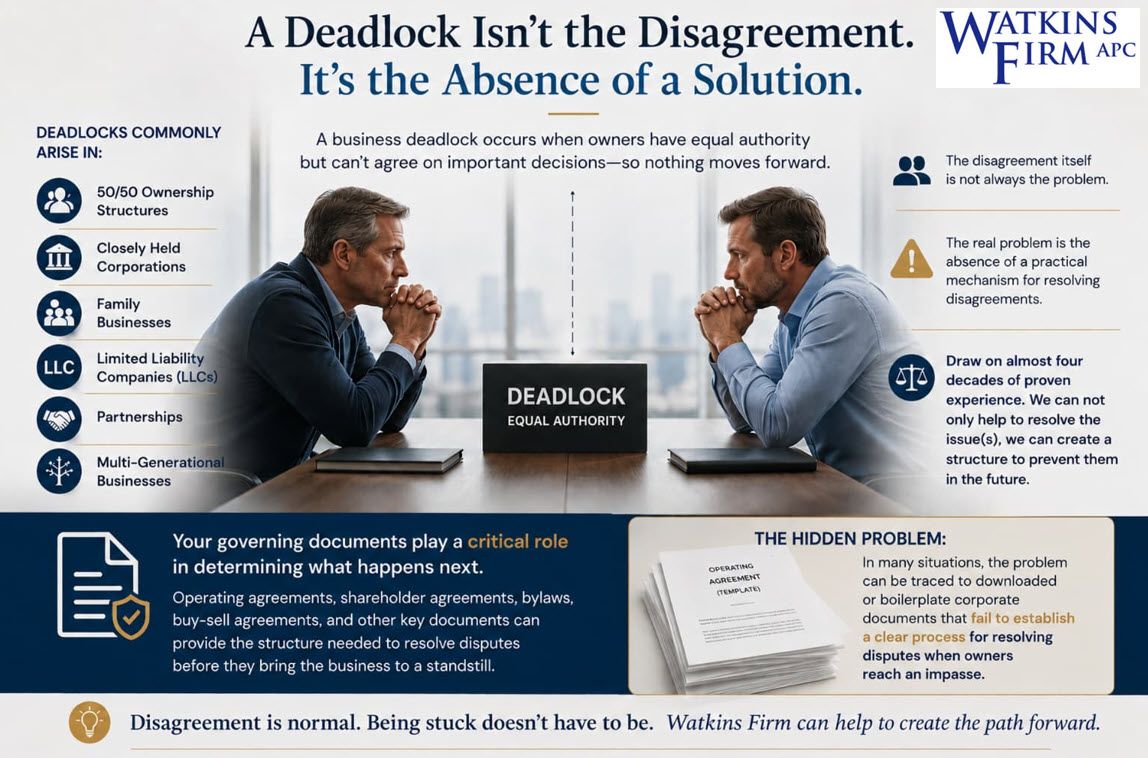
Deadlocks commonly arise in:
- 50/50 ownership structures
- Closely held corporations
- Family businesses
- Limited liability companies (LLCs)
- Partnerships
- Multi-generational businesses
The disagreement itself is not always the problem.
In many situations, the more significant issue is the absence of a practical mechanism for resolving disagreements once they occur.
Most business deadlocks are not caused by disagreement.
They are caused by the absence of an agreed method for resolving disagreement.
This is why operating agreements, shareholder agreements, bylaws, buy-sell agreements, and other governing documents often play a critical role in determining what happens next.
In many situations, the problem can be traced to downloaded or boilerplate corporate documents that fail to establish a clear process for resolving disputes when owners reach an impasse.






The Most Important Thing You Need to Know Right Now
 Business deadlocks are more common than many business owners realize.
After almost four decades of helping business owners, shareholders, LLC members, partners, founders, and investors resolve ownership disputes, we can tell you this with confidence:
There is most often a good path forward.
The challenge is determining which path makes the most sense based upon the governing documents, ownership structure, financial realities, business objectives, and the priorities of the individuals involved.
The first step is usually understanding the facts.
What do the operating agreement, shareholder agreement, bylaws, buy-sell agreement, or other governing documents actually say? What rights exist? What obligations exist? What options are available? What outcome is each owner trying to achieve?
In many situations, business owners become focused on the disagreement itself when the more important questions involve structure, process, and objectives.
There are actions you should take immediately, and there are actions you should avoid. There are conversations that should continue, and others that may benefit from experienced guidance before positions become entrenched or relationships deteriorate further.
It should encourage you to know that many business deadlocks are resolved without litigation. In some situations, effective coaching and guidance help owners navigate the issue themselves. In others, direct negotiation, facilitated discussions, or mediation provide an effective path toward resolution. Some deadlocks are resolved through ownership transitions, buyouts, or changes to governance structures designed to prevent similar issues from arising in the future.
When necessary, the Watkins Firm is prepared to protect your interests through filing or defending a lawsuit, settlement conferences, arbitration or other formal legal proceedings.
Our objective is always to help you to protect all you’ve worked so hard to build, while working to identify the most practical, effective, and economically sound path forward.
Our initial consultation is substantive, valuable, and complimentary. We invite you to engage the chat module on your screen, call (858) 535-1511, or contact us to discuss your situation, review the governing documents, understand your options, and begin creating a path forward.
Can a Business Deadlock Be Resolved Without Going to Court?
Absolutely.
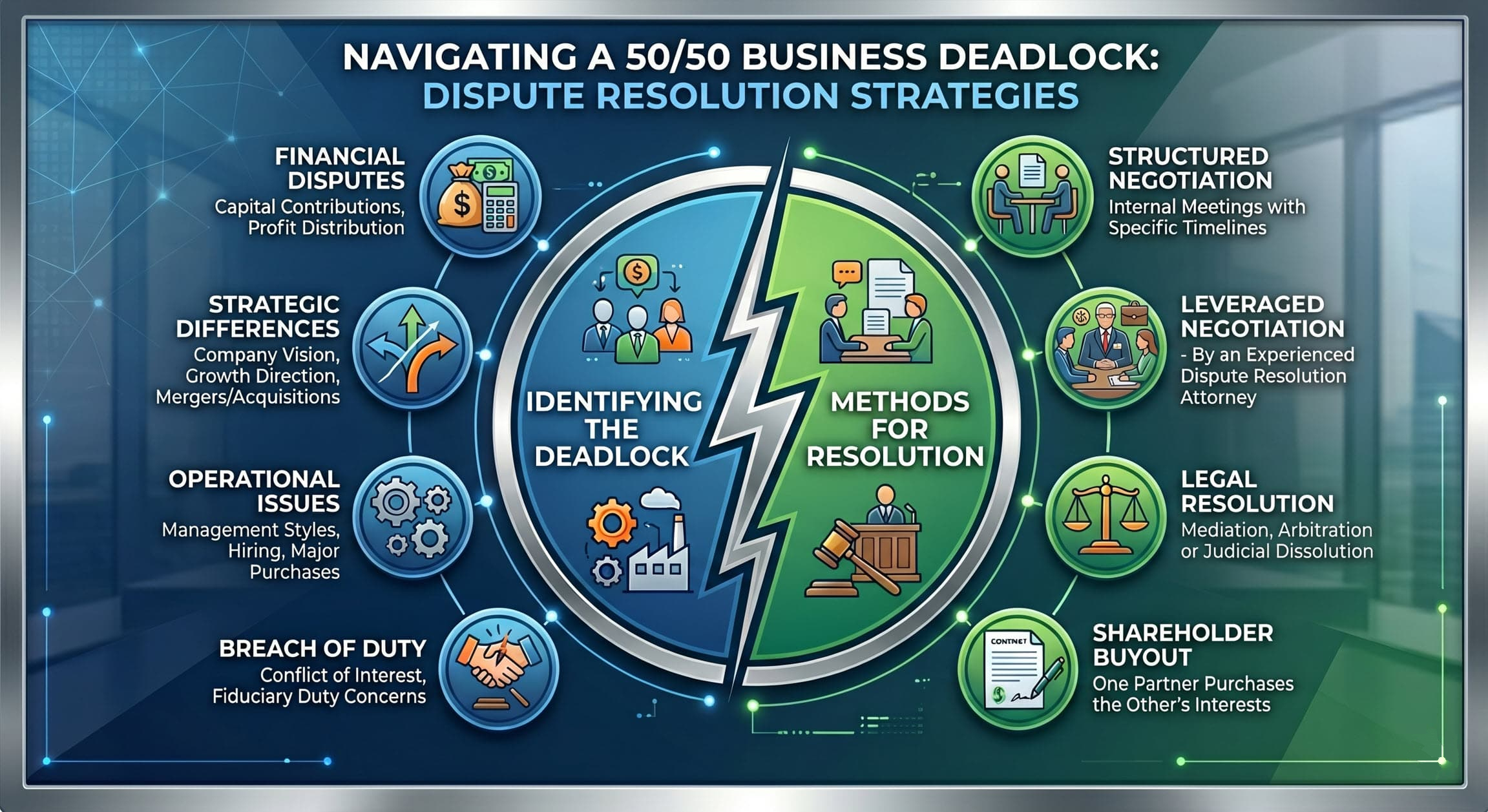
Most business deadlocks do not begin in a courtroom and many never reach one. In our experience, the vast majority of deadlock situations can be resolved through effective, leveraged negotiation once the governing documents, financial realities, ownership interests, and business objectives are clearly understood.
The challenge is that many owners become so focused on the disagreement itself that they lose sight of the larger objective: protecting the value of the business and creating a practical path forward.
When agreement can be reached, solutions may include changes in governance, revised compensation structures, ownership transfers, buy-sell agreements, Membership Interest Purchase Agreement or MIPA, or other negotiated resolutions designed to allow the business to continue operating successfully.
When negotiation is unsuccessful, the filing of a lawsuit, mediation, arbitration, litigation, or dissolution may become necessary.
What Happens If Business Owners Cannot Agree?
The answer depends upon the ownership structure of the business, the governing documents, and the nature of the disagreement.

Some operating agreements, shareholder agreements, bylaws, and buy-sell agreements contain specific provisions designed to resolve deadlocks. Others provide little guidance, leaving owners dependent upon negotiation or California law.
Potential outcomes may include:
- Negotiated resolution
- Buyout
- Ownership transfer
- The filing or defense of a lawsuit
- Mediation
- Arbitration
- Dissolution
The appropriate solution depends upon the objectives of the owners involved and the long-term interests of the business itself.
When Should I Speak With an Attorney About a Business Deadlock?
 The best time to seek advice is often before positions become entrenched and before actions are taken that may unnecessarily increase conflict or reduce available options.
This is why Watkins Firm offers a free, substantive consultation.
Business owners frequently wait until communication has completely broken down before seeking guidance. By that point, relationships may be damaged, valuable evidence may be lost, and practical resolution options may have narrowed significantly.
Early guidance can help business owners better understand their rights, obligations, available options, next steps, and the most effective strategy for protecting their interests while preserving business value whenever possible.
We Disagree About the Future of the Business

Strategic deadlocks often arise when business owners have different visions for the future of the company. One owner may wish to expand, acquire competitors, hire additional staff, pursue new opportunities, seek outside investment, or take greater risks. The other may prefer a more conservative approach focused on preserving capital, limiting exposure, or maintaining the existing business model.
In many situations, the disagreement itself is not the primary issue. The more significant question is whether the governing documents provide a process for resolving strategic disputes before they threaten the value of the business.
It should encourage you to know Watkins Firm resolves the vast majority of business deadlock situations through effective, leveraged negotiation. By understanding the governing documents, ownership structure, business objectives, and practical realities facing the company, it is often possible to identify solutions that allow the business to continue moving forward.
When necessary, we are prepared to file or defend a lawsuit, and manage a settlement conference, mediation, arbitration, or trial that may become necessary to protect your ownership interests and business value.
The Next Action Step: Gain insight and actionable options through a complimentary and substantive consultation. We invite you to engage the chat module on your screen, schedule your complimentary assessment, or call (858) 535-1511 to begin understanding your options and creating a path forward.
You may also be interested in:
→ Business Ownership Disputes
→ Shareholder Disputes
→ LLC Member Disputes
→ Buy-Sell Agreement or MIPA
Resolving Compensation Deadlocks
We Can’t Agree on Compensation
Compensation disputes frequently arise when business owners disagree regarding salaries, bonuses, profit distributions, benefits, retained earnings, or the appropriate relationship between ownership and compensation. These disagreements often become more pronounced as businesses grow, ownership responsibilities change, or financial performance fluctuates.
Questions regarding compensation frequently involve broader issues concerning fairness, contributions, authority, and expectations.
The solution is often found within the governing documents, financial records, ownership structure, and the objectives of the parties involved. In many situations, compensation disputes can be resolved through effective negotiation once the relevant facts and financial realities are clearly understood.
It should encourage you to know Watkins Firm resolves the vast majority of business owner disputes through effective, leveraged negotiation designed to protect ownership interests while preserving business value.
When necessary, we are prepared to pursue formal legal remedies to protect your interests.
The Next Action Step: Before positions become entrenched, seek experienced guidance regarding your rights, options, and practical opportunities for resolution. Gain insight and actionable options through a complimentary and substantive consultation. We invite you to engage the chat module on your screen, schedule your complimentary assessment, or call (858) 535-1511 to begin understanding your options and creating a path forward.
You May Also Be Interested In:
→ Dividend or Profit Distribution Disputes
→ Shareholder Disputes
→ LLC Member Disputes
→ Business Ownership Disputes
Resolving Contribution and Workload Deadlocks
I’m Doing Most of the Work

One of the most common sources of resentment among business owners occurs when one owner believes they are carrying a disproportionate share of the workload while ownership percentages, authority, compensation, or profit distributions remain unchanged.
Over time, frustration can evolve into conflict regarding compensation, ownership interests, management authority, and the future of the business itself.
The challenge is often determining whether the governing documents address owner responsibilities and whether expectations were clearly established when the business was formed. In many situations, the underlying issue is not simply workload. It is the growing perception that the relationship has become unfair.
Watkins Firm frequently assists business owners in identifying practical solutions that address both the business realities and the underlying concerns driving the conflict.
The Next Action Step: Before frustration leads to actions that may damage the business or the relationship, seek experienced guidance regarding your options. We invite you to engage the chat module on your screen, schedule your complimentary assessment, or call (858) 535-1511 to begin understanding your options and creating a path forward.
You May Also Be Interested In:
→ Business Ownership Disputes
→ Shareholder Disputes
→ Buy-Sell Agreements or MIPAs
→ Disputes Between Members in an LLC
Resolving Contribution and Workload Deadlocks
I’m Doing Most of the Work
One of the most common sources of resentment among business owners occurs when one owner believes they are carrying a disproportionate share of the workload while ownership percentages, authority, compensation, or profit distributions remain unchanged.
Over time, frustration can evolve into conflict regarding compensation, ownership interests, management authority, and the future of the business itself.
The challenge is often determining whether the governing documents address owner responsibilities and whether expectations were clearly established when the business was formed. In many situations, the underlying issue is not simply workload. It is the growing perception that the relationship has become unfair.
Watkins Firm frequently assists business owners in identifying practical solutions that address both the business realities and the underlying concerns driving the conflict.
The Next Action Step: Before frustration leads to actions that may damage the business or the relationship, seek experienced guidance regarding your options. We invite you to engage the chat module on your screen, schedule your complimentary assessment, or call (858) 535-1511 to begin understanding your options and creating a path forward.
You May Also Be Interested In:
→ Business Ownership Disputes
→ Shareholder Disputes
→ Buy-Sell Agreements or MIPAs
→ Disputes Between Members in an LLC
Resolving Ownership Exit Deadlocks
One Owner Wants Out
Not every business deadlock involves misconduct, conflict, or wrongdoing. In many situations, one owner simply wishes to retire, pursue other opportunities, reduce involvement, or move on to the next chapter of life.
The challenge arises when the owners cannot agree regarding:
- Business valuation
- Buyout terms
- Payment structures
- Ownership transfers
- Succession planning
- Future management of the company
These issues often become more complicated when the governing documents are outdated, incomplete, or silent regarding exit procedures.
It should encourage you to know Watkins Firm has extensive experience helping business owners navigate ownership transitions while protecting both business value and ownership interests.
The Next Action Step: Understanding the governing documents, valuation issues, and practical options available is often the first step toward a successful transition. We invite you to engage the chat module on your screen, schedule your complimentary assessment, or call (858) 535-1511 to begin understanding your options and creating a path forward.
You May Also Be Interested In:
→Exit Strategies
→ Buy-Sell Agreements
→ Business Disputes are about Money
→ Business Ownership Disputes
Resolving Trust and Governance Deadlocks
Trust Has Broken Down
Many business deadlocks ultimately trace back to a breakdown in trust.
Communication changes.
Questions go unanswered.
Financial information becomes more difficult to obtain.
Management decisions no longer make sense.
Concerns begin to emerge regarding transparency, authority, fiduciary obligations, or the conduct of another owner.
The challenge is determining whether the concerns are justified, what information is available, what rights exist, and what steps can be taken to protect ownership interests while preserving business value whenever possible.
It should encourage you to know Watkins Firm regularly assists business owners, shareholders, LLC members, and partners in understanding their rights, obtaining access to critical information, and identifying practical paths toward resolution.
When necessary, we are prepared to pursue formal legal remedies to protect your interests.
The Next Action Step: Before making accusations or taking unilateral action, seek experienced guidance regarding your rights, options, and the most effective path forward. We invite you to engage the chat module on your screen, schedule your complimentary assessment, or call (858) 535-1511 to begin understanding your options and creating a path forward.
You May Also Be Interested In:
→ Commingling or Misappropriation / Embezzlement
→ Breach of Fiduciary Duty
→ Disputes between Members in an LLC
→ Business Ownership Disputes
The Underlying Issue Is Not Always the Issue
 Business owners frequently arrive believing the deadlock is about a specific disagreement. Compensation. A buyout. Additional capital. Strategic direction. An ownership transfer.
In many situations, however, the disagreement itself is only the visible symptom. The underlying issue may involve changing expectations, unequal contributions, differing tolerance for risk, succession concerns, financial pressure, communication breakdowns, or a gradual erosion of trust between the owners.
This is one of the reasons business deadlocks can be difficult to resolve without experienced guidance. Owners often become focused on winning the argument when the more important objective is understanding what is actually preventing the business from moving forward. Identifying the underlying issues frequently provides the clearest path toward practical solutions, successful negotiations, and the preservation of business value.
Understanding How the Deadlock Developed
Most business deadlocks do not occur overnight. They develop gradually as disagreements accumulate, communication deteriorates, expectations diverge, and important decisions remain unresolved.
Understanding what happened, when it happened, and how the parties arrived at the current impasse is often one of the most important steps in identifying practical solutions and protecting business value. In many situations, a thorough chronology reveals patterns, misunderstandings, and unresolved issues that were not obvious when viewed individually.
The clearest understanding of how the deadlock developed often provides the clearest path forward.
Trust Erosion
Trust is rarely lost all at once. It often begins with small changes that appear insignificant at first. Questions go unanswered. Financial information becomes more difficult to obtain. Important decisions are made without meaningful discussion. Transparency begins to decline.
Over time, owners stop relying on one another and begin verifying information independently. As confidence erodes, routine business decisions become increasingly difficult because the issue is no longer the decision itself. The issue becomes confidence in the person making it.
 Changing Expectations
Many businesses are formed during a period of optimism. The owners share common goals, responsibilities are flexible, and future success seems aligned with everyone’s interests.
Years later, circumstances may look very different. One owner may want aggressive growth while another seeks stability. One may believe additional authority is warranted while another believes compensation should change. The assumptions that existed when the business was formed may no longer reflect present reality.
Deadlocks frequently occur when the business has evolved, but the expectations of the owners have evolved in different directions.
Unequal Contributions
One of the most common causes of ownership conflict occurs when owners begin to believe they are contributing unequally to the success of the business.
One owner may be responsible for generating revenue. Another may oversee operations, administration, or management. One may be working long hours while another has become less involved. Whether those perceptions are entirely accurate is often less important than the resentment they create.
When owners no longer believe contributions, authority, ownership interests, and compensation are properly aligned, disagreements can quickly become difficult to resolve.
Changing Life Circumstances
 Businesses change, but so do the people who own them. Common “triggers” include:
- Marriage
- Divorce
- Children
- Retirement planning
- Health concerns
- Financial pressures
- Relocation
- New opportunities
These all influence how owners view risk, responsibility, and the future of the company.
Many deadlocks develop not because the owners have become adversaries, but because they have reached different stages of life and are no longer working toward the same objectives.
Growth of the Business
Success often creates challenges that did not exist when the company was smaller.
As revenue grows, the financial consequences of important decisions increase. Questions regarding compensation, distributions, hiring, expansion, debt, acquisitions, succession planning, and future direction become more significant because the stakes are higher.
The business may have grown substantially while the governance structure remained largely unchanged. What once worked informally may no longer be sufficient to guide decisions affecting a much larger and more valuable enterprise.
Money
 Money is rarely just about money. Financial issues arising out of:
- Disagreements regarding compensation
- Profit distributions
- Capital contributions
- Valuation
- Ownership percentages
- Investment decisions, or
- cash flow
often reflect deeper concerns regarding fairness, authority, trust, and competing visions for the future of the business.
Financial disagreements frequently become the focal point of a deadlock, even when the underlying issues originate elsewhere.
Control
Many business deadlocks ultimately become disputes regarding authority and decision-making.
Questions arise regarding who has the authority to hire employees, approve expenditures, enter into contracts, pursue growth opportunities, seek financing, or determine the future direction of the company.
These issues become particularly difficult when ownership is divided equally and the governing documents fail to establish a practical mechanism for resolving disagreements. Without a clear process, even routine decisions can become obstacles to progress.
Exit
 Not every deadlock begins with conflict. In many situations, one owner simply wants to leave the business. Reasons include, but are not limited to:
- Retirement
- Health concerns
- Burnout
- Family obligations
- Financial needs, or
- The desire to pursue a different opportunity may lead an owner to seek an exit.
The challenge is that one person’s decision to leave often creates difficult questions regarding valuation, buyouts, payment terms, succession planning, and the future of the company itself. Many deadlocks arise because the owners never established a clear plan for what would happen when one of them eventually wanted out.
Why Should You Consider a Business Formation and Corporate Attorney from the Watkins Firm?
 Why should you partner with a Watkins Firm corporate attorney? Navigating California’s intricate entity structures and protective firewalls requires both precise legal craftsmanship and deep industry experience. The Watkins Firm provides more than 40 years of local experience and insight serving the business, healthcare, technology, and real estate investment communities in San Diego and throughout California.
Meet Daniel Watkins
Dan has practiced in the areas of business, medical practices and healthcare business, high tech/science, real estate and employment defense law since 1987. He is a trusted litigation strategist and true trial attorney with over 50 jury and bench trials to his credit. Dan has successfully represented both large companies and individuals and achieved substantial victories in well-publicized trials throughout California and the U.S.
He is experienced in business and corporate formation and administration, as well as all forms of alternative dispute resolution, including binding arbitration and mediation. Clients value Dan’s ability to listen carefully, understand complex challenges, and develop practical, effective solutions to difficult legal problems.
DECADES OF TRIAL AND LITIGATION EXPERIENCE
Dan has nearly four decades of experience working with, for, and against some of the largest insurance companies in the country. He has successfully tried and litigated cases in the areas of Healthcare Compliance, Commercial Litigation, Unfair Business Practices, Fraud, Breach of Contract, Battery, Premises Liability, Product Defect, Medical Malpractice, Discrimination, Sexual Harassment, Construction Defect, as well as Unfair Competition, Defamation, and Trade Secrets.
In December 2003, Dan commenced litigation against Health South Surgery Centers-West, Inc. and its subsidiaries, exposing the company’s extensive mismanagement and misconduct of its surgery centers. Dan has also been asked by some of California’s largest municipalities and corporations to conduct legally required investigations into matters involving alleged employment discrimination and harassment.
You can rely upon direct, personalized access and insightful corporate guidance based on three distinct institutional pillars:
- Four Decades of Specialized Experience: Our corporate practice group has guided founders, directors, and executive teams through complex corporate governance matters, partner equity distributions, employment defense strategies, and multi-million-dollar commercial transactions for more than forty years.
- Responsive, Client-Focused Advocacy: We understand the intense demands placed on business owners and corporate officers. We provide process-driven, preventative legal strategies that actively insulate your personal assets while freeing your leadership team to focus entirely on growth and corporate execution.
- A Proven Track Record of Commercial Success: We have successfully overseen the formation of thousands of California businesses, designed dual-entity networks for expanding groups, managed thousands of corporate mergers and acquisitions, and defended clients from relatively minor operational disputes to high-exposure litigations that commanded national attention.
Our corporate attorneys anticipate problems, analyze risk patterns, and implement customized protective shielding before internal deadlocks or external liabilities have a chance to escalate into catastrophic exposure. Working with the Watkins Firm places an unshakeable record of real-world results directly on your side of the equation.