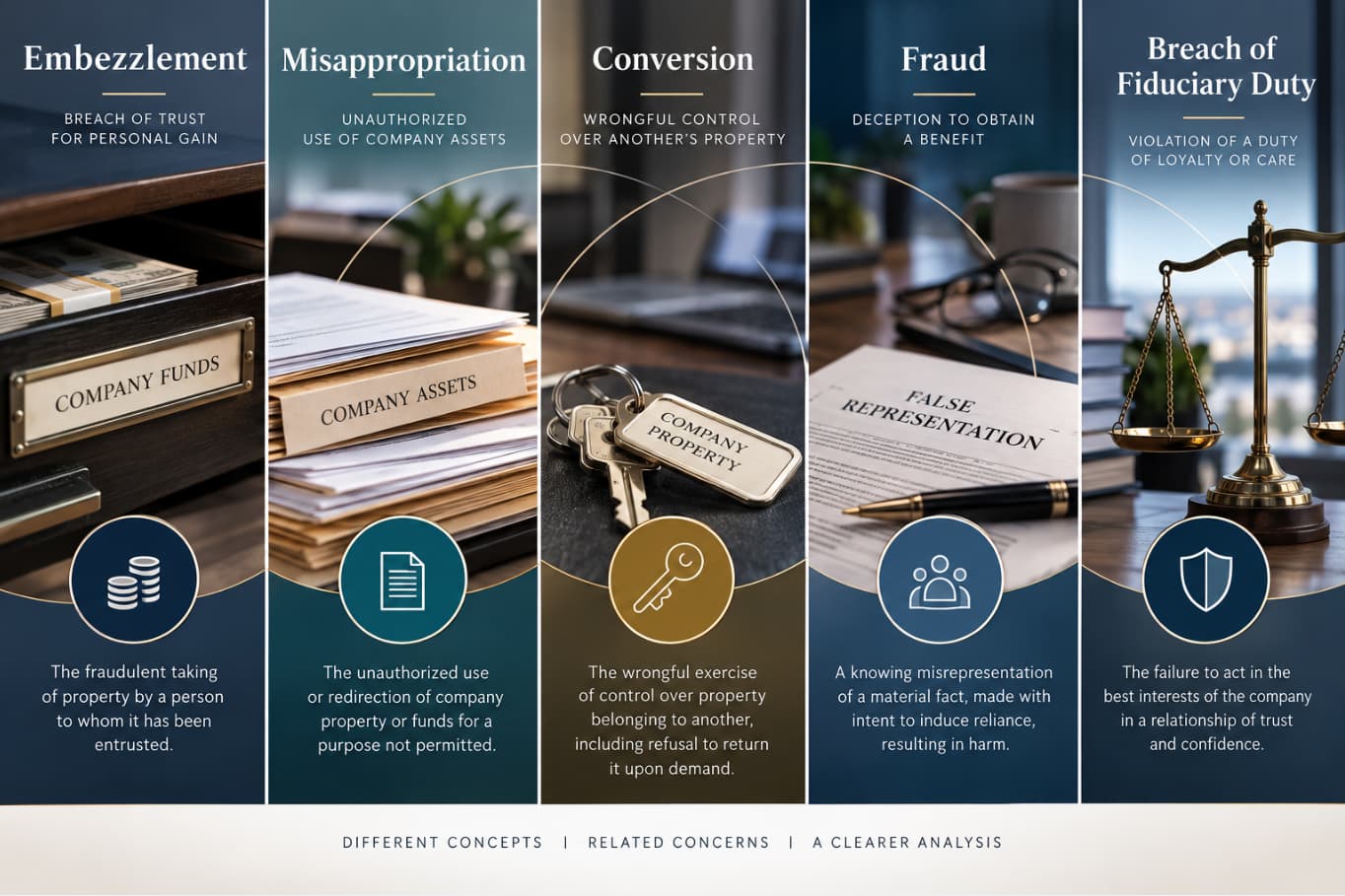
Embezzlement, Misappropriation and the Breach of Fiduciary Duty

A business dispute involving missing funds or misused assets is one of the most difficult challenges a San Diego company can face. Whether the entity is a corporation, an LLC, or a partnership, the concern often begins with a simple question: What happened to the company's money, and who was responsible for it?

You may have discovered unexplained withdrawals, payments to an unfamiliar business, personal expenses charged to company accounts, or financial records that no longer reconcile. A partner, officer, employee, or other person with access to company funds may have an explanation you do not yet understand. In other situations, the person accused believes the transactions were authorized, consistent with past practices, or part of a broader ownership disagreement.

Business professionals reviewing financial reports and company records

These circumstances can create serious financial and operational consequences. They may also place important business relationships under strain. But an unexplained transaction does not, by itself, establish embezzlement, fraud, or a breach of fiduciary duty. The facts, the person's authority, the governing agreements, and the available records must be examined before the conduct can be properly characterized.

Misappropriation and embezzlement may involve the wrongful taking or use of money or property entrusted to another person. Depending on the circumstances, the conduct may also give rise to civil claims involving business fraud, conversion, breach of contract, or breach of fiduciary duty. The legal claims and available remedies depend on what occurred and the duties that applied to the person involved.

For the business, the immediate concern is often how to understand the transactions, protect company assets and records, and determine whether additional losses may be occurring. For the person accused, the concern may be how to establish the purpose and authorization of the transactions while protecting their legal and professional interests.

Financial records and bank statements being examined with a calculator and laptop

The Watkins Firm represents businesses and individuals in disputes involving the alleged misuse of company funds and assets. Our work begins with understanding the circumstances, identifying the relationships and responsibilities involved, and determining what the evidence may establish. From there, we help clients evaluate the available options for protecting their interests and resolving the dispute.

How Is This Situation Developing in Your Business?

Misappropriation and embezzlement disputes do not always begin with an obvious theft. They may begin with an unexplained transfer, accounting records that no longer make sense, a disagreement over an owner’s use of company funds, or an accusation that a transaction was unauthorized.

The circumstances matter. A business owner trying to understand missing money faces different immediate concerns than an employee whose financial responsibilities are being questioned or a partner accused of taking an improper distribution.

The following situations describe some of the most common ways these disputes arise. Select the one that most closely reflects what you are experiencing to learn more about the issues, evidence, and options that may matter in your circumstances.

Which Best Describes Where You Are at This Moment?

You have found transactions, withdrawals, payments, or changes in the company's finances that you cannot explain.

  • Money has been transferred or withdrawn without your knowledge.
  • Business funds appear to have been used for personal expenses.
  • Payments, reimbursements, or compensation do not make sense.
  • Distributions have changed without a clear explanation.
  • Financial records do not account for where company money went.

Learn More →

Financial figures marked with a question mark during a review of unexplained transactions

You have discovered financial activity involving someone with an ownership interest or position of authority that raises questions about how company money is being used.

  • Company funds appear to have been used to pay an owner's personal obligations.
  • Payments have been made to a business connected to an owner, officer, partner, or family member.
  • Compensation, distributions, or reimbursements have changed without a clear explanation.
  • Company money or assets appear to have been transferred to another business or account.
  • You have been unable to obtain a satisfactory explanation of transactions involving someone who controls the company's finances.

Learn More →

Business owners and professionals discussing company financial matters at a conference table

You have discovered irregularities in the company's financial records or transactions involving an employee or another person responsible for handling business money or assets.

  • Payroll records include payments to people whose work or employment you cannot verify.
  • Invoices or vendor payments involve businesses you do not recognize.
  • Expense reimbursements appear inflated, duplicated, or unrelated to company business.
  • Accounting records, payees, or transaction details have been changed without a clear explanation.
  • Company inventory, equipment, vehicles, or other assets cannot be accounted for.

Learn More →

Professional reviewing accounting records and financial reports with a calculator

A business owner, partner, employer, or other person has questioned transactions you believe were authorized, legitimate, or consistent with your responsibilities.

  • You have been accused of taking money or using company assets for personal purposes.
  • A payment, reimbursement, distribution, loan, or compensation arrangement is now being challenged.
  • You believe the transactions were approved or consistent with the company's past practices.
  • You have been asked to explain financial records, provide documents, or respond to allegations.
  • An ownership, employment, or business relationship has deteriorated, and your handling of company money is now part of the dispute.

Learn More →

Business professionals discussing financial records and reviewing documents together

Understanding and Responding to Missing or Unexplained Company Funds

When Company Money Cannot Be Accounted For

Discovering unexplained transactions can create immediate concern about the company's financial condition and the people responsible for its money. The concern may begin with a single withdrawal, a series of unfamiliar payments, an unexpected change in distributions, or financial statements that no longer reconcile.

The first challenge is determining what actually occurred. A transaction that appears improper may have been authorized, incorrectly recorded, or connected to an arrangement that is not immediately apparent. Other transactions may reveal a pattern of unauthorized activity. The distinction matters because the appropriate response depends on the evidence, the authority of the people involved, and the potential effect on the business.

Financial figures being examined with a question mark highlighting uncertainty

What Matters Most When Money Is Missing

The most important questions are not limited to how much money appears to be missing. They include who had access to the funds, who authorized the transactions, where the money went, and whether the activity is continuing.

The company's governing documents, banking records, accounting systems, contracts, and established financial practices may all be relevant. It is also important to distinguish a disputed business decision from an unauthorized use of company property. The same transaction may be viewed differently by the people involved, and the available records may not initially tell the complete story.

How the Watkins Firm Evaluates the Financial Activity

The Watkins Firm begins by developing an understanding of the business, the people involved, and the circumstances that led to the discovery. We work with clients to identify the relevant transactions, establish a chronology, and determine what information is available and what may be missing.

Depending on the circumstances, that work may involve reviewing bank statements, general ledgers, accounting entries, invoices, payment records, communications, and the documents that establish financial authority. Where appropriate, forensic accounting or other financial expertise may help trace funds, reconcile records, and identify patterns that are not apparent from a preliminary review.

The objective is to understand the source and movement of the funds, the purpose of the transactions, and the evidence bearing on authorization. That foundation allows the client to evaluate the dispute based on facts rather than assumptions.

Evaluating the Available Paths Forward

Once the circumstances are better understood, the next step is to evaluate the business's objectives and the available options. Those objectives may include stopping continuing losses, obtaining missing information, recovering company assets, resolving an ownership disagreement, or preserving the business relationship where that remains possible.

Some matters may be addressed through an accounting, a negotiated repayment or resolution, changes to financial controls, or other business arrangements. Others may require formal legal proceedings to obtain information, protect assets, or pursue appropriate claims. The available approach depends on the facts, the parties' rights, and the urgency of the circumstances.

The Watkins Firm considers the potential financial harm, the strength of the available evidence, the cost and consequences of the available options, and the client's broader business objectives before recommending a course of action.

Next Action Step

If you have discovered missing or unexplained company funds, you do not need to determine the legal nature of every transaction before speaking with counsel. A productive initial conversation can help identify the information that matters, the immediate risks, and the steps that may preserve your options while the circumstances are evaluated.

We invite you to a complimentary and substantive conversation regarding your situation, objectives, and concerns. You can reach out through the chat module on this page, our contact form, or by calling (858) 535-1511.

It is important to understand where you are, what information is available, what information may be missing, your options moving forward, and the most productive and effective steps you can take to protect your interests and accomplish your objectives.


Investigating Employee, Accounting and Vendor Financial Irregularities

When Financial Records or Employee Activity Raise Questions

A business may discover financial irregularities through an internal review, a change in accounting personnel, a vendor inquiry, an employee complaint, or a transaction that does not appear to have a legitimate business explanation.

The concern may involve payroll, expense reimbursements, invoices, altered payees, inventory, equipment, or other company assets. In some circumstances, the irregularities may reflect accounting errors, inadequate controls, or misunderstandings about authorization. In others, they may indicate intentional misuse of company property.

The challenge is determining what happened without assuming that every discrepancy establishes misconduct or allowing uncertainty to prevent an appropriate response.

Professional reviewing financial records and accounting reports with a calculator

What Matters Most When Accounting or Employee Activity Is Questioned

The first priority is understanding the scope of the irregularities and the responsibilities of the people involved. What transactions are in question? Who created, approved, or processed them? What records support the payments or movement of assets? Are there additional transactions that require review?

The distinction between access and authority is important. An employee may have the ability to process a payment without having authority to approve it. A manager may have discretionary authority subject to company policies or other limitations. The applicable responsibilities depend on the person's role, the governing documents, and the circumstances.

The business must also consider whether the activity is continuing, whether relevant records are available, and whether other employees, vendors, or financial institutions may possess information needed to understand the transactions.

How the Watkins Firm Develops the Financial Record

The Watkins Firm approaches these matters by establishing a chronology and identifying the records necessary to evaluate the suspected activity. Depending on the circumstances, the review may involve payroll records, vendor invoices, expense reports, bank statements, accounting-system entries, purchase orders, inventory records, and relevant communications.

Where appropriate, forensic accounting may assist in tracing payments, identifying duplicate or unusual transactions, reconciling accounts, and determining whether records have been altered or transactions concealed.

The analysis also considers the explanations offered by the people involved. A disputed reimbursement, vendor payment, or payroll entry must be evaluated in light of the applicable policies, authorization practices, and available evidence.

This work helps determine whether the matter involves an error, a control failure, an employment dispute, or conduct that may support civil claims or other appropriate action.

Evaluating Recovery, Business Controls and Legal Options

The available response depends on the nature of the conduct, the evidence, the amount at issue, and the business's objectives. Some matters may be resolved through corrected accounting, repayment, employment-related action, or changes to internal financial procedures. Others may require formal proceedings to obtain information, recover property, or pursue damages.

The Watkins Firm evaluates the potential claims and remedies in the context of the person's actual duties and the harm suffered by the business. An employee's duty of loyalty, contractual obligations, agency responsibilities, and any applicable fiduciary duties must be considered separately rather than assumed from the person's job title.

Where criminal conduct is suspected, the relationship between civil recovery and any potential criminal investigation may also require careful consideration. The existence of a criminal allegation does not eliminate the need to establish the facts and evaluate the business's civil options.

Next Action Step

If accounting, payroll, vendor, or employee activity has raised concerns about company funds or assets, a substantive conversation with counsel can help identify the records that matter, the immediate business risks, and the appropriate next steps. The objective is to understand the circumstances and preserve the ability to respond effectively as the evidence develops.

We invite you to a complimentary and substantive conversation regarding your situation, objectives, and concerns. You can reach out through the chat module on this page, our contact form, or by calling (858) 535-1511.

It is important to understand where you are, what information is available, what information may be missing, your options moving forward, and the most productive and effective steps you can take to protect your interests and accomplish your objectives.

Responding to Allegations of Misappropriation or Embezzlement

When Your Handling of Company Money Is Being Questioned

Being accused of taking or improperly using company funds can place your employment, ownership interest, professional reputation, and business relationships at risk. The allegation may arise from a transaction you believed was authorized, a compensation or distribution arrangement, a reimbursement, a loan, or a disagreement over how company money was managed.

In some matters, the accusation follows a change in ownership, a deteriorating business relationship, or a dispute over control of the company. In others, an internal review may identify transactions that require explanation.

An accusation does not establish that the conduct was improper. At the same time, a belief that a transaction was authorized does not, by itself, resolve the legal questions. The circumstances, records, and applicable duties must be evaluated.

Business professionals reviewing disputed financial records and company documents

What Matters Most When You Are Accused

The immediate concern is understanding precisely what conduct is being questioned and what information may explain it. Which transactions are involved? What authority did you have? Were the payments approved, disclosed, or consistent with established practices? What agreements, communications, or accounting records support your understanding?

The nature of the relationship also matters. An employee, officer, director, LLC member, partner, or other person may have different obligations depending on their role and the governing law. The existence and scope of any fiduciary duty should be evaluated rather than assumed.

It is also important to understand whether the allegation involves a civil business dispute, an employment matter, a potential criminal investigation, or more than one of these concerns. The appropriate response may differ depending on the circumstances.

How the Watkins Firm Evaluates the Allegations and Available Evidence

The Watkins Firm begins by understanding the allegations, the business relationship, and the client's explanation of the transactions. We examine the relevant agreements, financial authority, accounting records, communications, and history of the parties' practices.

The analysis may involve determining whether a payment was compensation, a distribution, reimbursement, repayment, a loan, or another authorized business transaction. We also consider whether the company received the benefit associated with the payment and whether the records accurately reflect what occurred.

Where the allegations involve a broader ownership or employment dispute, the chronology may be particularly important. The timing of the transactions, prior approvals, changes in company practices, and the circumstances surrounding the accusation may all affect the evaluation.

The objective is to identify the evidence that supports or challenges the allegations and determine the legal issues that actually require resolution.

Evaluating Your Options and Protecting Your Interests

Depending on the circumstances, the available response may involve providing an explanation supported by records, resolving an accounting disagreement, negotiating a business resolution, or defending against civil claims. Some matters may require formal litigation to address disputed facts, ownership rights, or allegations of wrongdoing.

The Watkins Firm evaluates the claims being asserted, the evidence supporting them, the duties that may apply, and the potential financial and business consequences. We also consider whether the allegations involve direct or company-level claims and whether the person asserting them has the legal right to pursue the requested relief.

If criminal allegations or an investigation are involved, the potential consequences of communications and parallel civil proceedings require particular care. The strategy should account for the client's full circumstances rather than treating the matter as an ordinary accounting disagreement.

Next Action Step

If you have been accused of misappropriation or embezzlement, you do not need to accept another person's characterization of the transactions before obtaining legal advice. A substantive conversation can help you understand the allegations, identify the information that may support your position, and evaluate how to respond while protecting your legal and business interests.

We invite you to a complimentary and substantive conversation regarding your situation, objectives, and concerns. You can reach out through the chat module on this page, our contact form, or by calling (858) 535-1511.

It is important to understand where you are, what information is available, what information may be missing, your options moving forward, and the most productive and effective steps you can take to protect your interests and accomplish your objectives.

THE MOST IMPORTANT THING YOU NEED TO KNOW RIGHT NOW

The most important thing you need to know right now

The greatest risk—and the strongest opportunity to protect your interests—may exist right now, before the full extent of the financial activity is understood and before anyone has decided whether litigation is necessary.

When company money is missing, transactions are disputed, or someone has been accused of improperly using business assets, the immediate decisions can affect the evidence, the company's financial position, and the options available to everyone involved. Records may be changed or lost, additional transactions may occur, business relationships may deteriorate, and statements made before the facts are understood may complicate an already difficult situation.

The most important thing is to protect the evidence, understand the financial activity, and preserve your options before deciding how the dispute should be resolved.

That does not mean every unexplained transaction requires an emergency lawsuit or that every accusation establishes wrongdoing. It means the circumstances should be evaluated carefully enough to identify what needs attention now, what information is missing, and which decisions should be made with the benefit of legal guidance.

This Is Why You Need to Speak With an Experienced San Diego Business Litigation Attorney at Watkins Firm

Our experienced business litigation attorney can help you understand the legal and practical significance of the transactions before you take steps that may be difficult to reverse.

The Watkins Firm works with clients to identify the people and relationships involved, the authority under which money or assets were handled, the records that may explain the activity, and the potential consequences for the business. We consider what information should be preserved or obtained, whether immediate protective measures may be appropriate, and how communications with the other parties should be approached.

This Is Why You Need to Speak With an Experienced San Diego Business Litigation Attorney at Watkins Firm

The objective is not to assume that a crime or civil violation has occurred. It is to establish a reliable understanding of the circumstances and help you make informed decisions that protect your interests while the facts are developed.

Preserve the Financial Records and Establish a Chronology

Financial disputes are often resolved—or substantially clarified—by understanding the sequence of events. A single accounting entry may not explain why a payment was made, who approved it, or where the money ultimately went.

Relevant information may include bank statements, general ledgers, invoices, payroll records, expense reports, contracts, governing agreements, emails, text messages, and records showing who had authority over the accounts. Depending on the circumstances, accounting-system histories and other electronic records may also be important.

The Watkins Firm's approach emphasizes identifying the relevant transactions, tracing the movement of funds, and establishing a chronology of the activity. Where appropriate, forensic accounting or other financial expertise may assist in reconciling records and determining what the available evidence establishes.

Preserving the original records and understanding what information may be missing can be more valuable than attempting to reach an immediate conclusion about who is responsible.

Organized legal and financial records used to establish a chronology of events
Secure digital access representing protection of financial accounts and company information

Consider Whether Company Assets or Financial Access Need Protection

If the activity may be continuing, the business may need to consider whether its existing financial controls are adequate. That may involve reviewing account access, payment authority, approval procedures, or the ability of particular individuals to move company money or assets.

Any protective measures should be considered in light of the company's governing documents, employment relationships, contractual obligations, and the rights of the people involved. An owner or manager may not have unlimited authority to exclude another person from company accounts or records simply because a dispute has arisen.

Your Watkins Firm counsel can help evaluate what steps may be appropriate, who has authority to take them, and whether additional legal protection may be necessary. The goal is to reduce the risk of further harm without creating unnecessary legal or operational problems.

COMMUNICATIONS & CONSEQUENCES

Be Careful With Accusations, Explanations and Communications

Financial disputes can become highly personal, particularly when they involve a business partner, family member, trusted employee, or long-standing professional relationship. It may be tempting to confront someone immediately, demand repayment, circulate accusations, or provide a detailed explanation before the relevant records have been reviewed.

Those communications can have consequences. An accusation may damage a business relationship or reputation, while an incomplete explanation may create confusion about the purpose or authorization of a transaction. If criminal allegations are possible, communications may require additional care.

Before making significant accusations, admissions, repayment arrangements, or other commitments, it may be appropriate to obtain legal guidance about the circumstances and the information available. This is particularly important when the dispute involves ownership rights, employment consequences, or potential parallel civil and criminal matters.

UNDERSTANDING THE TRANSACTION

Understand the Transactions Before Deciding What They Mean

The legal characterization of a disputed transaction depends on more than the fact that money changed hands.

A payment may involve compensation, a distribution, a loan, reimbursement, a related-party transaction, or an unauthorized use of company property.

The relevant questions may include who approved the transaction, what authority existed, whether the company received a benefit, how the payment was recorded, and whether it was consistent with governing agreements or established practices.

For the person accused, these same questions may be essential to explaining the transaction and protecting their position. For the business, they may help distinguish an accounting problem or ownership disagreement from conduct that supports a legal claim.

A careful evaluation can help prevent the parties from committing to a legal theory or business response before the underlying facts are sufficiently understood.

Preserve Your Options Before Choosing a Final Strategy

You do not need to decide immediately whether the ultimate solution is litigation, settlement, repayment, an accounting, changes to business controls, or a separation of ownership interests. Those decisions should be informed by the evidence, the potential financial harm, the applicable legal rights, and the client's objectives.

In some circumstances, early communication and a negotiated resolution may preserve business value and avoid unnecessary expense. In others, formal proceedings may be necessary to obtain information, protect assets, or pursue appropriate relief. The most productive path depends on the circumstances.

The Watkins Firm helps clients evaluate these options in the context of their business and personal priorities. Our objective is to understand what has occurred, identify the available paths forward, and help you make decisions that protect your interests and accomplish your objectives.

The immediate priority is to preserve the ability to make those decisions from a position of knowledge, rather than allowing uncertainty, emotion, or the passage of time to narrow your options.

We invite you to a complimentary and substantive conversation regarding your situation, objectives, and concerns. You can reach out through the chat module on this page, our contact form, or by calling (858) 535-1511.

Employee working with company financial records and business assets
EMPLOYEE RESPONSIBILITY • TRUST • AUTHORITY

Is an Employee a Fiduciary?

A common question business owners ask is whether the theft or misuse of company funds by an employee constitutes a breach of fiduciary duty. While employees may owe their employer a Duty of Loyalty, not every employee is a formal fiduciary.

The question becomes more complicated when an employee has been placed in a position of trust and confidence and exercises substantial responsibility or control over the company's money, accounting, contracts, or other important assets. Depending upon the employee's authority, responsibilities, and relationship with the business, additional duties may apply. As attorneys, we may argue that employees entrusted with this level of responsibility are “de facto fiduciaries.”

01

The Controller or Head of Accounting

Someone with substantial authority over the company's financial records and accounts—the “keys to the vault.”

02

The Payroll Manager

Someone with the ability to create or modify payroll records, change compensation information, or potentially create “ghost employees.”

03

Key Managers

Employees with authority to bind the company to contracts, control significant assets, or make important business decisions without constant oversight.

The employee's title alone does not answer the question. The actual authority entrusted to that person, the responsibilities they assumed, and the nature of the business relationship all matter.

That is why it can be useful to think about these responsibilities as different layers.

Three-layer cake illustrating the layers of duty in a business setting
FOUNDATION GREATER TRUST BUSINESS LEADERSHIP
RELATIONSHIP • RESPONSIBILITY • DUTY

The Layers of Duty in a Business Setting

While this may seem like a lot to a non-attorney, these layers actually carry significant meaning. Think of it as a cake with multiple layers. The two main ingredients in the cake are “Loyalty” and “Care.”

The size of each layer does not represent the seriousness of the responsibility. As you move up the cake, fewer people occupy those positions, but the nature and scope of their responsibilities may become substantially different.

01 LOYALTY
02 CARE
01 FOUNDATION

The Foundation: The Duty of Loyalty

The bottom of the cake, the biggest section, might be legally referred to as a “Duty of Loyalty.” Most general employees owe their employer a duty of loyalty. Employees are charged with a duty of loyalty not to steal from the company, divert company property for their own benefit, or improperly help competitors.

02 GREATER TRUST

The Middle Layer: Greater Responsibility and Trust

The middle layer of the cake is a little smaller. Those who have greater responsibility and trust may also have responsibilities involving care, competence, and diligence—in practical terms, “I won't be careless with your money or negligent with your assets.”

Depending upon the person's role, authority, and relationship with the business, additional duties may apply. A fiduciary duty involves significant obligations of loyalty and care. As attorneys, we argue that employees who have been entrusted with substantial control over company money, accounting, or financial affairs may become “de facto fiduciaries.”

Whether a fiduciary relationship exists depends upon the actual relationship and responsibilities involved. Simply having access to company money does not necessarily answer the question.

03 TOP LAYER

The Top Layer: Officers, Owners and Those Responsible for the Business

The top of the cake involves a smaller group of people who may exercise substantial authority over the company, its assets, and the interests of others in the business. This may include corporate officers and directors, partners, LLC managers, and others whose positions or relationships create significant legal responsibilities.

The precise duties depend upon the type of business entity, the person's position and authority, and the governing agreements. This is why the title a person holds is only part of the analysis.

04
FROM DUTY TO REMEDY

Why Do the Different Layers of Duty Matter?

The duties matter because they help determine what responsibilities existed, whether those responsibilities were violated, and what claims, defenses, and remedies may be available.

An employee accused of diverting company money may present different legal issues than a financial manager entrusted with the company's accounting. A dispute involving an officer, director, partner, or LLC manager may involve still different responsibilities arising from that person's relationship with the business.

Those distinctions can affect the availability of damages, restitution, injunctive relief, disgorgement of profit, accounting actions, or other appropriate relief.

01 THE FACTS
02 THE RELATIONSHIP
03 THE DUTY
04 THE ALLEGED VIOLATION
05 THE AVAILABLE REMEDY

The important point is that the remedy follows from the facts, the relationship, the duty that actually existed, and the nature of the alleged violation. The person's title—or the accusation alone—does not determine the result.

MISAPPROPRIATION • EVIDENCE • RECOVERY

Misappropriation: Proof and Consequences

Misappropriation of company funds or assets may involve a single disputed transaction, but it can also involve a pattern of financial activity that develops over time. Understanding what happened requires more than identifying money that appears to be missing. The transactions, financial records, authority of the people involved, and movement of the company's money or assets must be examined together.

For the business seeking recovery, the challenge is establishing what occurred and the financial consequences of the conduct. For the person accused, many of the same records may establish authorization, explain the purpose of a transaction, or demonstrate that the allegations do not accurately reflect what happened.

Misappropriation of funds, assets or inventory

Common Patterns of Misappropriation

Misappropriation can take many forms. Some concerns become apparent through the accounting records, while others surface because company property cannot be located, a vendor relationship raises questions, or personal and business finances appear to have been mixed.

Common patterns include:

01

Accounting and Payroll Irregularities: Fictitious entities, false invoices, altered payees, questionable payroll entries, or payments to people whose work for the company cannot be verified.

02

Asset Misuse: The unauthorized taking, transfer, or use of company property, inventory, IT equipment, vehicles, or other business assets.

03

Expense and Vendor Schemes: Inflated or fabricated business expenses, questionable vendor payments, or undisclosed gifts, fees, or kickbacks associated with company business.

04

Commingling of Funds: The use of company accounts or assets to satisfy personal obligations or family expenses.

05

Related-Party Transactions: Payments or transfers involving an owner, officer, partner, family member, or affiliated business that raise questions about authorization, disclosure, or the benefit received by the company.

The existence of one of these circumstances does not necessarily establish misappropriation. The underlying records and the explanation for the transaction still matter.

02

Proving What Happened May Require More Than Reviewing the Books

Simply reviewing the books is rarely enough.

Financial records being examined closely with a magnifying glass
THE RECORDS SHOW THE TRANSACTION. THE EVIDENCE EXPLAINS WHAT HAPPENED.

Accounting records can show that a transaction occurred, but they may not explain who authorized it, why it was made, where the money ultimately went, or whether the entry accurately reflects the underlying transaction.

The Watkins Firm's approach is to uncover the relevant facts, trace the source and movement of funds, and establish the chronology of what happened. That may require comparing financial records with bank statements, invoices, payroll information, contracts, communications, governing documents, and other evidence surrounding the transactions.

Where appropriate, forensic accounting may provide additional insight into the movement of money, inconsistencies between records, unusual transaction patterns, or the financial consequences to the business.

The chronology can be especially important. When did the activity begin? Who had access or authority at that time? When were payments approved or questioned? Were transactions disclosed? Did accounting practices or financial controls change? What happened before and after the dispute arose?

The objective is not merely to find an unusual entry. It is to develop the evidence necessary to understand what actually occurred.

03

Authorization Can Be Just as Important as the Transaction

BUSINESS Was the transaction unauthorized?
THE CENTRAL QUESTION AUTHORITY
PERSON ACCUSED Was the transaction authorized?

A transaction that appears questionable when viewed in isolation may have an explanation. Compensation, distributions, reimbursements, loans, related-party payments, and other transactions may have been authorized by governing agreements, prior approvals, established company practices, or the people empowered to make those decisions.

Conversely, a transaction recorded in the company's books does not necessarily establish that it was properly authorized.

This is why both sides of a misappropriation dispute may depend upon many of the same records. The business may use them to establish that funds were diverted or used without authority. The person accused may use them to establish authorization, disclosure, a legitimate business purpose, or consistency with prior practices.

Understanding the authority behind the transaction is therefore an important part of determining whether the conduct supports a legal claim or reflects a different type of business dispute.

04

The Financial Consequences Depend Upon What Can Be Proven

When misappropriation or a related civil claim can be established, the available relief depends upon the facts, the legal claim involved, the financial harm, and the relationship between the parties.

Potential remedies may include:

Damages

Compensation for financial losses that can be established as resulting from the wrongful conduct.

01
02

Accounting

An accounting may be available in appropriate circumstances to determine financial activity and amounts that may be owed.

Restitution

Depending upon the claim and circumstances, recovery may include restoration of money or property wrongfully obtained or retained.

03
04

Disgorgement

Certain claims and relationships may support recovery intended to require a person to surrender profits or benefits obtained through wrongful conduct.

Rescission

In appropriate circumstances, a transaction or agreement affected by actionable misconduct may be subject to rescission or other relief intended to unwind the transaction.

05
06

Injunctive or Other Equitable Relief

The circumstances may support court orders intended to protect property, prevent continuing conduct, or address other aspects of the dispute.

Potential Punitive Damages

Punitive damages may be available in appropriate cases depending upon the claims asserted, the conduct established, and the evidence supporting that relief.

07

The existence of a financial loss does not automatically establish entitlement to any particular remedy. The available recovery follows from the claims that can actually be proven and the relief available under those circumstances.

05

Recovery and Defense Begin With the Same Question: What Does the Evidence Establish?

BUSINESS SEEKING RECOVERY

For a business seeking recovery, the evidence may establish the amount of money or property involved, how it moved, who controlled it, and whether the transactions were authorized.

PERSON ACCUSED

For the person accused, the evidence may establish a legitimate explanation, prior authorization, disclosure, established business practices, or other facts that challenge the allegations.

In either situation, the strongest position begins with the records, the chronology, the relationships involved, and a clear understanding of the financial consequences.

The Watkins Firm works to establish what happened before determining what should happen next.

The “Gold Fever” Phenomenon

“Business partner fraud… It never happens until you make money. It’s like gold fever. People with all the greatest virtues you’ve ever seen—all of a sudden the company is expanding, and money disappears. This includes shareholder fraud, officer fraud, and usurpation—the taking of corporate assets in secret.” — Dan Watkins, Founding Partner

Listen to our Recent Sound Business Insights Podcast:
Episode 14 – Shareholders’ Rights and Disputes”

Watkins Firm Sound Business Insights - Episode 14 – Shareholders’ Rights and Disputes


01

How do you prove that someone misappropriated company funds?

Proof usually begins with establishing what happened to the money or property, who had access or control, what authority existed for the transaction, and where the funds or assets ultimately went. Bank statements, accounting records, invoices, payroll information, contracts, emails, text messages, governing documents, and other business records may all become important.

The chronology matters as well. A transaction viewed by itself may tell only part of the story. Understanding when the activity began, who knew about it, what was authorized, how it was recorded, and what happened afterward can help establish whether company funds were actually misused.

02

What is the difference between embezzlement and misappropriation?

Embezzlement generally involves the fraudulent appropriation of property that was entrusted to the person accused of taking or using it. Misappropriation is a broader term commonly used to describe the improper diversion or use of money or property for an unauthorized purpose.

In a business dispute, the conduct may also raise issues involving conversion, business fraud, breach of fiduciary duty, or other civil claims. The appropriate legal theory depends upon the actual transactions, relationships, authority, and evidence rather than the label initially placed on the conduct.

03

Can an employee be responsible for misappropriating company funds?

Yes. An employee may have access to company accounts, payroll, vendor payments, expense reimbursements, inventory, equipment, or other assets and may be responsible for their improper use or diversion.

The employee's responsibilities are important, however. Not every employee has the same duties or authority. An employee entrusted with substantial responsibility for the company's money, accounting, contracts, or assets may present different legal issues than an employee with limited access or decision-making authority.

04

What if a business partner, officer, or manager is using company money for personal expenses?

The first question is usually whether the payment or use of company money was authorized. Compensation, distributions, reimbursements, loans, and other payments to owners or management may be legitimate depending upon the circumstances.

If company money is instead being diverted for personal purposes without appropriate authority, disclosure, or business justification, the circumstances may support claims involving misappropriation, breach of fiduciary duty, conversion, fraud, or other business disputes. The entity structure, governing agreements, financial records, and history of the transactions can be important in determining what occurred.

05

What should I do if I discover unexplained withdrawals or transfers from my company?

Preserve the records before making assumptions about what happened. Bank statements, accounting records, transaction histories, invoices, payroll information, contracts, communications, and governing documents may become important evidence.

It can also be important to determine who currently has access to company money or assets and whether additional transactions are occurring. Before making accusations or taking actions that could affect the business or the evidence, understand the transactions, establish the chronology, and obtain advice about the options available to protect the company and your interests.

06

Do I need a forensic accountant to prove misappropriation?

Not every dispute requires a forensic accountant. In some matters, the relevant transactions can be established from existing financial and business records. More complicated situations may benefit from forensic accounting when funds moved through multiple accounts, records are incomplete or inconsistent, transactions occurred over an extended period, or the financial consequences are difficult to determine.

The important point is to determine what evidence is necessary for the particular dispute rather than assuming that reviewing the company's general ledger alone will provide the answer.

07

What if I have been accused of embezzlement or misappropriating company funds?

Do not assume that a disputed transaction establishes wrongdoing. The purpose of the transaction, your authority to make it, governing agreements, previous approvals, established company practices, communications, and accounting treatment may all be important.

Preserve the records that explain what happened. Avoid altering or deleting financial information, emails, text messages, or other potentially relevant material. An accusation involving company money can develop into a business, employment, civil litigation, or potentially criminal matter, so understanding the allegations and the evidence early can be important.

08

What if the payment or distribution was authorized?

Authorization can be a significant issue. A payment characterized later as misappropriation may have been approved compensation, a distribution, reimbursement, loan, repayment, or another legitimate business transaction.

The question may therefore become who possessed authority to approve the transaction, what the governing agreements provided, whether the transaction was disclosed, how similar transactions were handled previously, and what the contemporaneous business records show. This is one reason the underlying evidence is more important than the accusation itself.

09

Can a company recover money or property that was misappropriated?

Potentially. The available recovery depends upon what occurred, the claims that can be established, the financial harm, and the relationship between the parties. Depending upon those circumstances, potential relief may include damages, restitution, an accounting, disgorgement, rescission, injunctive or other equitable relief, and, in appropriate cases, punitive damages.

Determining what can actually be recovered begins with tracing the money or property, establishing the resulting financial consequences, and identifying the claims and remedies supported by the evidence.

10

How quickly should I speak with an attorney about suspected misappropriation or embezzlement?

Early advice can be valuable because financial activity may be continuing and important records, access to accounts, communications, and business relationships may be affected by what happens next.

The objective is not necessarily to file a lawsuit immediately. It is to understand what happened, preserve the evidence, determine whether company assets or interests require protection, and understand your options before making decisions that may be difficult to reverse.

DISCUSS YOUR SITUATION

We invite you to a complimentary and substantive conversation regarding your situation, objectives, and concerns. You can reach out through the chat module on this page, our contact form, or by calling (858) 535-1511.

Why Choose Daniel Watkins and the Watkins Firm?

Experience Matters When the Dispute Matters.

Daniel Watkins has practiced law in San Diego since 1987. He attended the University of San Diego School of Law, worked at respected San Diego firms, and founded his own business law firm more than 30 years ago.

For Dan, San Diego is more than the market in which he practices. It is his community. He and his team have built lasting relationships with clients, many of whom have been with the firm since its beginning.

Over the course of his career, Dan has helped clients form businesses, protect and defend them, navigate difficult disputes, and later sell or merge those same companies.

Daniel Watkins, Founding Partner of the Watkins Firm
Daniel Watkins Founding Partner, Watkins Firm
Business Experience

A Business Attorney Who Understands the Businesses He Represents

Dan’s experience spans healthcare and medical practices, high technology and science, construction, hospitality, real estate, manufacturing, employment, and other commercial industries.

Each type of business has its own operational realities, legal requirements, regulatory obligations, and financial concerns.

Working with companies across these industries has given Dan insight into how businesses operate, how transactions are structured, how financial losses occur, and how commercial disputes actually develop.

That breadth becomes especially important when a dispute involves complicated records, conflicting explanations, specialized industry practices, or substantial financial exposure.

Litigation and Trial Experience

A Trusted Litigation Strategist and True Trial Attorney

Dan is a trusted litigation strategist and true trial attorney with over 50 jury and bench trials to his credit. Dan has successfully represented both large companies and individual litigants and achieved substantial victories in well-publicized trials throughout California and the U.S.

Dan doesn’t believe in needlessly aggressive litigation however he also doesn’t believe there is a case that can’t be won. There is always a way.

He has won numerous cases experts said couldn’t be won. Dan and his team pride themself in looking at cases differently than most attorneys. Clients value Dan’s ability to listen carefully, understand complex challenges, and develop practical, effective solutions to difficult legal problems.

His litigation experience includes Healthcare Compliance, Commercial Litigation, Unfair Business Practices, Fraud, Breach of Contract, Battery, Premises Liability, Product Defect, Medical Malpractice, Discrimination, Sexual Harassment, Construction Defect, Unfair Competition, Defamation, and Trade Secrets.

Dan has also spent nearly four decades working with, for, and against some of the largest insurance companies in the country.

Demonstrated Experience

Significant Litigation and Investigative Work

01

HealthSouth Surgery Center Litigation

In December 2003, Dan commenced litigation against Health South Surgery Centers-West, Inc. and its subsidiaries, exposing the company’s extensive mismanagement and misconduct of its surgery centers.

02

Municipal and Corporate Investigations

Dan has also been asked by some of California’s largest municipalities and corporations to conduct legally required investigations into matters involving alleged employment discrimination and harassment.

The Firm Dan Built

More Than Three Decades of Solutions-Based Representation

When Dan founded the Watkins Firm, he began building a team of attorneys and staff who could learn from one another and share a commitment to the clients they serve.

Over more than three decades, the firm has become a long-standing San Diego business law institution.

Dan and his team believe they have a responsibility to continue the firm’s tradition of solutions-based representation. They work to understand their clients, care about the businesses and people they represent, and develop practical solutions to difficult legal problems.

Why It Matters

What This Experience Means for Your Business Dispute

01

Experienced Judgment Across Decades of Business and Litigation

Dan’s practice since 1987 has involved complex transactions, ownership disputes, fraud allegations, commercial litigation, employment matters, and other consequential business issues.

His experience provides perspective when the facts are complicated, the financial consequences are substantial, or the opposing parties strongly disagree about what occurred.

02

Resolution Focused, but Prepared to Litigate

A business dispute should not become prolonged litigation simply because litigation is available.

The Watkins Firm evaluates the evidence, damages, risks, and objectives of the client and pursues opportunities for productive resolution when appropriate.

When negotiation or mediation cannot produce an acceptable result, Dan and his team have the litigation and trial experience necessary to continue pursuing the matter.

03

Experience Turning Complicated Facts Into a Coherent Case

Business disputes can involve years of transactions, financial records, contracts, emails, representations, and conflicting explanations.

The firm works to establish the chronology, identify the relevant evidence, understand the damages, and develop a clear explanation of what happened and why it matters.

A case that can be clearly understood is generally in a stronger position to be evaluated, negotiated, mediated, litigated, or tried.

The Ultimate Question

Why Should You Hire the Watkins Firm?

Because the objective is not to make your business dispute larger than it needs to be.

It is to understand what happened, identify what is at stake, evaluate the available options, and develop a strategy designed to protect your interests and accomplish your objectives.

Dan’s decades of business litigation and trial experience have taught him when a dispute may be resolved—and when being prepared to try the case becomes essential to achieving the best available outcome.

Your matter begins with a substantive conversation. We invite you to speak with the Watkins Firm about your situation, your concerns, and what you hope to accomplish.

Reviewed and approved by Daniel Watkins, Founding Partner, Watkins Firm.

Experienced San Diego Business Law Lawyers

Call 858-535-1511 for a Free Consultation

Begin with a Conversation

Most matters begin with a free, substantive consultation.  This is a clear discussion of your current situation, what is known, and what is uncertain. The purpose of that conversation is to understand your position and determine the most effective next step.
That initial consultation is focused, structured, and practical. It is designed to identify risk, clarify options, and determine whether further action is necessary.

If you are starting a business, facing a business challenge, evaluating a situation, or simply need clarity on where you stand, we invite you to a conversation.

Call Directly

(858) 535-1511
Talk through your situation with an experienced business attorney.

Live Chat

Engage the Chat Module –
Get a Quick Answer or connected to a Watkins Firm Attorney

Contact Us

Share Your Situation
Provide details on our contact form and we will reach out to you.