

Navigating the Complexity of California Real Estate
 California real estate represents some of the highest-value assets in the world, but it also carries a level of legal and regulatory exposure that is unique to the state. In San Diego, success is not merely a matter of finding the right parcel or securing a buyer; it is a matter of navigating a dense, constantly shifting web of state laws, local ordinances, and judicial precedents.
It is important to recognize that many of the undeveloped parcels remaining in San Diego carry significant “latent” restrictions. Older restrictive covenants, aggressive setback requirements, and outdated zoning can severely restrict—or entirely eliminate—the viability of your project. Identifying these infrastructure conflicts early is the only way to protect your capital and your timeline.
From the 2026 Transit-Oriented Development (TOD) mandates that override local zoning to the intricate disclosure requirements of AB 455 and AB 723, the landscape is designed to penalize the unprepared. Whether you are a developer repositioning an underutilized commercial asset or a homeowner protecting your property’s value, the cost of a single oversight—be it a mismanaged drainage issue or an ambiguous contract—can far exceed the cost of proactive legal counsel.
At the Watkins Firm, we view real estate through the lens of prevention. We provide the institutional knowledge and “San Diego-specific” patterns required to insulate your interests, resolve friction before it escalates, and protect your options in an increasingly litigious environment.
Insights from the Field: The Sound Business Insights Podcast
Legal strategy is best understood through the patterns of real-world cases. In these episodes, we break down the institutional behavior of California real estate disputes and the foundational laws that govern them.
Episode 43: Real Estate Disputes
The Focus: Why disputes escalate, the “leveraged negotiation” model, and how to protect your economic exposure when a deal turns adversarial.

Episode 8: Real Estate Law Overview
The Focus: A high-level framework of California’s complex regulatory environment—essential for developers and out-of-state investors.

The Business of Development: Strategic Risk Management
 For the professional developer, the goal is certainty. In 2026, California’s push for housing density through transit-adjacent development has opened massive opportunities, but it has also created a new layer of friction. Projects now face a collision between state-mandated density and local municipal resistance, often governed by aging private covenants (CC&Rs).
At the Watkins Firm, our experienced California real estate attorneys provide the legal infrastructure required to convert a high-risk proposal into a viable asset. We focus on identifying the “project killers”—those infrastructure and regulatory conflicts that don’t appear on a standard title report but emerge the moment you seek an entitlement.
San Diego Local Counsel: The “Internal Logic” of the Region
National firms often apply broad, standardized logic to California projects. This approach frequently leads to expensive delays during the entitlement process because it misses the local “internal logic” of San Diego’s planning departments and judicial tendencies.
As your Local Counsel, we provide the grounded expertise needed to navigate:
- The Entitlement Maze: We help you determine exactly where state housing laws—such as the 2026 TOD updates—override local zoning restrictions, allowing you to maximize density while minimizing municipal friction.
- Title & Covenant Scrubbing: We go beyond the surface of a title report to identify “unlawfully restrictive” or obsolete private covenants. Removing these obstacles early prevents them from becoming a “stop-work” order or a point of leverage for a neighborhood opposition group.
- Infrastructure & Easements: We proactively manage the “invisible” side of development—DNS issues, complex drainage patterns, and lateral support requirements. In San Diego’s topography, these are not just engineering challenges; they are legal liabilities that must be resolved before the first shovel hits the ground.
Strategic Entity Formation: The Real Estate MSO
For developers and investors entering the healthcare or professional services space, standard LLC structures are often insufficient. California’s strict regulatory environment requires a clear separation between business operations and professional practice.
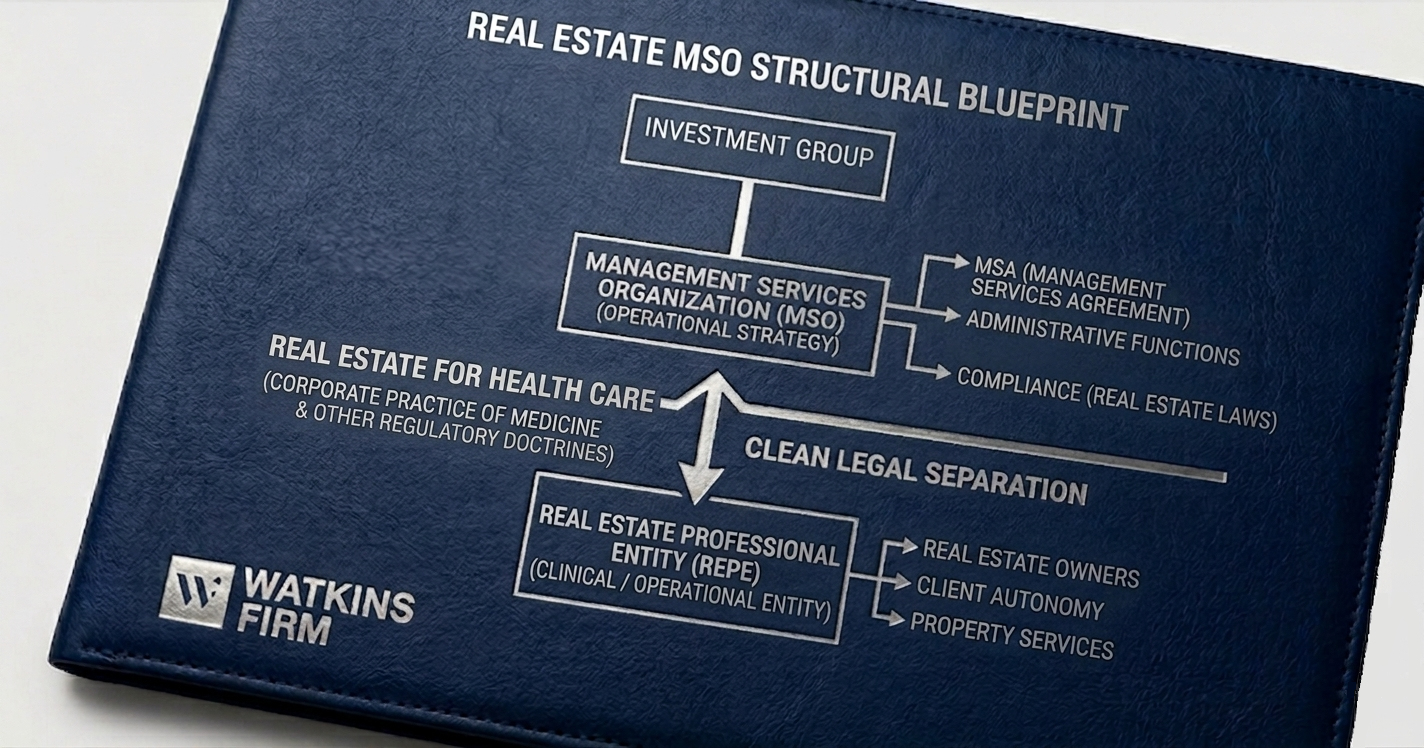
The Management Services Organization (MSO) is the stabilizing architecture for these ventures. At the Watkins Firm, we help developers and investors structure MSOs that allow them to:
- Capture Value in Medical Real Estate: By owning the MSO, the developer manages the facility, equipment, and administrative staff, providing these as a service to a physician-owned Professional Corporation (PC).
- Maintain Regulatory Compliance: We ensure your Management Services Agreement (MSA) respects the “Corporate Practice of Medicine” doctrine, insulating the investor from the risks of unlicensed practice claims.
- Scale Through Joint Ventures: The MSO model is an ideal platform for Joint Ventures, allowing for outside capital and operational expertise to fuel the growth of multi-site healthcare or professional service locations.
Why the MSO Matters for Your Project
In 2026, California has intensified its oversight of healthcare business structures through mandates like SB 351. A improperly structured MSO isn’t just a tax headache—it’s a “stop-work” order for your entire investment. We provide the “law-first” foundation required to ensure your MSO is built for long-term stability and eventual exit.
From Development to Dispute: The Boundary Friction Bridge
 In San Diego, the transition from a successful project to a legal dispute often happens at the property line. Whether you are a developer breaking ground on a new mixed-use site or a homeowner protecting your investment, “taking the law into your own hands” is an exceptionally expensive mistake.
California property law regarding views and foliage is often counter-intuitive. As founding partner Dan Watkins notes, “The law is fickle.” Rights are rarely universal; they are dictated by a hyper-local intersection of community CC&Rs, title reports, and specific municipal ordinances.
The $50,000 Error: Trees and Treble Damages
A common point of friction is the “overhanging branch” or the “blocked view.” While it may be tempting to resolve the issue with a chainsaw, the financial consequences are severe.
Replacement Costs: Replacing a single mature tree can cost between $30,000 and $50,000.
Statutory Penalties: California law allows for treble damages (triple the actual loss) in cases of timber trespass to discourage self-help remedies.
The “Reasonable Use” Doctrine: While you generally have the right to trim branches overhanging your line, if your actions kill or significantly damage the tree, you may be held liable for its full replacement value.
Resolving Neighbor & Boundary Disputes in San Diego
 When friction or a neighbor dispute arises over drainage, boundaries, or views, our goal is to provide a “leveraged negotiation” path that avoids the cost of a full trial while securing your property rights.
Common Adjoining Landowner Issues:
- Drainage and Water Runoff: In San Diego’s hillsides, changes to a neighbor’s property that alter water flow can threaten the structural integrity of your land. We help establish the “Reasonable Use” record to force a resolution.
- Prescriptive Easements: If a neighbor has been using a portion of your land for years, they may be on the verge of a legal claim to continue doing so. Timely legal intervention is required to “interrupt” this process and protect your title.
- Boundary Encroachments: From misplaced fences to retaining walls or storage sheds and out buildings built inches (or feet) over the line, these “minor” issues become major hurdles during a sale or refinancing.