Something has happened inside the business, and you are concerned that someone you trusted has crossed a line. Money may be missing. An important transaction may have been concealed. A partner, officer, director, or other insider may have benefited personally from a company decision. A customer or business opportunity may have been diverted. You may simply know that something has changed and need to understand what happened.
Or you may be on the other side. You made a business decision you believed was appropriate, and now a partner, shareholder, or the company is accusing you of violating a fiduciary duty.
Either situation can have serious consequences. It is also important not to reach conclusions too quickly. A questionable transaction, failed business decision, conflict between owners, or personal benefit does not automatically establish a breach of fiduciary duty.
The attorneys at Watkins Firm represent both sides of these disputes. The first step is to determine what relationship existed, what duties actually applied, what happened, and what the evidence shows.
Does Any of This Sound Familiar?
Breach of fiduciary duty disputes often begin before anyone uses that legal term.
Something has happened inside the business that raises questions about money,
loyalty, disclosure, ownership, authority, or trust. You may recognize your
situation in one of these common circumstances.
You have discovered conduct suggesting that someone trusted with company
information, customers, employees, or opportunities may be using those
resources to compete with the business.
An officer, partner, manager, or trusted employee has started or assisted a competing business.
Customers or clients are being solicited or redirected.
Employees have been encouraged to leave for a competing company.
Confidential customer, pricing, financial, or strategic information has been copied or used elsewhere.
Company systems, files, contacts, or resources may have been used to support the competing operation.
You believe someone with responsibility for the business is making
decisions that are reckless, poorly informed, conflicted, or causing
substantial harm.
Significant decisions are being made without adequate information or investigation.
Warning signs or serious business risks appear to have been ignored.
Company resources continue to be committed to decisions that are producing substantial losses.
You question whether the decision-maker was acting for the company or pursuing another interest.
You need to know whether a bad business decision can actually constitute a breach of fiduciary duty.
You made or participated in a business decision, transaction, payment,
or other action that another owner or the company now claims violated
your responsibilities.
You have received a demand letter or been threatened with litigation.
A shareholder, partner, or co-owner claims you benefited improperly from a transaction.
You are accused of withholding information or failing to disclose a conflict.
A business decision you believed was authorized is now being characterized as self-dealing or misconduct.
You need to understand whether you owed the alleged duty, what authority you had, and whether the accusation is supported by the facts.
Unexplained withdrawals, payments, reimbursements, transfers, or changes in
distributions deserve careful examination, but an unusual transaction does
not establish a breach of fiduciary duty by itself. The first task is to
determine what happened to the money, who authorized the transaction,
whether there was a legitimate business purpose, and whether the person
involved had the authority to act.
The company's financial records often provide the starting point. Bank
statements, general ledgers, credit card records, reimbursement records,
compensation records, distributions, loan documents, and related
communications can help establish where the money went and whether the
transaction was properly recorded and disclosed.
The legal questions then become more focused. Was company money used for a
personal purpose? Did an officer, director, partner, manager, or other
fiduciary receive an improper benefit? Was the transaction authorized or
approved? Was material information withheld from the people entitled to
receive it?
These distinctions matter because misappropriation of company funds may
support a breach of fiduciary duty claim, but the two legal theories are not
interchangeable. The relationship between the parties, the source of the
money, the authority for the transaction, and the documentary record can
determine what claims belong to an individual owner, what claims may belong
to the company, and what remedies may be available.
The Next Action Step:
If company money is missing or financial activity cannot be explained,
begin by preserving the records you lawfully possess and identifying the
transactions that concern you. Gain insight and actionable options through
a complimentary and substantive consultation. We invite you to
engage the chat module on your screen,
schedule your complimentary consultation,
or call
(858) 535-1511
to begin understanding what happened and what options may be available.
A transaction involving someone on both sides of a business decision
requires more than simply asking whether that person received a benefit.
The circumstances surrounding the transaction matter. An important starting
point is determining who benefited, what was disclosed, and who approved the
transaction. Those questions can substantially change the legal analysis.
For example, a company may have legitimate reasons to do business with
another company owned by an officer, director, partner, manager, or
shareholder. The existence of that relationship does not necessarily
establish wrongdoing. The concern becomes more significant when a personal
financial interest was concealed, the decision-maker used company authority
to obtain an undisclosed benefit, approval was obtained without complete
information, or the terms were detrimental to the company.
The governing documents, meeting records, contracts, communications,
financial records, disclosures, and approvals can help establish how the
transaction was presented and decided. It is also important to determine
the capacity in which the person acted. Someone may simultaneously be an
owner, director, officer, employee, or manager, and those roles are not
necessarily interchangeable when fiduciary obligations are analyzed.
Once the transaction and decision-making process are understood, counsel can
evaluate whether the conduct represents a legitimate business transaction,
an adequately disclosed conflict, or potential self-dealing and breach of
fiduciary duty.
The Next Action Step:
If you have discovered that someone inside the company benefited from a
transaction they influenced or approved, gather the transaction documents
and communications available to you before drawing conclusions or
confronting the other party. Gain insight and actionable options through
a complimentary and substantive consultation. We invite you to
engage the chat module on your screen,
schedule your complimentary consultation,
or call
(858) 535-1511
to begin evaluating the transaction and protecting your interests.
When Important Business Information Has Been Concealed
When important information was withheld, the question is often not limited
to whether the underlying business decision was permissible. It may also be
necessary to determine whether someone in a fiduciary relationship had an
obligation to disclose material information before that decision or
transaction occurred.
That can include an undisclosed financial interest, a related-party
transaction, compensation arrangement, ownership change, significant
negotiation, competing interest, or other information that would have
affected how another owner or the company evaluated the matter. Concealment
and failures of disclosure are therefore important components of many
fiduciary-duty disputes.
The sequence of events can be particularly important. What did the fiduciary
know? When did they know it? What were the other owners, directors,
partners, or managers told? What documents existed at the time? Who approved
the transaction, and would that approval have been different if all material
facts had been known?
Emails, texts, notices, financial reports, meeting records, disclosures,
agreements, and transaction documents can help reconstruct that history.
Once the chronology is established, it becomes easier to distinguish an
ordinary communication failure or business disagreement from concealment
that may support a fiduciary-duty claim.
The Next Action Step:
If you believe important information was deliberately withheld, preserve
the communications and records you already have and avoid altering or
deleting relevant materials. Gain insight and actionable options through a
complimentary and substantive consultation. We invite you to
engage the chat module on your screen,
schedule your complimentary consultation,
or call
(858) 535-1511
to begin establishing what was known, what should have been disclosed, and
what options remain available.
A customer, contract, acquisition, property, investment, supplier
relationship, or other opportunity can have substantial value to a business.
When someone entrusted with company interests takes or redirects that
opportunity for personal benefit, the circumstances should be examined
carefully.
The central question is not simply whether the person ultimately benefited.
Counsel must determine how the opportunity arose, how closely it was
connected to the company's existing or anticipated business, what role the
individual held, what they knew because of that role, whether the company had
an interest in pursuing the opportunity, and what was disclosed before the
opportunity went elsewhere.
The trail may lead beyond the original company. Another entity may have been
formed or used to receive the customer, contract, revenue, property, or
opportunity. Ownership records, communications, contracts, customer records,
financial transactions, and the timing of events can help establish where
the opportunity went and who ultimately benefited.
When the diversion is continuing, timing can also affect the practical
options available. Continued customer diversion, asset transfers, or use of
company information may present different strategic considerations than an
opportunity that was lost months or years earlier.
The Next Action Step:
If you believe a customer, contract, or business opportunity was diverted,
preserve the documents and communications showing how the opportunity
originated, who handled it, and where it ultimately went. Gain insight and
actionable options through a complimentary and substantive consultation.
We invite you to
engage the chat module on your screen,
schedule your complimentary consultation,
or call
(858) 535-1511
to begin determining what occurred and what can be done about it.
When Someone Inside the Company Is Building or Assisting a Competing Business
Discovering that an officer, partner, manager, or trusted employee may be
competing with the company raises several different questions. Competition
itself is not enough to resolve the legal issue. The person's role, duties,
timing, conduct, and use of company information or resources all matter.
The situation becomes substantially more concerning when someone uses a
position inside the company to solicit its customers, recruit employees,
redirect opportunities, copy confidential information, or use company
systems and resources to establish or support a competing operation.
The evidence in these disputes is often digital as well as financial.
Emails, customer communications, file-access histories, downloads, cloud
storage, account activity, company devices, and other records may help
establish what information was accessed and how it was used. California
fiduciary-duty cases also recognize the significance of an officer's use of
confidential company information to assist a competitor.
This is an area where early decisions can matter. Evidence should be
preserved appropriately, but access to accounts, devices, communications,
or other information must also be lawful. The objective is to determine what
actually occurred while protecting the company's customers, information,
employees, opportunities, and legal position.
The Next Action Step:
If you believe someone inside the company is competing with the business,
avoid deleting, changing, or disrupting potentially relevant records before
the situation has been evaluated. Gain insight and actionable options
through a complimentary and substantive consultation. We invite you to
engage the chat module on your screen,
schedule your complimentary consultation,
or call
(858) 535-1511
to begin understanding the conduct and determining how the business can
respond.
When You Are Being Excluded From a Business You Own
Being an owner on paper does not always mean being treated like an owner in
practice. Exclusion from meetings, restricted access to company information,
changes in voting power, selective distributions, dilution, or unexpected
changes in management authority can substantially affect an owner's position
even when the underlying ownership interest has not formally disappeared.
The first step is to establish what rights actually exist. Articles, bylaws,
shareholder agreements, operating agreements, partnership agreements,
amendments, voting records, ownership records, and other governing documents
may determine who has management authority, what information an owner is
entitled to receive, how ownership interests can be issued or transferred,
and what procedures govern important company decisions.
The financial side of the relationship also matters. Changes in compensation
or distributions, insider salaries, related-party transactions, and benefits
provided to some owners but not others may help explain whether the dispute
is simply about management direction or whether company authority is being
used to disadvantage another owner.
These cases can involve overlapping issues of fiduciary duty, shareholder or
member rights, access to records, ownership control, and sometimes
dissolution or business divorce. The objective is to identify what changed,
determine how it was accomplished, and understand what rights and remedies
remain available before additional changes make the dispute more difficult
to unwind.
The Next Action Step:
If your access, authority, distributions, voting power, or practical role
in the company has changed unexpectedly, preserve the governing documents,
notices, financial information, and communications available to you. Gain
insight and actionable options through a complimentary and substantive
consultation. We invite you to
engage the chat module on your screen,
schedule your complimentary consultation,
or call
(858) 535-1511
to begin understanding your ownership rights and protecting your position.
When a Fiduciary's Decisions Are Causing Serious Harm to the Business
A decision that loses money, fails to produce the expected result, or appears
unwise in hindsight is not automatically a breach of fiduciary duty. Courts
are not intended to second-guess every unsuccessful business decision. The
more important questions concern how the decision was made and whether the
person making it complied with the duties that actually applied.
That requires looking beyond the outcome. What information was available
when the decision was made? Was reasonable inquiry undertaken? Were
significant warnings ignored? Did the decision-maker obtain appropriate
advice? Was there a personal or conflicting interest? Was judgment actually
exercised, or did someone proceed without adequately considering the
consequences?
The person's capacity also matters. An individual may simultaneously serve
as a director, officer, shareholder, employee, or manager. The legal rules
governing conduct undertaken as a corporate director do not necessarily
apply identically when that same individual acts in another capacity.
A careful review can therefore protect both sides of the dispute. It can
identify conduct that warrants legal action, but it can also distinguish
actionable misconduct from a legitimate business judgment that simply
produced a poor result.
The Next Action Step:
If decisions are causing substantial harm to the company, preserve the
records showing what was decided, what information was available, who
participated, and what concerns were raised at the time. Gain insight and
actionable options through a complimentary and substantive consultation.
We invite you to
engage the chat module on your screen,
schedule your complimentary consultation,
or call
(858) 535-1511
to begin determining whether the problem is a business disagreement, poor
judgment, or conduct that may support a legal claim.
When You Are Accused of Breaching a Fiduciary Duty
An accusation of breach of fiduciary duty is not proof that a breach
occurred. These claims can arise after a transaction fails, owners fall into
conflict, financial results disappoint expectations, or people who once
agreed about a decision later interpret the same events very differently.
The first questions should be factual and legal. Did you owe the alleged
fiduciary duty? To whom was it owed? In what capacity were you acting? What
authority did you have? A person who is simultaneously an owner, officer,
director, employee, partner, or manager may have different rights and
obligations depending upon the role in which the challenged action was
taken.
The decision-making record can then become extremely important. Governing
agreements, board approvals, consents, disclosures, emails, financial
information, advice received, alternatives considered, and records showing
the business purpose behind the decision may provide a substantially
different picture from the allegations contained in a demand letter or
complaint.
Conflicts and alleged self-dealing require particularly careful analysis of
what was disclosed and approved. Likewise, an unsuccessful business decision
should not automatically be transformed into misconduct simply because the
outcome was unfavorable.
Early legal review also provides an opportunity to determine how to respond
before positions become unnecessarily hardened. Relevant records should be
preserved, applicable agreements and corporate documents should be reviewed,
and available insurance policies and notice requirements may need prompt
attention.
The Next Action Step:
If you have received a demand letter, lawsuit, or accusation of breach of
fiduciary duty, resist the temptation to answer every allegation before
the underlying facts and documents have been reviewed. Gain insight and
actionable options through a complimentary and substantive consultation.
We invite you to
engage the chat module on your screen,
schedule your complimentary consultation,
or call
(858) 535-1511
to begin evaluating the accusation, your authority and responsibilities,
and the available response.
The Most Important Thing You Need to Know Right Now
The greatest risk you face, and the greatest opportunity to achieve the best possible outcome in the issues that concern you, such as in a breach of fiduciary duty dispute, isn't down the road or in a courtroom.
It is right now.
There are actions you should take, and those that might harm your best interests. There are communications you should send, and those you should not. How will you know the difference?
If you believe someone has violated their duties to the business—or you have been accused of doing so—what you do next can affect the evidence, the business, your legal position, and the options available to you. It will also affect your ability to achieve the best result in your matter.
This is why you need to speak with an experienced, proven business litigation attorney at Watkins Firm before making your next important move. We provide a thorough, free initial consultation. Learn where things really stand, and what you should consider doing next, through a phone call, (858) 535-1511, sending us an email or by engaging the chat module on this page. We are here to help answer questions, and help to get things moving in the right direction.
California Business Relationships
What Is a Fiduciary Duty in a California Business?
Most people in business are permitted to protect and advance their own interests. They negotiate for the best price, compete for favorable terms, and make decisions based on what benefits them or their company.
A fiduciary relationship is different.
A fiduciary has been placed in a position of trust, authority, management, control, or responsibility for interests that are not solely their own. Because of that relationship, the law may impose obligations that go beyond those found in an ordinary arm’s-length business transaction.
That distinction matters when something goes wrong. The question is not simply whether someone made money, exercised authority, pursued an opportunity, or made a decision another owner dislikes. The questions are what relationship existed, what duties arose from that relationship, to whom those duties were owed, and whether the person complied with them.
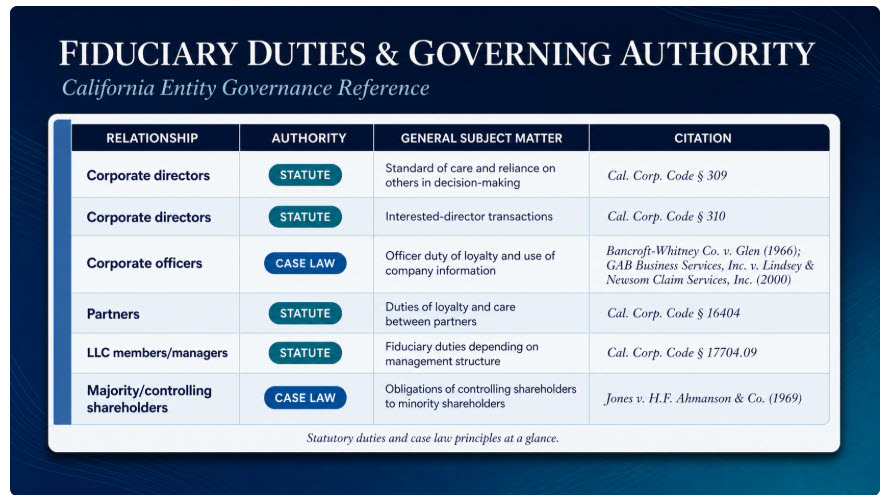
The answer can be very different depending on whether the person was acting as a corporate director, officer, partner, LLC member or manager, controlling shareholder, agent, or in another position of trust. California law does not impose one identical fiduciary standard on everyone who holds a position of responsibility in a business. The project architecture specifically recognizes that the person's role, authority, entity structure, governing documents, and capacity can affect the analysis.
That is why identifying the relationship comes first.
Who Owes a Fiduciary Duty in a California Business—and Why?
A title alone does not answer the question. Someone may simultaneously be a shareholder, director, president, employee, or manager. Those roles are not interchangeable when fiduciary obligations are analyzed. The person's authority, the type of business entity, the governing agreements, and the capacity in which the challenged conduct occurred can all matter.
Corporate Directors
California Corporations Code § 309 governs corporate directors when they are performing their duties as directors. It requires a director to act in good faith, in a manner the director believes to be in the best interests of the corporation and its shareholders, and with the care, including reasonable inquiry, that an ordinarily prudent person in a similar position would use under similar circumstances.
The distinction matters because § 309 is a director standard. It should not automatically be applied to every officer, employee, owner, or other person simply because that person also holds a position of responsibility in the company.
Corporate Officers
Corporate officers can also owe fiduciary duties, but their obligations should not simply be described as though § 309 governs their conduct as officers.
California decisions recognize fiduciary obligations owed by corporate officers. GAB Business Services, Inc. v. Moore recognizes that an officer participating in management can owe a fiduciary duty of loyalty and that restricting the officer's authority does not necessarily eliminate that duty. Bancroft-Whitney Co. v. Glen provides a concrete example involving an officer's use of confidential company information while assisting a competitor in recruiting important employees.
The person's title therefore may not be enough. The capacity in which the person was acting when the disputed conduct occurred can be critical.
Business Partners
Partners have fiduciary obligations arising from the partnership relationship. California partnership law separately governs those obligations, including duties concerning loyalty and care and a partner's conduct toward the partnership and the other partners.
Partnership duties arise from partnership law. They should not be analyzed by simply borrowing the standards governing corporate directors.
That distinction can become important when a dispute concerns partnership property, competing interests, business opportunities, accounting, disclosure, or a transaction in which one partner's interests may conflict with those of the partnership or the other partners.
LLC Members and Managers
Limited liability companies require their own analysis.
Whether fiduciary duties apply can depend upon whether the LLC is member-managed or manager-managed, who actually manages the business, the statutory framework, what the operating agreement provides, and the person's role in the conduct being challenged.
Being an LLC member and managing an LLC are not necessarily the same thing for purposes of fiduciary-duty analysis.
For that reason, the duties of an LLC member or manager should not be defined by importing California Corporations Code § 309 or other standards applicable to corporate directors.
This is why it is important to speak with an experienced attorney from Watkins Firm for a free, substantive consultation.
Controlling and Majority Shareholders
Ownership presents another distinction. A shareholder does not become a corporate director or officer merely by owning shares. But fiduciary obligations can arise from the exercise of controlling shareholder power.
The practical inquiry may therefore involve more than someone's percentage ownership. How control was exercised can matter.
That can become significant when the disputed conduct involves insider transactions, distributions, dilution, voting power, ownership changes, or treatment of minority shareholders.
Joint Venturers, Agents, and Others Entrusted With Business Interests
Fiduciary obligations can also arise outside the familiar titles of director, officer, partner, or LLC manager. Joint venturers, agents, and others entrusted with authority over another person's or company's interests may have fiduciary obligations arising from the nature of that relationship.
The same caution applies to employees. Not every employee owes the same fiduciary obligations merely because they work for the company. Authority, agency, management responsibility, access to confidential information, and the nature of the conduct can matter.
Not Every Business Relationship Creates a Fiduciary Duty
Trusting someone in business does not necessarily make that person a fiduciary.
Contracting parties, vendors, customers, and other ordinary commercial actors do not automatically become fiduciaries simply because one side trusted the other, relied upon what was said, or expected the other party to behave fairly.
That distinction matters to both sides of a fiduciary-duty dispute. Before determining whether a duty was breached, it is first necessary to determine whether the relationship actually created the fiduciary duty being alleged.
Once that relationship and the source of the duty are understood, the next question is more specific: What did the fiduciary duty require that person to do—or prohibit that person from doing?
What Does a Fiduciary Duty Require Someone to Do—or Not Do?
A fiduciary duty is not a single rule that applies identically to every person in every business. What the duty requires depends upon the relationship, the type of business entity, the authority the person holds, and the capacity in which that person is acting.
But the underlying principle is important: when someone has been entrusted with authority or responsibility for interests beyond their own, they may be required to exercise that authority with loyalty, appropriate care, good faith, and disclosure consistent with the duties governing that particular relationship.
01
The Duty of Loyalty
A fiduciary generally cannot use a position of trust or authority simply to advance a conflicting personal interest at the expense of the person or business to whom the duty is owed.
Questions about loyalty commonly arise when someone receives an undisclosed personal benefit, competes with the business, diverts a customer or business opportunity, misuses confidential information, or participates in a transaction while concealing an adverse interest.
The central question is often straightforward: Was the person exercising business authority for the interests they were entrusted to serve—or using that authority to benefit themselves or another competing interest?
02
The Duty of Care
Where a duty of care applies, the law may require appropriate diligence, attention, inquiry, and informed decision-making.
That does not mean every decision must succeed. Business decisions are often made with incomplete information and uncertain outcomes. The result of a decision and the process used to make that decision are two different things.
The precise standard depends upon the fiduciary relationship involved. For example, California Corporations Code § 309 establishes specific standards governing corporate directors when performing their duties as directors. Those standards should not simply be assumed to govern every officer, partner, LLC member or manager, employee, or other person who may owe fiduciary obligations.
03
Good Faith
Good faith can also be important in evaluating fiduciary conduct, but it should not be treated as a single freestanding rule that applies identically to every fiduciary relationship.
The person's purpose, interests, knowledge, authority, and decision-making can all matter when determining whether conduct was consistent with the obligations that actually applied.
04
The Duty of Disclosure
Sometimes the problem is not simply what someone did. It is what they did not tell the other owners or the company before they did it.
Disclosure can become especially important when the person entrusted with authority has a personal interest in a transaction or possesses material information that others involved in the decision do not have.
Questions may arise concerning an undisclosed financial interest, concealed related-party transaction, undisclosed compensation, an ownership change, withheld financial information, secret negotiations, or a competing interest that was never revealed.
The issue may therefore be not only whether a transaction or decision was permissible, but what the company or other interested parties were entitled to know before it occurred.
A Bad Business Decision Is Not Automatically a Breach of Fiduciary Duty
Businesses take risks. Investments fail. Strategies do not work. Transactions that appeared promising produce disappointing results. Owners and directors sometimes make decisions that, with hindsight, they wish they had made differently.
A bad result does not, by itself, establish a breach of fiduciary duty.
The more important questions may concern how the decision was made, what information was considered, whether appropriate inquiry occurred, whether the decision-maker had a conflicting personal interest, and whether the person complied with the duties that actually applied to the role in which they were acting.
General reference only — not legal advice. Consult a California attorney about your specific facts.
California's Business Judgment Rule and Corporate Directors
California Corporations Code § 309 provides an important framework for evaluating the conduct of corporate directors performing their duties as directors.
The statute requires a director to act in good faith, in a manner the director believes to be in the best interests of the corporation and its shareholders, and with the care, including reasonable inquiry, that an ordinarily prudent person in a similar position would use under similar circumstances. The statute also addresses circumstances in which directors may rely upon information, opinions, reports, and statements provided by certain officers, employees, professionals, and board committees.
The law therefore does not simply ask whether the decision ultimately worked.
It looks at the decision-making that occurred when the decision was made.
The Rule Protects Business Judgment—Not Simply a Bad Outcome
A director should not automatically face liability simply because someone later demonstrates that another decision would have produced a better result.
But the protection afforded to legitimate business judgment does not make the decision-making process irrelevant. The California authority assembled for this page recognizes the importance of reasonable inquiry where circumstances require it.
In Gaillard v. Natomas Co., the court emphasized that directors cannot simply close their eyes when reasonable inquiry is required.
The distinction is important: courts can distinguish between an honest business judgment that produced a poor result and conduct that may not qualify for the protections afforded to legitimate business decision-making.
A Person's Title and the Capacity in Which They Acted May Be Different
Business owners frequently wear several hats.
The same person may be a shareholder, director, corporate officer, president, employee, or manager. When a dispute develops, simply identifying every title that person held may not answer which fiduciary rules governed the challenged conduct.
Gaillard illustrates why that distinction matters. The case involved individuals who held positions as both directors and officers. The fact that they were directors did not mean Corporations Code § 309 necessarily governed conduct undertaken in their capacities as officer-employees.
The important question may therefore be not merely, “What title did this person hold?” but “In what capacity was this person acting when the disputed conduct occurred?”
When the Business Judgment Rule May Not Resolve the Dispute
Invoking “business judgment” does not necessarily end the analysis.
The facts may require closer examination when the challenged decision involves a personal financial interest, self-dealing, an undisclosed conflict, allegations of bad faith, inadequate inquiry, a failure actually to exercise judgment, or conduct undertaken in a capacity governed by different legal obligations.
Nor does the existence of one of those circumstances automatically establish liability. It means the actual relationship, applicable duty, decision-making process, disclosures, interests involved, and surrounding evidence may need to be examined before determining whether the conduct was protected business judgment or a potential breach of fiduciary duty.
This Is Why You Need to Speak With a Watkins Firm Attorney
By this point, one thing should be clear: breach of fiduciary duty is rarely determined by one transaction, one document, or one person's version of what happened.
The type of business matters. The relationship between the people involved matters. The authority each person possessed matters. Governing agreements can matter. So can the capacity in which someone acted, what was disclosed, what was withheld, who benefited, what decisions were made, and what the records actually show.
Even the same conduct can raise different legal questions depending upon who did it, the duties that person actually owed, and the circumstances in which it occurred.
That is also why these matters require candid conversations.
If you believe someone you trusted has violated duties owed to you or the business, your attorney needs to understand not only what you believe happened, but the history of the relationship, how the business actually operated, what authority people exercised, what was said, what was documented, and what may still be happening.
If you have been accused of breaching a fiduciary duty, the same principle applies. An accusation does not establish a breach. Your attorney needs to understand the duty you actually owed, the capacity in which you acted, the information available when decisions were made, the authority you possessed, what was disclosed, and the business reasons behind the conduct now being challenged.
✓
These are often sensitive conversations involving people who have worked together, invested together, built companies together, or trusted one another for years. They need to be handled carefully, confidentially, and with an understanding of both the law and the business at stake.
A webpage can help you recognize the issues. It can explain the legal framework and help you identify questions worth asking. It cannot determine what California law means when applied to your particular relationships, documents, decisions, communications, and facts.
That requires legal judgment.
The Watkins Firm Can Help You Understand Where Things Really Stand
The business litigation attorneys at Watkins Firm can review the circumstances with you, ask the questions that need to be asked, examine the relevant documents and relationships, and help you understand the legal and practical significance of what has occurred.
Just as importantly, we can help you understand what you should consider doing next—and what you may want to avoid doing before you know where you stand.
Whether you are concerned that a fiduciary duty has been violated or you have been accused of violating one, Watkins Firm provides a thorough, free initial consultation.
Tell us what happened. We will help you begin making sense of it.
Claims+Defenses
Watkins Firm Represents Both Fiduciary Duty Claims and Defenses
Watkins Firm represents shareholders and others who believe fiduciary duties have been violated. We also represent corporate officers, directors, executives, majority shareholders, and others who have been accused of breaching fiduciary obligations.
Understanding these disputes from both perspectives matters. The same transaction, communication, or business decision can look very different once the governing relationship, authority, documents, disclosures, and surrounding circumstances are examined.
How the Analysis Develops
01
Personal Interests Can Change the Legal Analysis
When a fiduciary participates in a business decision while also having a personal or competing interest, the circumstances may require much closer examination.
Who benefited? What interest did the fiduciary have? What was disclosed? Who knew about it? Who approved the transaction, and under what circumstances?
Those questions can become particularly important when a dispute involves self-dealing, an interested transaction, undisclosed compensation, related businesses, or other circumstances in which the fiduciary's interests and the company's interests may not have been aligned.
02
Disclosure May Matter Before a Decision Is Made
When a fiduciary has a personal interest or conflict involving a proposed transaction, what was disclosed—and when it was disclosed—can become important.
Approval obtained after material information was withheld is a very different factual situation from a decision made after the relevant interests and circumstances were disclosed.
That is one of the reasons fiduciary-duty disputes often require examination of emails, meeting minutes, financial records, agreements, board materials, and communications surrounding the decision—not simply the final transaction itself.
03
Experience Matters Because the Legal Question Is Rarely Isolated From the Business
Fiduciary-duty disputes can involve corporate governance, ownership rights, financial records, contracts, operating or shareholder agreements, disputed transactions, employment relationships, confidential information, and years of business history.
Understanding the fiduciary-duty question may therefore require understanding how the business actually operated—not merely reading the allegation made by one side.
Watkins Firm's business litigation attorneys have substantial experience evaluating and litigating disputes involving business owners, corporate management, shareholders, partners, and others accused of misusing—or affected by the misuse of—business authority.
04
What Did the Fiduciary Duty Require in Your Business?
The statutes and cases provide the legal framework. But applying that framework requires understanding how your particular business was organized and operated, what authority the people involved possessed, what agreements governed their relationship, and what actually occurred.
The Important Question
The important question is not simply, “What are fiduciary duties?” It is, “What fiduciary duties applied in this business, to these people, under these circumstances?”
Relationships • Decisions • Records • Evidence
Fiduciary-duty disputes often cannot be understood from the challenged transaction alone. The surrounding records can help establish what authority existed, what people knew, what was disclosed, how decisions were made, and what occurred before and after the event in dispute.
Common Dispute Patterns
Common Breach of Fiduciary Duty Issues in a Business
Fiduciary duty allegations frequently arise during shareholder, partnership, and other internal business disputes. Watkins Firm has extensive experience handling claims involving:
01Conflicts of interest and self-dealing
02Commingling of company and personal assets
03Partnership disputes
04Shareholder disputes
05Misuse of confidential information or trade secrets
06Competing against the company
07Cooperating with or advancing the interests of a competitor
08Failure to exercise appropriate care in performing fiduciary responsibilities
From Allegation to Proof
What Must Be Proven in a Breach of Fiduciary Duty Case?
A breach of fiduciary duty claim requires more than showing that someone made a poor decision or acted in a way another owner disagreed with.
01DutyDid a fiduciary duty exist?
→
02BreachWas that duty breached?
→
03CausationDid the breach cause harm?
→
04HarmDid damages or another legally recognizable injury result?
The issues generally include whether a fiduciary duty existed between the parties, whether that duty was breached, whether the breach caused harm, and whether damages or another legally recognizable injury resulted.
The conduct and the loss must also be connected. It is not enough to identify questionable conduct and an unrelated business loss.
Who Owns the Claim?
Who Was Harmed—the Owner or the Business?
When fiduciary misconduct harms a business, an individual owner may understandably feel that he or she has also been harmed. But determining who legally suffered the injury can affect how a claim must be pursued.
Potential Path
Direct Claim
An individual right or injury may, depending upon the circumstances, support a claim belonging directly to the owner.
OR
Potential Path
Company / Derivative Claim
When the injury belongs to the company, the claim may need to be pursued through a derivative action.
Depending upon the circumstances, an owner may have a direct claim involving an individual right or injury, or the claim may belong to the company and need to be pursued through a derivative action.
The distinction can affect who owns the claim, who may bring it, the procedures that apply, and where any recovery ultimately belongs.
Financial Consequences
What Damages May Result From a Breach of Fiduciary Duty?
A breach of fiduciary duty can cause substantial financial harm. Determining damages may require establishing what loss actually resulted from the challenged conduct and how that loss was connected to the breach.
That can require examination of financial records, transactions, distributions, company assets, compensation, lost business opportunities, and other evidence necessary to understand both what happened and its financial consequences.
Establishing that a fiduciary duty was breached and determining the financial consequences of that breach are separate parts of the analysis.
Watkins Firm Handles Fiduciary Duty Claims and Defenses
Watkins Firm has more than 40 years of experience handling complex business disputes, including breach of fiduciary duty claims.
We represent people and businesses seeking to hold fiduciaries accountable, as well as officers, directors, owners, and others accused of breaching fiduciary obligations.
In either situation, understanding the relationship, the conduct, the resulting harm, and the evidence connecting them can be critical to determining what options are available.
Listen to our Recent Sound Business Insights Podcast: “Episode 17 – Violation of Breach of Fiduciary Duty”
Frequently Asked Questions About Breach of Fiduciary Duty in a California Business
01What constitutes a breach of fiduciary duty in a California business?
A breach may occur when someone who owes fiduciary obligations fails to comply with the duties applicable to that particular relationship. Depending upon the circumstances, allegations may involve self-dealing, undisclosed conflicts of interest, misuse of company money or property, concealment of material information, improper competition, diversion of business opportunities, misuse of confidential information, or failure to exercise required care.
Whether particular conduct constitutes a breach depends upon who owed the duty, to whom it was owed, what the duty required, and the facts surrounding the conduct.
02Who can owe fiduciary duties in a California business?
Fiduciary obligations can arise in a number of business relationships, including those involving corporate directors and officers, partners, certain LLC members and managers, controlling shareholders, agents, joint venturers, and others entrusted with authority over another person's or company's interests.
The source and scope of those duties are not necessarily the same. A person's title alone does not determine what fiduciary obligations applied or whether they were breached.
03Does every shareholder or LLC member owe fiduciary duties to the other owners?
Not necessarily. Ownership alone does not establish one universal set of fiduciary duties.
The analysis may depend upon the type of entity, whether an LLC is member-managed or manager-managed, whether a shareholder exercises control, the person's actual authority, the governing agreements, and the capacity in which the person acted.
This is one reason fiduciary-duty questions should be evaluated according to the particular business relationship rather than broad assumptions about someone's ownership interest.
04Is a conflict of interest automatically a breach of fiduciary duty?
Not every potential conflict automatically establishes a breach. The nature of the relationship, the applicable duty, what was disclosed, the fiduciary's personal interest, the approval process, and other circumstances may all be important.
California law specifically addresses certain interested-director transactions. More broadly, when a fiduciary has interests on both sides of a business decision, who benefited, what was disclosed, who approved the transaction, and how the decision was made can become important questions.
05Is a bad business decision a breach of fiduciary duty?
Not by itself. Businesses take risks, and even carefully considered decisions sometimes produce substantial losses.
For corporate directors, California's Business Judgment Rule recognizes an important distinction between an unfavorable outcome and the process by which a legitimate business judgment was made. Good faith, reasonable inquiry, conflicts of interest, the information available at the time, and whether judgment was actually exercised may matter.
Hindsight alone does not turn every unsuccessful business decision into a breach of fiduciary duty.
06Can an officer or owner breach a fiduciary duty by competing with the company?
Potentially, depending upon the person's duties and the circumstances.
Disputes may arise when someone secretly establishes a competing company, diverts customers or employees, uses confidential business information, cooperates with a competitor, or uses company resources to develop a competing enterprise.
The timing of the conduct, the person's role, the information or opportunities involved, and the fiduciary obligations actually owed can all affect the analysis.
07What if important financial information or a transaction was concealed?
Failure to disclose material information can become a significant issue in a fiduciary-duty dispute.
Examples can include undisclosed related-party transactions, unexplained transfers, hidden compensation arrangements, undisclosed financial interests, withheld business records, secret negotiations, or ownership and control changes that were not disclosed.
Sometimes the central question is not simply what happened, but what others were entitled to know before the decision or transaction occurred.
08Can I personally sue if fiduciary misconduct caused the company to lose money?
That depends upon who legally suffered the injury.
An owner may feel the economic consequences when money or property is taken from a company, but the underlying injury may belong to the business itself. In other circumstances, conduct may directly violate an individual owner's rights.
This distinction can determine whether a claim is direct or derivative and can affect standing, procedure, ownership of the claim, and where a recovery belongs.
Determining who was legally harmed can be just as important as determining what the fiduciary did.
09What evidence can be important in a breach of fiduciary duty dispute?
The relevant evidence depends upon the allegations, but these cases frequently require examination of corporate or LLC records, governing agreements, financial statements, bank records, accounting information, contracts, transaction documents, emails, text messages, meeting minutes, compensation records, ownership records, and communications concerning disputed decisions.
The history of how the business actually operated can also matter.
Documents that appear routine when a business relationship is functioning normally can become important evidence once authority, disclosure, financial benefit, or decision-making is disputed.
10What should I do if I believe a fiduciary duty has been breached—or I have been accused of breaching one?
Avoid assuming that the allegation itself establishes what happened or what the law requires. Fiduciary-duty disputes can depend upon the business entity, relationships involved, governing documents, authority exercised, capacity in which someone acted, disclosures made, resulting harm, and documentary record.
There may also be actions or communications that help protect your position—and others that could make the dispute more difficult.
Before making your next consequential move, speak with an experienced California business litigation attorney who can evaluate the particular facts, relationships, documents, and legal duties involved.
Watkins Firm provides a thorough, free initial consultation. Call (858) 535-1511, send us an email, or engage the chat module on this page to discuss your questions and learn what you should consider doing next.
Why Should You Consider a Breach of Fiduciary Duty Attorney from the Watkins Firm?
Breach of fiduciary duty disputes are rarely simple. The outcome can depend on the business relationship, the duties that actually existed, the capacity in which someone acted, what was disclosed, who benefited, what harm resulted, and what the documentary record ultimately shows.
The Watkins Firm brings more than 40 years of business law and litigation experience to these disputes. Our attorneys understand California businesses from both sides of the equation: how companies are formed, governed, operated, financed, and managed—and what happens when relationships between owners, directors, officers, partners, members, and other fiduciaries break down.
Meet Daniel Watkins
Dan has practiced in the areas of business, medical practices and healthcare business, high tech/science, real estate and employment defense law since 1987. He is a trusted litigation strategist and true trial attorney with over 50 jury and bench trials to his credit. Dan has successfully represented both large companies and individuals and achieved substantial victories in well-publicized trials throughout California and the U.S.
He is experienced in business and corporate formation and administration, as well as all forms of alternative dispute resolution, including binding arbitration and mediation. Clients value Dan’s ability to listen carefully, understand complex challenges, and develop practical, effective solutions to difficult legal problems.
DECADES OF TRIAL AND LITIGATION EXPERIENCE
Dan has nearly four decades of experience working with, for, and against some of the largest insurance companies in the country. He has successfully tried and litigated cases in the areas of Healthcare Compliance, Commercial Litigation, Unfair Business Practices, Fraud, Breach of Contract, Battery, Premises Liability, Product Defect, Medical Malpractice, Discrimination, Sexual Harassment, Construction Defect, as well as Unfair Competition, Defamation, and Trade Secrets.
In December 2003, Dan commenced litigation against Health South Surgery Centers-West, Inc. and its subsidiaries, exposing the company’s extensive mismanagement and misconduct of its surgery centers. Dan has also been asked by some of California’s largest municipalities and corporations to conduct legally required investigations into matters involving alleged employment discrimination and harassment.
You can rely upon direct, personalized access and experienced guidance grounded in three important strengths:
More Than Four Decades of Business and Litigation Experience: Our attorneys have represented business owners, shareholders, partners, directors, officers, executives, and companies in complex disputes involving corporate governance, ownership rights, financial transactions, conflicts of interest, misuse of company assets, and other alleged breaches of fiduciary duty.
Experience Representing Claims and Defenses: Watkins Firm represents people and businesses seeking to hold fiduciaries accountable, as well as those accused of breaching fiduciary obligations. <strong>Understanding both sides matters when the same transaction, communication, or business decision may be interpreted very differently by the people involved.</strong>
Business Experience Behind the Legal Analysis: A fiduciary dispute does not occur in isolation. It may involve operating agreements, shareholder agreements, financial records, ownership structures, employment relationships, confidential information, transactions, and years of business history. Our attorneys understand how those pieces fit together and how they can affect the legal and practical options available.
The first objective is to understand what actually happened, what duties applied, and where you stand before important decisions are made.
Whether you believe a fiduciary duty has been violated or you have been accused of violating one, Watkins Firm can help you evaluate the circumstances, understand your options, and determine what you should consider doing next.
Most matters begin with a free, substantive consultation. This is a clear discussion of your current situation, what is known, and what is uncertain. The purpose of that conversation is to understand your position and determine the most effective next step. That initial consultation is focused, structured, and practical. It is designed to identify risk, clarify options, and determine whether further action is necessary.
If you are starting a business, facing a business challenge, evaluating a situation, or simply need clarity on where you stand, we invite you to a conversation.
Call Directly
(858) 535-1511 Talk through your situation with an experienced business attorney.
Live Chat
Engage the Chat Module – Get a Quick Answer or connected to a Watkins Firm Attorney