






The Most Important Thing You Need to Know Right Now
The overwhelming majority of shareholder disputes are not caused by unexpected events.
 They are caused by important questions that were never fully addressed when the company was formed, ownership interests changed, new investors were added, management responsibilities evolved, or the business began to grow.
Many business owners are surprised to learn that corporate bylaws, shareholder agreements, and buy-sell agreements are often downloaded from generic templates, copied from another company, or treated as little more than administrative paperwork. Unfortunately, these documents frequently become some of the most important documents in the company when disagreements arise.
The question is rarely whether a business will face challenges, ownership transitions, management disagreements, or changing circumstances. The real question is whether the governing documents anticipate those situations and provide a clear process for resolving them.
Well-drafted corporate documents help define ownership rights, voting authority, management responsibilities, profit distributions, ownership transfers, dispute resolution procedures, and the expectations of everyone involved. They provide clarity before disagreements occur and help preserve stability when difficult decisions must be made.
Just as importantly, these documents should not remain static. As a company grows, ownership changes, business objectives evolve, or new risks emerge, shareholder agreements, buy-sell agreements, and corporate bylaws should be reviewed and updated to reflect the current realities of the business.
After more than four decades representing California business owners, shareholders, investors, and closely held companies, the Watkins Firm has seen firsthand how strong corporate governance documents help prevent disputes, reduce uncertainty, preserve business value, and protect the interests of the people who have worked hard to build the company.
The best time to address these issues is before a disagreement develops. Careful planning today often prevents expensive disputes tomorrow.
If You Are Forming a New Corporation
Corporate Formation • Ownership Structure • Governance Documents • Voting Rights • Shareholder Protections
The decisions made during the formation of a corporation often have a lasting impact on the future success of the business and the relationships between its owners.
Many business owners focus on entity formation, filings, and operational issues while giving less attention to the corporate documents that will ultimately govern ownership rights, management authority, voting procedures, profit distributions, ownership transfers, dispute resolution, and future transitions.
The first step is understanding the objectives of the owners and the realities of the business itself.
Who will own the company? How will decisions be made? What happens if an owner wishes to leave? How will profits be distributed? What authority will management have? What restrictions should apply to the transfer of shares? What protections should exist for minority owners?
Carefully drafted shareholder agreements, corporate bylaws, buy-sell agreements, and related governance documents help establish clear expectations before disagreements arise. These documents provide important protections for both the corporation and its owners while reducing uncertainty as the business grows and evolves.
 The Watkins Firm has helped establish thousands of California corporations over more than four decades of practice. We guide our clients through the formation process, the selection of appropriate entity structures, and the development of customized governance documents designed to address the unique needs, objectives, and circumstances of each business.
The Next Action Step: Gain insight and actionable options through a complimentary and substantive consultation. We invite you to a complimentary and substantive conversation regarding your situation, objectives, and concerns. You can reach out through the chat module on this page, our contact form, or by calling (858) 535-1511.
You May Also Be Interested In:
→ Business Formation and Entity Selection
→ LLC, S Corporation or C Corporation
→ Buy-Sell Agreements
→ Corporate Governance Documents
If You Need a Shareholders’ Agreement
Ownership Rights • Voting Authority • Profit Distributions • Transfer Restrictions • Dispute Resolution
A shareholders’ agreement establishes the relationship between the owners of a corporation and helps define the rights, responsibilities, expectations, and restrictions that govern the company moving forward.
Many business owners focus on ownership percentages while overlooking the issues that often become the source of future disputes. Questions regarding voting authority, management responsibilities, profit distributions, ownership transfers, buyouts, the admission of new investors, dispute resolution procedures, and the protection of minority shareholders should be addressed long before disagreements arise.
The first step is understanding the objectives of the owners and the realities of the business itself.
How will important decisions be made? What voting thresholds should apply? What happens if an owner wishes to sell their shares? How will disputes be resolved? What protections should exist for minority owners? How will future ownership transitions be handled?
A well-drafted shareholders’ agreement helps establish clear expectations, reduce uncertainty, and provide practical solutions to foreseeable challenges before they develop into costly disputes. The agreement should reflect the specific objectives, ownership structure, and operational realities of the company instead of relying upon generic or boilerplate language.
The Watkins Firm has drafted, reviewed, negotiated, and updated shareholder agreements for California businesses for more than four decades. We help our clients identify potential risks, address future contingencies, and create governance documents that protect both the company and its owners.
The Next Action Step: Gain insight and actionable options through a complimentary and substantive consultation. We invite you to engage the chat module on this page, our contact form, or by calling (858) 535-1511 to discuss your objectives, ownership structure, and the governance provisions that may help protect the company moving forward.
You May Also Be Interested In:
→ Buy-Sell Agreements
→ Business Ownership Disputes
→ Shareholder Disputes
→ Resolving Your Business Deadlock
If You Need a Buy-Sell Agreement
Ownership Transitions • Business Valuation • Buyout Rights and Obligations • Triggering Events • Business Continuity
Many business owners spend years building a successful company without fully addressing one of the most important questions they will eventually face:
What happens when an owner leaves?
Retirement, disability, death, divorce, bankruptcy, disagreements between owners, and unexpected life events can create significant uncertainty if the rights and obligations of the parties have not been clearly established in advance. Without a carefully drafted buy-sell agreement, ownership transitions often become disruptive, expensive, and contentious.
The first step is understanding the ownership structure, business objectives, and the circumstances that may affect the company in the future.
What events should trigger a buyout? How will the company or remaining owners acquire an ownership interest? How will the business be valued? What payment terms should apply? How can continuity be preserved while protecting the interests of all parties involved?
A properly drafted buy-sell agreement provides a roadmap for ownership transitions before they occur. These agreements help establish clear expectations, reduce uncertainty, preserve business value, and protect both the company and its owners when significant changes arise.
 For more than four decades, the Watkins Firm has helped California business owners create and update buy-sell agreements tailored to the unique realities of their business, ownership structure, and long-term objectives. Careful planning today often prevents expensive disputes and uncertainty tomorrow.
The Next Action Step: Gain insight and actionable options through a complimentary and substantive consultation. We invite you to engage the chat module on this page, our contact form, or by calling (858) 535-1511 to discuss your ownership structure, future concerns, and the provisions that may help protect the company and its owners moving forward.
You May Also Be Interested In:
→ San Diego Buy-Sell Agreement Attorneys
→ Business Ownership Disputes
→ Resolving Your Business Deadlock
→ Shareholder Disputes
If You Are Updating Existing Corporate Documents
Outdated Corporate Documents • Ownership Changes • Governance Updates • Compliance Considerations • Risk Management
Many shareholder agreements, corporate bylaws, and buy-sell agreements are drafted when a company is first formed and then rarely revisited. Over time, however, businesses grow, ownership structures change, management responsibilities evolve, new investors are added, and business objectives shift.
Documents that once reflected the realities of the business may no longer provide the protections, clarity, or guidance necessary to address current circumstances.
The first step is understanding what has changed.
Have ownership interests been transferred? Have new shareholders been added? Have management responsibilities evolved? Are the existing documents consistent with the company’s current structure, operations, and objectives? Do the agreements adequately address ownership transitions, voting rights, dispute resolution, valuation methods, and other foreseeable challenges?
Regular review and updating of corporate governance documents helps reduce uncertainty, strengthen protections, improve clarity, and address issues before they become sources of conflict. In many situations, updating existing documents is substantially less expensive than resolving disputes that arise from outdated or incomplete agreements.
For more than four decades, the Watkins Firm has helped California business owners review, update, and strengthen shareholder agreements, corporate bylaws, buy-sell agreements, and other governance documents to better reflect the realities of their business and the goals of its owners.
The Next Action Step: Gain insight and actionable options through a complimentary and substantive consultation. We invite you to engage the chat module on this page, our contact form, or by calling (858) 535-1511 to review your existing corporate documents, identify potential concerns, and evaluate opportunities to strengthen the governance structure of your company.
You May Also Be Interested In:
→ San Diego Buy-Sell Agreement Attorneys
→ Business Ownership Disputes
→ Shareholder Disputes
→ Resolving Your Business Deadlock
If You Have a Shareholder Dispute
Minority Shareholder Disputes • Breach of Fiduciary Duty • Access to Information • Buyout and Valuation Disputes • Ownership Conflicts
Most shareholder disputes do not begin with a lawsuit.
They often begin with growing frustration, unanswered questions, disagreements regarding management decisions, concerns about compensation or distributions, restricted access to information, valuation disputes, allegations of misconduct, or conflicts regarding the future direction of the company.
The first step is understanding the facts.
What do the shareholder agreement, corporate bylaws, buy-sell agreement, and other governing documents actually say? What rights exist? What obligations apply? What information is available? What information may be missing? What financial interests are at stake? What outcome is each party attempting to achieve?
Understanding these issues often helps identify strengths, weaknesses, risks, opportunities, and potential paths toward resolution.
The Watkins Firm resolves the vast majority of shareholder disputes through effective, leveraged negotiation after developing a thorough understanding of the governing documents, financial issues, business objectives, and the interests of the parties involved. In many situations, practical business solutions, ownership transitions, governance changes, or negotiated resolutions provide a more efficient and cost-effective path forward than litigation.
When necessary, the Watkins Firm is prepared to protect your interests through the filing or defense of a lawsuit, settlement conferences, mediation, arbitration, and at trial.
 The Next Action Step: Gain insight and actionable options through a complimentary and substantive consultation. We invite you to engage the chat module on this page, our contact form, or by calling (858) 535-1511 to discuss your situation, understand your options, and begin developing a strategy designed to protect your ownership interests and business objectives.
It is important to understand where you are, what rights and obligations exist, the impact of the governing documents, and the most productive steps available to protect your investment and achieve your objectives.
Many shareholder disputes are influenced not only by what has already happened, but by what happens next. An early conversation can help clarify your position, identify opportunities for resolution, and improve the likelihood of achieving a successful outcome.
You May Also Be Interested In:
→ San Diego Shareholder Dispute Attorneys
→ Business Ownership Disputes
→ Resolving Your Business Deadlock
→ Breach of Fiduciary Duty
San Diego Corporate Business Lawyers Provide Strong Corporate Documents
 The experienced business attorneys at Watkins Firm has served the San Diego and California business community for more than 40 years. We have helped to establish thousands of corporate entities for our clients over the years and provide sound advice and counsel through business formation and corporate entity selection.
This isn’t just about downloading a few forms and setting out to pursue business. The process of forming a corporation is much more than a few filings and a basic corporate entity. If you are serious about your company and the business you are preparing to undertake it is important to focus intently on the corporate documents themselves.
3 Key Takeaways Regarding a Corporate Shareholders’ Agreement and Corporate Bylaws
- These important corporate documents control everything regarding how a company is to be run, the relationship between the owners, individual and corporate responsibilities and how dividends and profits are to be realized and disbursed.
- Unfortunately, in many startups, the corporate shareholders’ agreement and corporate bylaws are merely “boilerplate,” often downloaded. The failure to tailor these important documents to the unique requirements of the underlying corporation will inevitably lead to expensive, time-consuming shareholder disputes and lawsuits.
- These documents should be regularly updated as part of corporate governance and compliance, and will have a tremendous impact on the success of the corporation and its shareholders, as well as the corporation’s value in any merger or acquisition.
There are several documents that make up a corporation, including the shareholders’ agreement and the corporate bylaws. A shareholders’ agreement defines the roles of the shareholders and their responsibilities to each other and the company. Bylaws establish the vision and values of the company and how a corporation is to be run. These corporate documents provide important protections for the corporation as well as the shareholders who own a stake in it.
There are more than 100 separate important choices to be made concerning all facets of how the company is to be structured and protected. The Watkins Firm guides our clients through every step of the corporate formation process. We have a substantial proprietary library of proven, successful corporate documents and contracts which are battle tested. We don’t create corporate documents from scratch. We tailor existing, proven shareholders’ agreement and corporate bylaws documents to meet your unique issues, objectives and needs in a cost-efficient and timely manner.
Why Do You Need a Shareholders’ Agreement?
 Why do you need a shareholders’ agreement and what should be included in this important corporate document? A shareholders’ agreement describes the roles of the shareholders, the rights and responsibilities of a shareholder, who may become a shareholder in the future as well as protections for minority shareholders. This document should provide specific formulas for dividends and other distributions of corporate profit.
Is it important to maintain a proportionate balance between the various shareholder’s interests? If so, when any shareholder must sell their shares the agreement may stipulate the value of those shares and how they are to be purchased by and distributed to existing shareholders in appropriate proportions to their holdings to protect existing power distribution. Does their need to be some form of restriction on selling or transferring shares?
These questions are best answered at the outset of a company’s formation when all the parties are energized and working together to get things up and running. Negotiating the value of a shareholder’s stake downstream when other conflicting interests are involved distracts the business leadership from running the day-to-day business and drives up the costs associated with resolving the issue or dispute at hand. How will disputes be resolved?
The shareholder agreement also stipulates how the shareholders will be involved in the active operation of the business. Will shareholders become officers of the corporation? Will they be included in the board of directors or have a say as to whom will be on the board?
The agreement should provide critical succession planning to allow the company to survive a major life events (often referred to as “triggers”) for one or more of the shareholders such as divorce, bankruptcy, incapacitation or death. What happens when a shareholder is no longer willing or able to continue to participate in the business? Who has the right to buy out the interest of another shareholder and how will the value of that stakeholder’s position be calculated if the shareholder wishes or needs to sell their interest? Usually, a “buy-sell” agreement establishes the process for valuation of the shareholders interest and how the company itself (or other shareholders) can purchase their interest.
A well-crafted shareholders’ agreement should clearly establish expectations for a shareholder, anticipate potential problems down the road before they become an issue and establish resolution(s) to protect the viability of the company while reducing the potential for litigation.
Listen to one of our Recent Sound Business Insights Podcasts:
“Episode 14 – Shareholders’ Rights and Disputes”

What Are Corporate Bylaws?
 What are the corporate bylaws and what are some of the important issues this corporate document should address? The bylaws establish the way the corporation will be governed and usually define requirements for an annual meeting, and the need to keep minutes for those meetings. How will normal operations proceed and what guidelines are the company’s managers required to follow?
It’s interesting to note one of the first signals potential investors, acquisition targets or buyers, bankers and even landlords will ask to see are your corporate bylaws. The bylaws should serve as a basic set of instructions for how the corporation will be run to ensure compliance with all laws and regulatory requirements while preserving corporate efficiencies and consistency.
The bylaws usually provide basic information about the identity of the company and where it operates as well as the fiscal or calendar year it will operate within. A statement of purpose is an opportunity for the founders of the corporation to lay out their vision and values and why the company was founded. The management team of the corporation will often refer to this section of the bylaws to ensure business operations and decisions are in alignment with the company’s vision and values.
Bylaws describe how officers are put in place, the procedure for elections, voting, responsibilities and associated salaries? Will there be a board of directors and how will the board be selected? How many directors will there be, how long will they serve and what qualifications should they possess?

When and where will the company hold shareholder meetings and what quorum shall be required for the meeting ? How will notices be given to shareholders?
Are there any potential threats which need to be addressed in the corporate bylaws such as strategies to prevent a hostile takeover? How will legal disputes be resolved and in what forum? Mediation? Arbitration? What potential conflicts of interest may arise and how should they be addressed?
The corporate bylaws provide an important foundation which protects the corporate veil by ensuring consistent, efficient, legal and ethical operations. They establish a vision and a set of values which should guide the corporation in the months and years ahead.
What Happens When There is a Conflict Between the Corporate Bylaws and the Shareholder Agreement?
An effective shareholders’ agreement should also address what should happen in the event that a provision of the agreement is in conflict with the corporate bylaws. The shareholders’ agreement is a document that is highly customized to the specific shareholders and their relationship. It should take priority over the bylaws, and if a conflict is identified the bylaws should be amended to address the issue. The shareholders’ agreement and corporate bylaws should be regularly updated as part of the process of corporate governance and compliance.
Understanding How a Buy-Sell Agreement Works
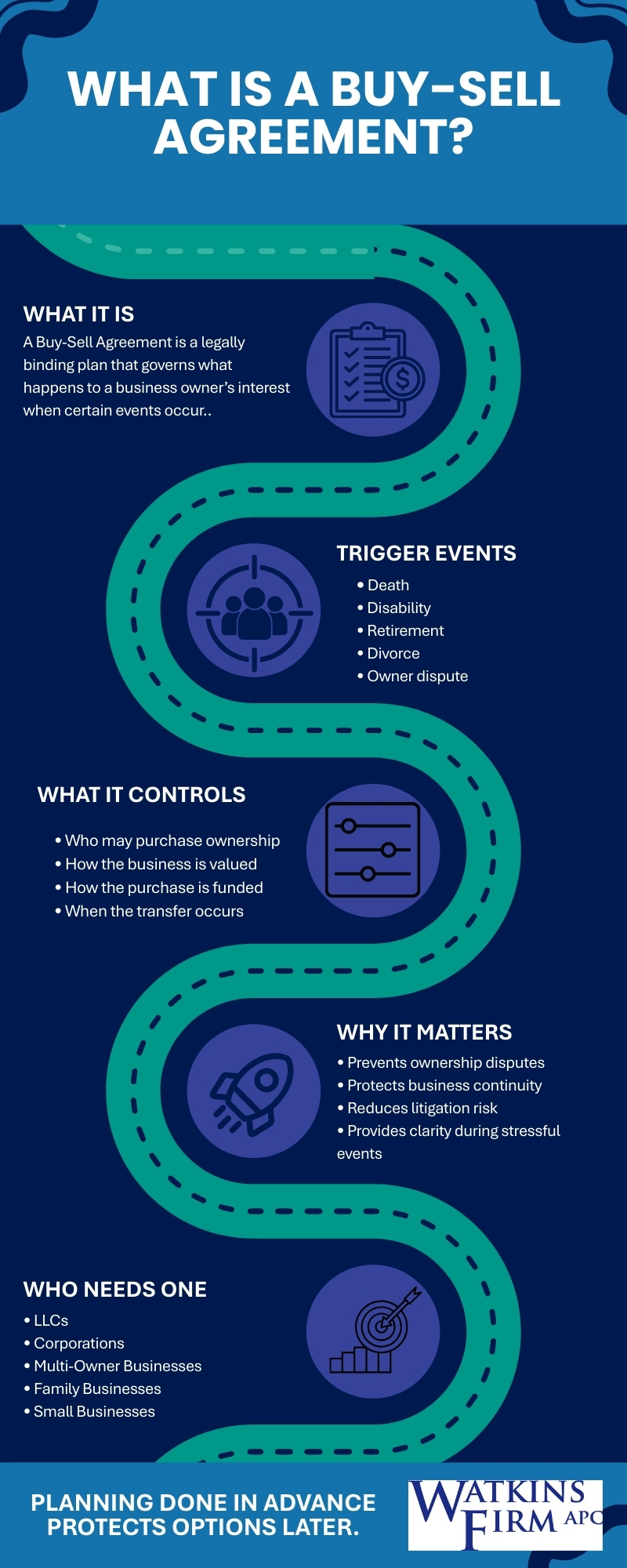 A buy-sell agreement is a legally binding contract that establishes what will happen to a business owner’s interest when certain events occur. Rather than forcing owners, family members, or business partners to make important decisions during a period of uncertainty, the agreement creates a process in advance.
Common triggering events include:
- Death of an owner
- Disability or incapacity
- Retirement
- Divorce
- Bankruptcy
- Voluntary departure from the business
- Certain ownership disputes or deadlocks
A properly drafted buy-sell agreement addresses several important questions:
- Who may purchase the departing owner’s interest
- Whether the company, the remaining owners, or a third party may acquire the shares
- How the ownership interest will be valued
- How the purchase will be funded
- When and how the transfer will occur
These agreements help preserve business continuity during ownership transitions and reduce uncertainty regarding the future of the company. They are frequently used by corporations, limited liability companies, family-owned businesses, closely held companies, and other businesses with multiple owners.
When carefully drafted and coordinated with shareholder agreements, corporate bylaws, and other governance documents, buy-sell agreements can help reduce the likelihood of future ownership disputes while protecting both the company and its owners.
Who Should Consider a Buy-Sell Agreement?
Buy-sell agreements are commonly used by:
- Limited Liability Companies (LLCs)
- Corporations
- Closely Held Businesses
- Multi-Owner Businesses
- Family-Owned Businesses
- Professional Practices
- Startups and Growing Companies
- Small Businesses with Multiple Owners
Any business with two or more owners should consider whether a buy-sell agreement would provide greater certainty regarding future ownership transitions.
The need for a buy-sell agreement becomes particularly important when owners have made significant financial investments, family members are involved in the business, ownership interests are not equal, or the company would be materially affected by the departure, disability, retirement, death, divorce, or bankruptcy of an owner.
Many business owners assume these events are unlikely or distant concerns. In reality, ownership transitions occur far more frequently than most companies anticipate. Establishing a clear process before a triggering event occurs often helps preserve business continuity, protect relationships between owners, reduce uncertainty, and minimize the likelihood of future disputes.
Why Should You Consider a Business Formation and Corporate Attorney from the Watkins Firm?
 Why should you partner with a Watkins Firm corporate attorney? Navigating California’s intricate entity structures and protective firewalls requires both precise legal craftsmanship and deep industry experience. The Watkins Firm provides more than 40 years of local experience and insight serving the business, healthcare, technology, and real estate investment communities in San Diego and throughout California.
Meet Daniel Watkins
Dan has practiced in the areas of business, medical practices and healthcare business, high tech/science, real estate and employment defense law since 1987. He is a trusted litigation strategist and true trial attorney with over 50 jury and bench trials to his credit. Dan has successfully represented both large companies and individuals and achieved substantial victories in well-publicized trials throughout California and the U.S.
He is experienced in business and corporate formation and administration, as well as all forms of alternative dispute resolution, including binding arbitration and mediation. Clients value Dan’s ability to listen carefully, understand complex challenges, and develop practical, effective solutions to difficult legal problems.
DECADES OF TRIAL AND LITIGATION EXPERIENCE
Dan has nearly four decades of experience working with, for, and against some of the largest insurance companies in the country. He has successfully tried and litigated cases in the areas of Healthcare Compliance, Commercial Litigation, Unfair Business Practices, Fraud, Breach of Contract, Battery, Premises Liability, Product Defect, Medical Malpractice, Discrimination, Sexual Harassment, Construction Defect, as well as Unfair Competition, Defamation, and Trade Secrets.
In December 2003, Dan commenced litigation against Health South Surgery Centers-West, Inc. and its subsidiaries, exposing the company’s extensive mismanagement and misconduct of its surgery centers. Dan has also been asked by some of California’s largest municipalities and corporations to conduct legally required investigations into matters involving alleged employment discrimination and harassment.
You can rely upon direct, personalized access and insightful corporate guidance based on three distinct institutional pillars:
- Four Decades of Specialized Experience: Our corporate practice group has guided founders, directors, and executive teams through complex corporate governance matters, partner equity distributions, employment defense strategies, and multi-million-dollar commercial transactions for more than forty years.
- Responsive, Client-Focused Advocacy: We understand the intense demands placed on business owners and corporate officers. We provide process-driven, preventative legal strategies that actively insulate your personal assets while freeing your leadership team to focus entirely on growth and corporate execution.
- A Proven Track Record of Commercial Success: We have successfully overseen the formation of thousands of California businesses, designed dual-entity networks for expanding groups, managed thousands of corporate mergers and acquisitions, and defended clients from relatively minor operational disputes to high-exposure litigations that commanded national attention.
Our corporate attorneys anticipate problems, analyze risk patterns, and implement customized protective shielding before internal deadlocks or external liabilities have a chance to escalate into catastrophic exposure. Working with the Watkins Firm places an unshakeable record of real-world results directly on your side of the equation.