San Diego Business Fraud Attorneys

Something isn’t adding up.
Money is missing. Financial information doesn’t match what you were told. A deal you relied on begins to unravel, and the explanations no longer make sense.
In many business disputes, the issue is not simply a disagreement. It is the result of conduct that was never appropriate in the first place—misrepresentation, omission of critical facts, or the misuse of funds or authority.
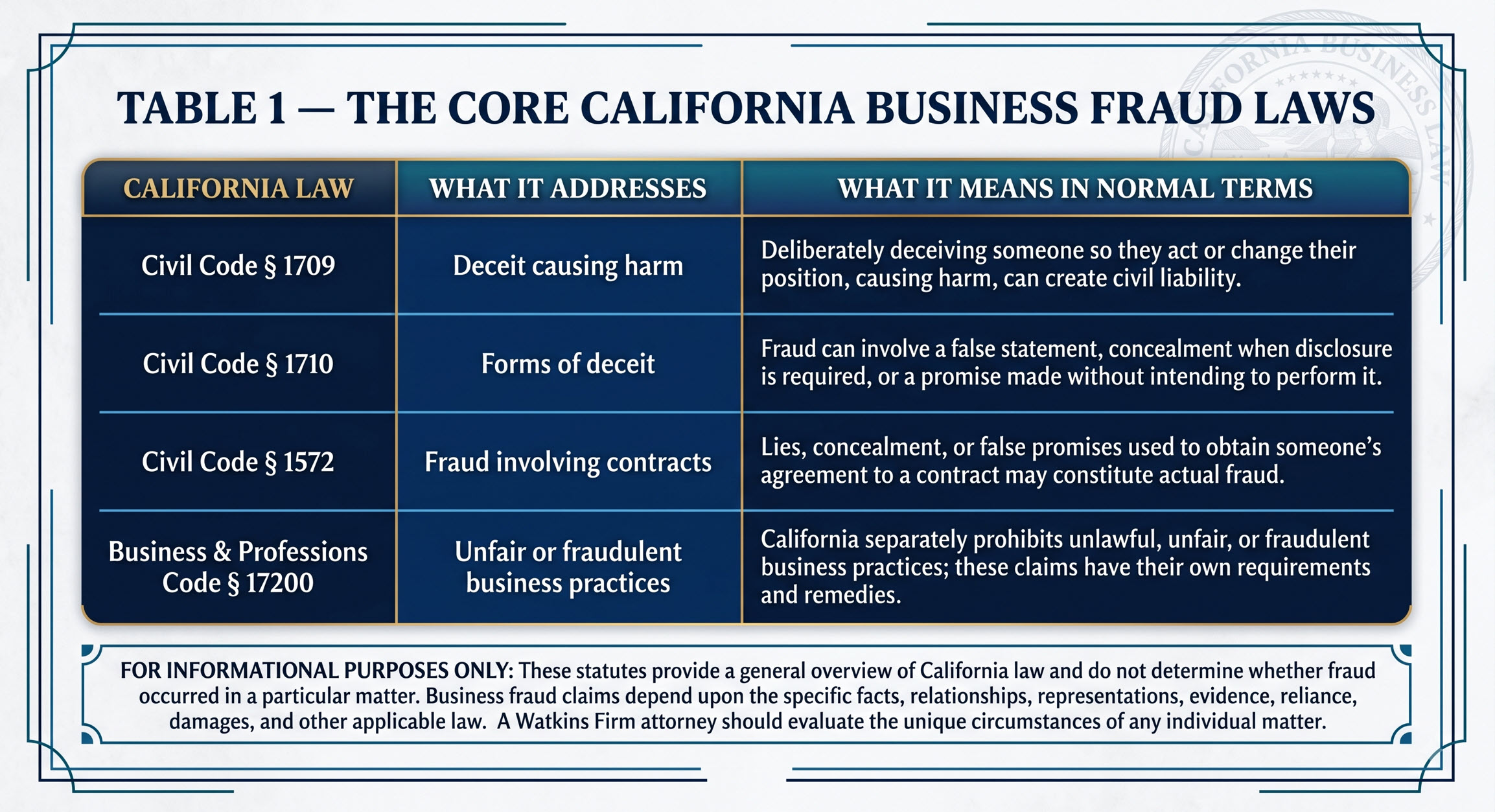
These situations are often the foundation of a business fraud claim.
Business fraud can take many forms, depending on what occurred and who was involved. Understanding what happened is the first step in determining what can be done next.
Where You Are in the Process Determines What You Should Do Next
Business fraud situations do not arrive fully formed. Most develop in stages. What you should do depends on when you recognize the issue.
You Suspect Something Isn’t Right
- Financial information doesn’t reconcile
- Transactions or reporting raise questions
- Explanations are incomplete or inconsistent
At this stage, the focus is on clarity. Understanding what is happening—before reacting—is critical.
You Are Beginning to See Financial Impact
- Funds are missing or misused
- Business decisions were based on inaccurate information
- Your position has already been affected
At this point, the issue is no longer theoretical. The focus shifts to documenting what occurred and assessing damages.
You Are Being Asked to Act or Respond
- A demand, explanation, or justification is being requested
- A transaction is moving forward despite concerns
- You are being pressured to make a decision
This is where timing becomes critical. What you say, agree to, or sign can significantly affect your position.
The Situation Has Escalated Into a Dispute
- The relationship has broken down
- Legal claims are being discussed or asserted
- Formal action may be necessary
At this stage, the focus is on strategy, leverage, and resolution—whether through negotiation, mediation, or litigation.
Understanding where you are in the process helps determine how the situation should be approached and what options remain available.
What Happened Determines What Comes Next
Business fraud presents in different ways. Where you are in the situation determines what can be done next.
If You Were Misled or Given Inaccurate Information
If Funds or Assets Have Been Misused
If Someone in a Position of Trust Acted Improperly
- Breach of fiduciary duty
- The “Layer Cake of Duty” – understanding violations of duty under the law in a business setting.
If the Conduct Involves Unfair or Deceptive Practices
In many cases, what begins as a concern or inconsistency becomes something more serious over time. Missing information turns into concealment.
Questionable decisions begin to affect financial outcomes. Trust begins to break down.
By the time most business owners recognize what is happening, the issue has already developed into a legal problem.
Understanding how these situations develop is important. It allows you to respond appropriately, protect your position, and avoid making decisions that may limit your options later.
The Importance of Chronology and Mastery of the Damages
In cases involving misappropriation or financial misconduct, what happened is only part of the issue.
When it happened—and how the events unfolded—is often what determines the outcome.
In many situations, the key to proving misconduct is not a single transaction, but a pattern:
- When financial behavior changed
- When records became inconsistent
- When explanations no longer aligned with the facts
Establishing a clear chronology allows the facts to speak for themselves. It becomes possible to demonstrate intent, isolate specific actions, and connect those actions to measurable financial harm.
At the same time, understanding the full scope of damages is essential. Without a clear assessment of financial impact, even well-documented misconduct may not lead to an effective outcome.
A structured approach—grounded in chronology and supported by a detailed analysis of damages—is what allows these cases to move from suspicion to proof.
How Business Fraud Occurs in California Business Disputes

Business fraud does not usually begin as an obvious event. It develops within the context of a transaction, a relationship, or a position of trust.
In many cases, one party provides financial information, projections, or representations that are not accurate. These statements may be intentionally false, or they may omit critical facts that would have changed the decision-making process.
In other situations, the misconduct occurs after the relationship is established:
- Funds are diverted or misused
- Financial records are altered or incomplete
- False vendors, expenses, or reporting structures are used to conceal activity
- Income, losses, or liabilities are misrepresented in connection with a sale, merger, or investment
Unfair business practices often exist alongside fraud. These involve deceptive or manipulative conduct between partners, shareholders, members, or others in positions of trust.
Over time, what begins as an inconsistency becomes a financial issue—and ultimately, a legal dispute.
Listen to one of our Recent Sound Business Insights Podcasts:
“Episode 32- Business Fraud”
What Must Be Proven in a Business Fraud Case

In order to pursue a business fraud claim, specific elements must be established. These are not assumptions—they must be supported by evidence.
A successful claim typically requires showing:
- A material misrepresentation, false statement, or omission
- Knowledge that the statement was false, or made with reckless disregard for the truth
- Reasonable reliance on that information in making a decision
- Measurable financial harm resulting from that reliance
These cases are often more complex than they appear. The issue is not simply what happened—but how it can be proven, and how the financial impact is established.
In many instances, the underlying conduct includes misrepresentation, concealment, or a failure to disclose critical information. In others, it may involve negligent conduct that created financial harm.
Why These Cases Are Often Misunderstood
Business fraud is rarely obvious at the outset. In many situations, the conduct is explained away, minimized, or misunderstood until the financial impact becomes difficult to ignore.

Several factors make these cases more complex than they appear:
- Information imbalance — One party controls access to financial data, reporting, or decision-making
- Gradual escalation — The issue develops over time, rather than through a single event
- Blended roles — The same individual may be an owner, officer, employee, or advisor
- Incomplete records — Financial documentation may be inconsistent, altered, or missing
- Delayed recognition — By the time the issue is identified, positions have already been affected
In many cases, the central issue is not simply whether something improper occurred. It is determining when it began, how it developed, and what the actual financial impact is.
That is why these matters require a structured approach grounded in chronology, documentation, and a clear understanding of damages.
What is considered business fraud in California?
Business fraud usually involves a material misrepresentation, omission of important information, or deceptive conduct that causes another party to rely on false information and suffer financial harm.
What is the difference between business fraud and unfair business practices?
Business fraud usually focuses on intentional deception. Unfair business practices can involve deceptive, misleading, or manipulative conduct even where the legal theory is broader than fraud. In many cases, the two overlap.
Can a breach of fiduciary duty also be a fraud claim?
Yes. In many business disputes, the same conduct may support claims for both business fraud and breach of fiduciary duty, especially where someone in a position of trust misuses funds, conceals information, or acts for personal gain.
What should I do if I suspect funds have been misappropriated?
Do not make assumptions or accusations before the facts are understood. The priority is to preserve records, understand the chronology of events, and evaluate the actual financial impact before taking action.
Do I need proof of intent to pursue a fraud case?
Fraud claims often require proof that a false statement or omission was made knowingly or recklessly. The ability to establish intent usually depends on documentation, chronology, and the surrounding facts.
Can business fraud cases be resolved without going to court?
Yes. Many of these disputes are resolved through leveraged negotiation or mediation once the facts, chronology, and damages are clearly established.
Why are chronology and damages so important in these cases?
Because these disputes often develop over time. Establishing when the conduct began, how it unfolded, and what financial harm resulted is often the key to proving the case and evaluating the right strategy.
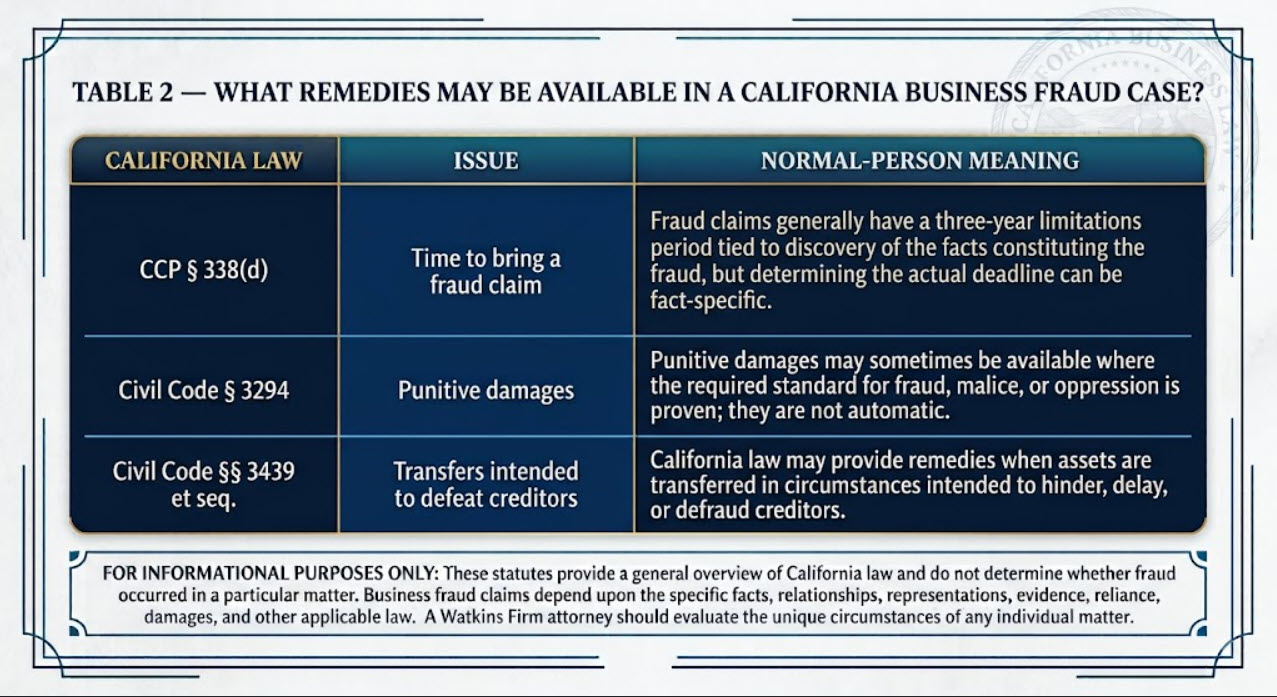
What damages can be recovered in a business fraud case?
Depending on the facts, a successful claim may involve direct financial losses, related damages, restitution, and in some cases punitive damages.
Contact Experienced San Diego Business Fraud Attorneys

We understand that these situations are often complicated by long-standing relationships; our approach is designed to provide clarity and protection without unnecessary escalation unless it serves your ultimate goals.
Unfortunately, fraud is quite common in California businesses. It is most often found in departments with employees who have access to business funds or accounting such as purchasing, sales, customer service, accounting and executive or management positions.
However, business professionals and investors alike should perform extensive due diligence in many business transactions such as mergers and/or acquisitions, stock purchase transactions, asset purchases (where debtors may try to liquidate assets and hide the money from rightful creditors) as well as taking a position in a company as a member or shareholder.
If you believe you are the victim of business related fraud in San Diego you will need the advice, counsel and legal skill of experienced San Diego business fraud attorneys at the Watkins Firm. We invite you to review the strong recommendations of our clients and contact the Watkins Firm or call 858-535-1511 for a complimentary consultation today.
Learn how the Watkins Firm can and will work to protect your financial and business interests while seeking the appropriate financial recovery and other remedies available under California law.